

On this page
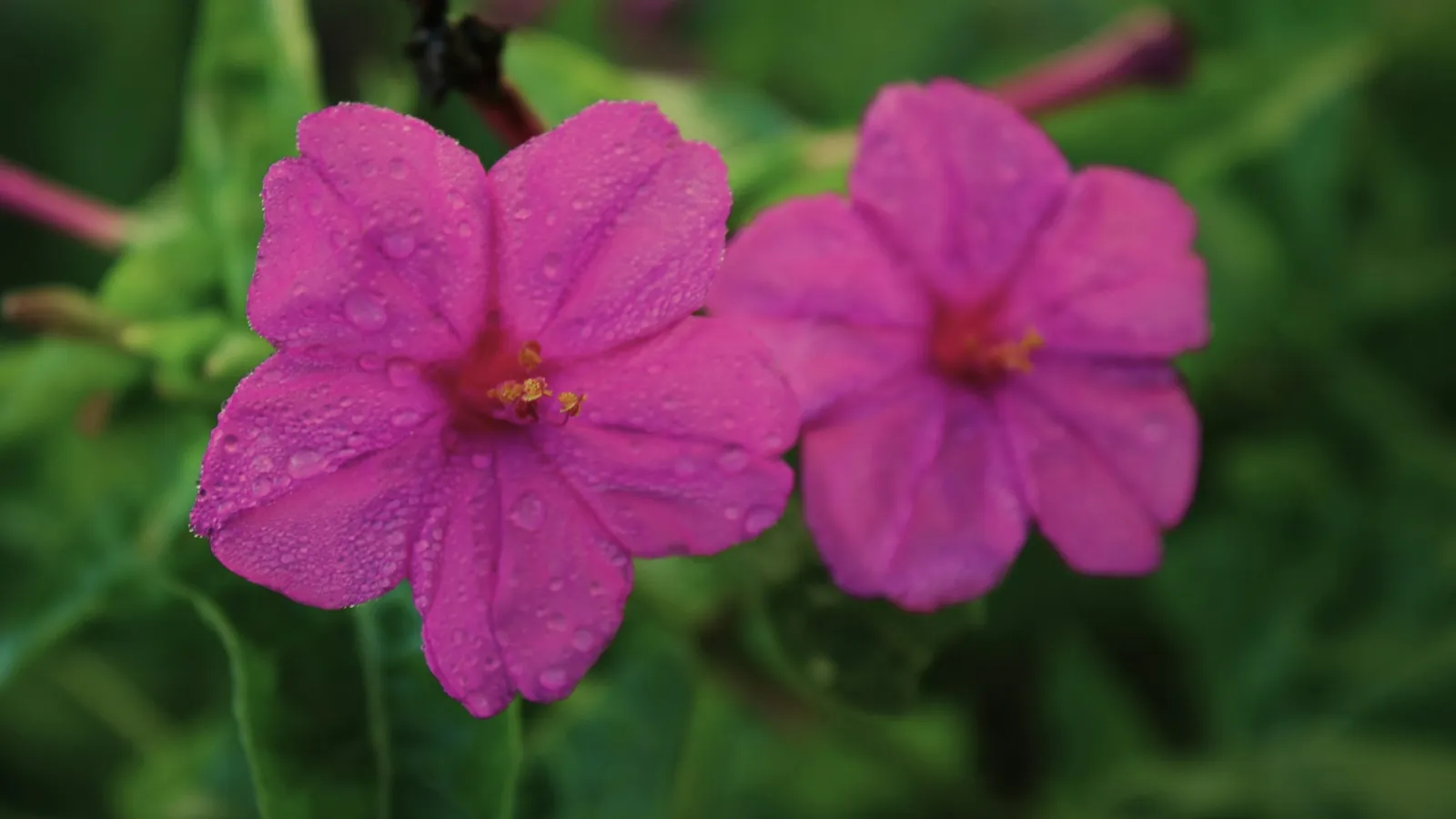
Textbooks use pink four o'clock flowers, or pink snapdragons, to show incomplete dominance: a heterozygote that looks halfway between its parents. The four o'clock plant is often linked to Carl Correns. His own papers tell a richer story. He was one of the scientists who rediscovered Mendel, he was the one who insisted early that dominance is not universal, and his four o'clock crosses turned up something more surprising than pink. This post covers his life, what he wrote, a worked example from his real counts, common mistakes, and what students can learn from him.
Who was Carl Correns?
The Deutsche Biographie records that Carl Correns was born in Munich on 19 September 1864 and died in Berlin on 14 February 1933. Orphaned young, he went to school in St Gallen in Switzerland, then studied botany at Munich, Graz, Berlin and Leipzig. He worked at Tübingen, Leipzig and Münster, and in 1914 became director of the new Kaiser Wilhelm Institute for Biology in Berlin-Dahlem, where he stayed until his death. The NDB says his crossing experiments with maize led him into the study of heredity, and that in 1899 he rediscovered Mendel's laws.
What did he say about dominance in 1900?
NCERT's Principles of Inheritance chapter notes that in 1900 de Vries, Correns and von Tschermak independently rediscovered Mendel's results. Correns's paper, G. Mendel's Regel über das Verhalten der Nachkommenschaft der Rassenbastarde, was received on 24 April 1900. A scan is in volume 18 of the Berichte der Deutschen Botanischen Gesellschaft.
He explained that he had found the same rule with maize and peas, believed it new, and then realised Mendel had found it in the 1860s, with the same explanation. But he disagreed with Hugo de Vries on one point. In our translation: "It is quite incomprehensible to me how de Vries can assume that in every pair of characters in which two races differ, one member dominates in the hybrid." Even in peas, he wrote, some pairs show no dominance; pea seed-coat colour gave hybrids with every shade in between. His postscript lists two conclusions, the first being that "in very many pairs of characters, one character does not dominate."
What did his four o'clock crosses show?
In December 1902 he reported his first crosses of Mirabilis jalapa colour varieties in Ueber Bastardirungsversuche mit Mirabilis-Sippen (scan). Some results were not what the textbook picture suggests. White × red gave plants that, in our translation, "all flowered homogeneously red", though he noted he had not yet measured the pigments. White × rosea gave pink plants like the rosea parent, but streaked with red. The big surprise was white × a pale yellowish variety (gilva): of 61 plants that flowered, 59 had pink flowers flecked and streaked with red, a colour neither parent showed.
His 1905 follow-up, "Zur Kenntnis der scheinbar neuen Merkmale der Bastarde" (on apparently new characters in hybrids), in volume 23 of the Berichte, explained it with two gene pairs. One pair decides whether pigment is made at all. The other decides whether that pigment is changed to red. Gilva carries "pigment, no change"; white carries "no pigment, change to red". The hybrid gets one working copy of each and shows colour.
Worked example: Correns's 9:3:4
Let F be pigment and M the change to red; f and m lack them. The F1 is FfMm. Selfing gives the usual 16 combinations:
F_M_ (9/16): pigment, changed: rosy-red.
F_mm (3/16): pigment, unchanged: yellowish.
ffM_ (3/16) and ffmm (1/16): no pigment: white either way, so 4/16.
So the expected ratio is 9 : 3 : 4. Correns's Table IV counted 758 second-generation plants: 437 rosy, 100 yellowish and 221 white (41 + 180).
Expected: 758 × 9/16 = 426.4; 758 × 3/16 = 142.1; 758 × 4/16 = 189.5.
Observed as percentages: 437/758 = 57.6; 100/758 = 13.2; 221/758 = 29.2. Expected: 56.25, 18.75, 25.
He explained the gap honestly: each gene pair on its own departed from 3:1, coloured plants being 70.8 per cent instead of 75, and red-changed plants 81.4 per cent instead of 75. (His running text prints the ratio as 537 : 100 : 241, but his own table and percentages give 437 : 100 : 221.)
What mistakes do students make with these ratios?
Calling every in-between colour incomplete dominance. Incomplete dominance is one gene, with a 1:2:1 F2. Correns's pink came from two genes interacting.
Expecting 3:1 from every cross. Correns warned in 1900 that dominance is not universal.
Adding classes wrongly. In 9:3:4, the 4 is 3 + 1 because two genotypes look the same.
Forgetting the NCERT example. NCERT uses the snapdragon for incomplete dominance; learn that cross for the exam.
Our post on incomplete dominance and codominance covers the exam patterns, and Hugo de Vries tells the rediscovery from the other side. If Punnett squares with two genes slow you down, the Fermi Problem Library has worked problems with a step-by-step solver that explains the reasoning.
What else did Correns find?
The NDB credits him as the first to show, in variegated-leaf plants, hereditary factors that do not follow Mendel because they sit outside the nucleus, in the cytoplasm. One of his early reports was on pale and variegated Mirabilis, published in the Zeitschrift für induktive Abstammungs- und Vererbungslehre.
What can you take from how he worked?
Separate the rule from the example. He kept segregation and set aside dominance as a general law.
Report surprises plainly. He printed the unexpected pink before he could explain it.
Count until the pattern shows. Hundreds of plants turned a puzzle into 9:3:4.
Next step: work out the F2 ratio for the cross white × red if the red parent were FFMM, and check it against the white × gilva result.


