

On this page
In the 18th century, a person who needed glasses for reading and a different pair for seeing far away had to constantly swap them. Benjamin Franklin found this irritating, especially when travelling. His solution became the standard design for bifocal lenses that is still taught in Class 10 science today.
Who invented bifocal glasses?
Benjamin Franklin is credited with inventing the bifocal lens. In a letter dated May 23, 1785 to his friend George Whatley, Franklin described how he created what he called "double spectacles."
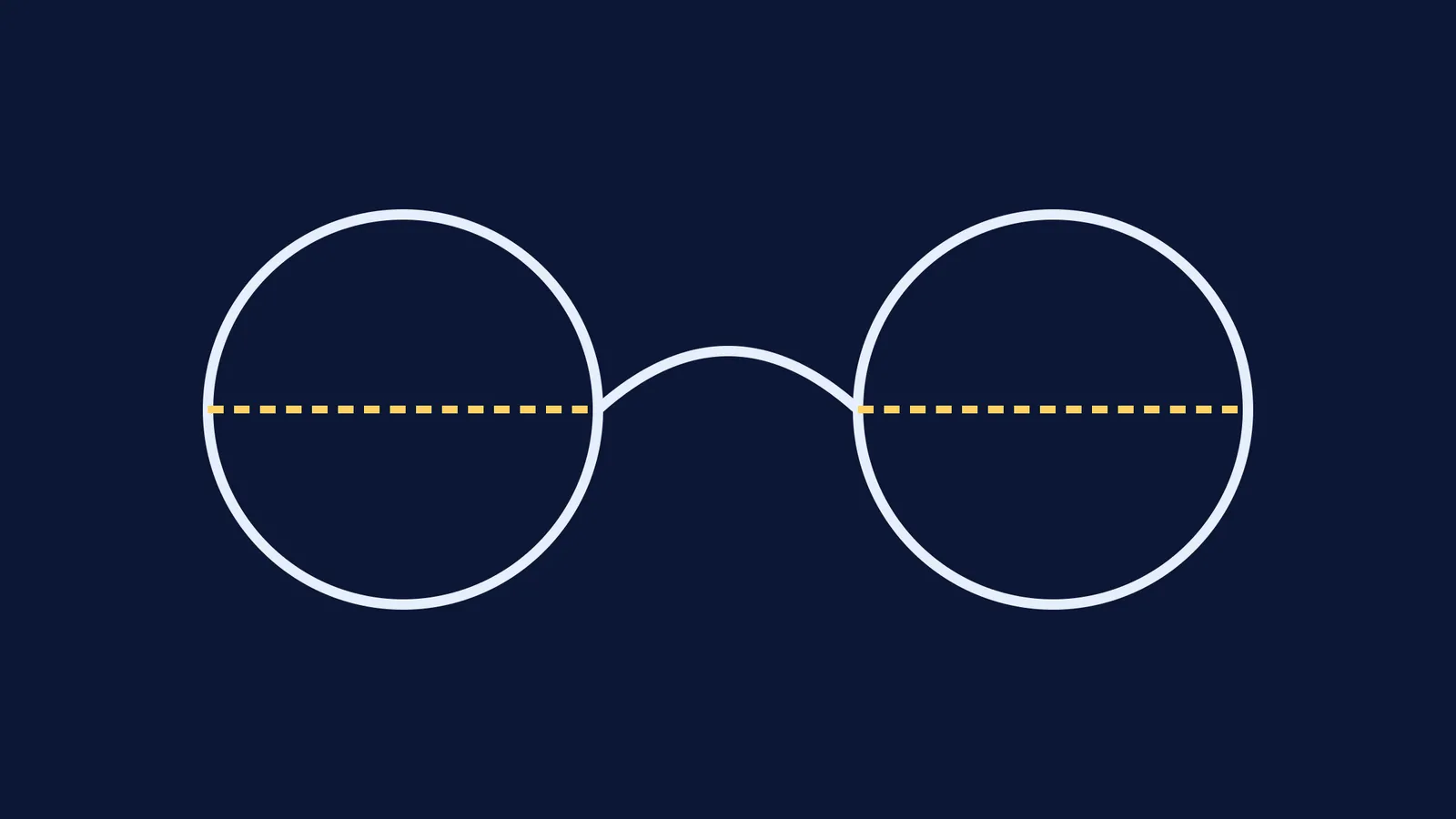
Frustrated by shifting between two pairs of glasses—one for reading and one for looking at the scenery—Franklin had his optician cut the lenses in half. He wrote, "I had the Glasses cut, and half of each kind associated in the same Circle." By placing the lens for distant vision in the upper half of the frame and the reading lens in the lower half, he only had to move his eyes up or down to see clearly. Franklin also noted that this invention was particularly useful in France; it allowed him to see what he was eating while simultaneously observing the facial expressions of people across the table, which helped him understand the French language better.
What are myopia and hypermetropia?
When students learn about the human eye in Class 10, they study common defects of vision that require corrective lenses.
Myopia (Near-sightedness): A person can see nearby objects clearly but cannot focus on distant objects. This happens because the eye lens is too curved or the eyeball is too long, causing light rays to meet in front of the retina.
Hypermetropia (Far-sightedness): A person can see distant objects clearly but struggles with near vision. The focal length of the eye lens is too long or the eyeball is too short, meaning rays meet behind the retina.
What is presbyopia?
A normal human eye can comfortably see objects as close as 25 cm, which is known as the least distance of distinct vision.
However, starting around the age of 40, the eye's ciliary muscles gradually weaken and the lens becomes less flexible. This age-related loss of accommodation is called presbyopia. To understand how a healthy eye adjusts its focus, you can study eye accommodation for near vision.
When a person with presbyopia also suffers from myopia, they need a lens that solves both problems. A bifocal lens uses Franklin's original principle:
The upper half is a concave lens: This diverging lens corrects myopia, bringing distant objects into sharp focus on the retina.
The lower half is a convex lens: This converging lens corrects the near vision defect caused by presbyopia, providing the extra focusing power needed for reading.
When you are working through ray diagrams for these lenses, a convex lens image formation simulation can help you visualise how the image position changes.
How to calculate the power of a bifocal lens?
If you are preparing for your board exams, you will often be asked to calculate the power required for each half of a bifocal lens. The power of a lens is the reciprocal of its focal length in metres (D = 1/f). A concave lens has a negative power, while a convex lens has a positive power.
Here is a worked example. Suppose a person has a far point of 2 m (they cannot see beyond this) and a near point of 50 cm (they cannot read closer than this).
Step 1: The upper lens (distant vision) For the concave upper half, the object is at infinity (u = -∞) and the image must form at their far point (v = -2 m). Using the lens formula: 1/f = 1/v - 1/u 1/f = (1 / -2) - (1 / -∞) = -0.5 The focal length is -2 m. The power is -0.5 D.
Step 2: The lower lens (near vision) For the convex lower half, they want to read a book at the standard near point (u = -0.25 m). The image must form at their actual near point (v = -0.50 m). 1/f = (1 / -0.50) - (1 / -0.25) 1/f = -2 + 4 = +2 The focal length is +0.5 m. The power is +2.0 D.
If you get stuck on the sign conventions—knowing when u and v should be negative—Fermi's AI tutor can draw the figure with you and explain the reasoning step by step until it clicks. You can also use the Fermi Concept Library to review the underlying rules of optics before tackling numericals.


