On this page
In 1789, Antoine-Laurent de Jussieu published a book that changed biology forever. By grouping plants into families based on multiple shared features instead of a single trait, his *Genera Plantarum* created the first "natural" system of classification 1. It was a massive leap beyond the artificial system that came before it, and his method offers a powerful lesson in how to study complex subjects today.
What was the artificial system of Linnaeus?
Before de Jussieu, the standard way to classify plants was Carl Linnaeus's artificial or sexual system, published in 1753 2. Linnaeus classified plants primarily by counting their reproductive organs—specifically the number and arrangement of stamens and pistils. It was an incredibly practical system: anyone could pick up a flower, count its parts, and find its name in a book.
However, because it relied on just one or two superficial traits, it often grouped completely unrelated plants together. For example, a cactus and a cherry tree might end up in the same class simply because they share the same number of stamens. It was an excellent filing system, but it did not reflect the true natural relationships between living things. Because the groups were arbitrary, knowing a plant's class told you nothing about its medicinal uses, its growing conditions, or its overall structure. When you prepare for exams, it is tempting to build a similarly superficial filing system in your head—which is why memorising physics formulas fails.
What is de Jussieu's natural system of plant classification?
Antoine-Laurent de Jussieu (1748–1836) took a completely different approach. His uncle, Bernard de Jussieu, had laid out a botanical garden at the Petit Trianon in Versailles in 1759 3. Bernard physically grouped living plants by their overall anatomical similarities. Antoine-Laurent spent years studying this garden and his uncle's notes, eventually translating that physical arrangement into a rigorous scientific theory.
In 1789, he published *Genera Plantarum*, which established the first widely accepted natural system of plant classification. Instead of picking one arbitrary feature, de Jussieu grouped plants based on a comprehensive set of shared characteristics. He organised the plant kingdom into 100 "natural orders," which we now call plant families. This meant that plants in the same family actually shared a common evolutionary history, even if Jussieu did not yet use that term. It gave his system incredible predictive power. His observations were so accurate that 76 of those original 100 families are still recognised by botanists today 4. His original families include many that you study in biology today, such as when comparing the floral traits of Fabaceae, Solanaceae and Liliaceae.
How did he group plant families by shared features?
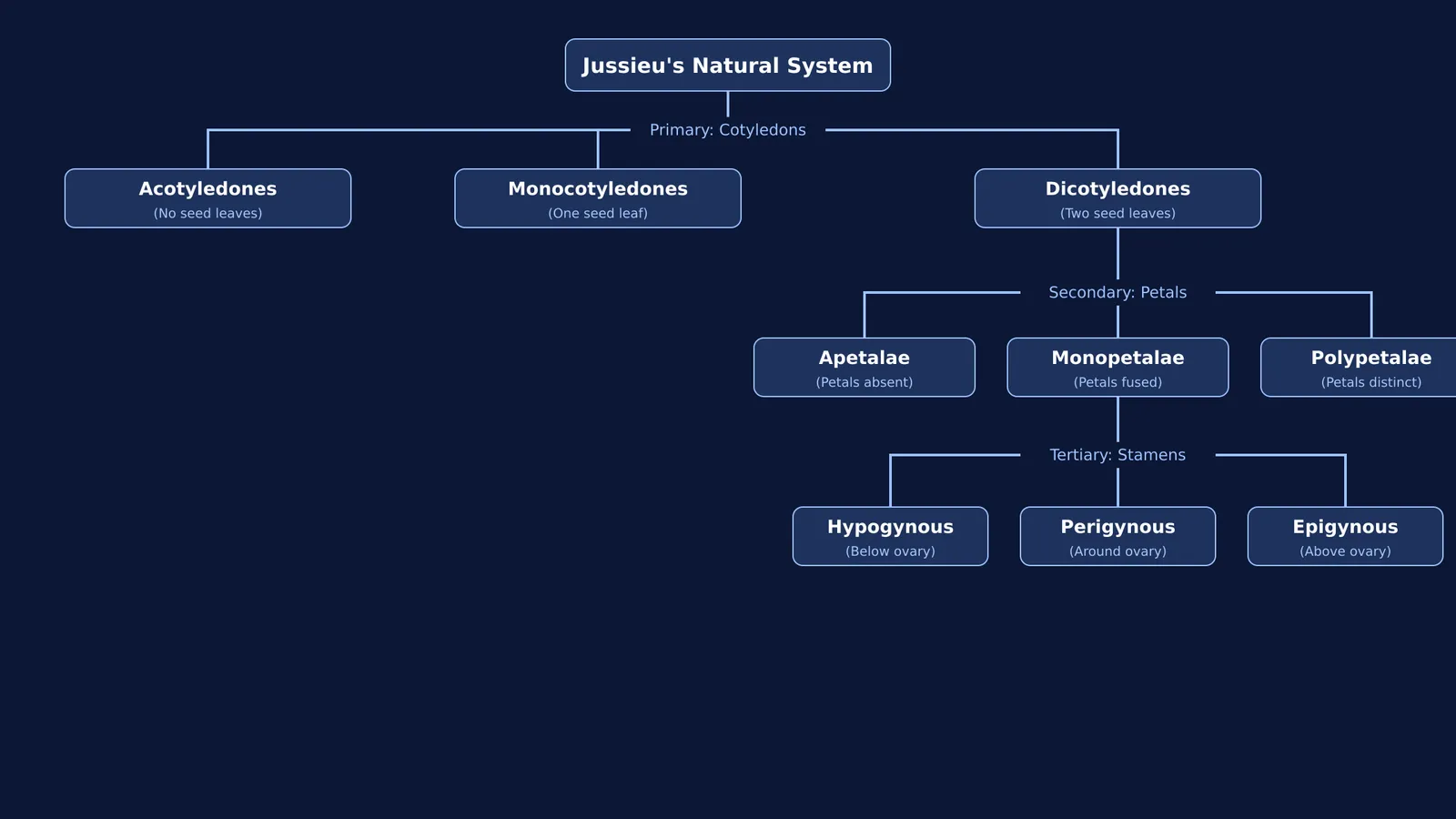
To make sense of thousands of traits, de Jussieu introduced the principle of the "subordination of characters." He argued that certain features are more fundamental to a plant's identity than others:
Primary characters: The number of seed leaves, or cotyledons. He split plants into Acotyledones (no seed leaves, like ferns), Monocotyledones and Dicotyledones (understanding monocot vs dicot seed structure remains a core part of biology).
Secondary characters: The petals. For Dicotyledones, he looked at whether petals were absent, fused into a tube, or distinct.
Tertiary characters: The position of the stamens relative to the ovary (whether they are hypogynous, perigynous, or epigynous).
Why is a natural system better for learning?
The shift from Linnaeus to de Jussieu mirrors a common challenge in student life. When you study a new topic, it is tempting to memorise isolated facts or look for a single keyword to guess the answer to a multiple-choice question. This rote memorisation is easy at first, but like the Linnaean system, it falls apart as the subject gets more complex.
True learning requires building a natural system. Instead of memorising one trait, you must look for multiple shared features and understand how concepts relate to one another. You need to know which principles are primary and which are secondary. Connecting ideas in this way gives your knowledge real predictive power when facing unseen questions in an exam.
This is exactly how Fermi's AI tutor is designed to teach. When you bring a problem to Fermi, it does not just hand you a disconnected answer. It works out what you already know and helps you see the underlying structure of the topic. If you need to see how ideas connect, the Concept Library maps out every concept in physics, chemistry, biology, and mathematics, showing you its place in the wider map.
By grouping knowledge into natural families of ideas, you stop relying on fragile memory tricks. Like de Jussieu, you build a map of understanding that lasts.