

On this page
During the Second World War, the Allied forces lost access to the quinine plantations of Java. Medical researchers rushed to find and test synthetic antimalarial drugs to protect troops fighting in tropical regions. One of the most promising new drugs was proguanil (then known as paludrine). But a crucial question remained: would these new drugs work forever, or could the parasite learn to beat them?
Ann Bishop, a pioneering biologist and Fellow of Girton College at the University of Cambridge, set out to find the answer (10.1098/rsbm.1992.0002). Working at the Molteno Institute, she ran meticulous experiments that laid the foundation for our modern understanding of drug resistance.
Why did Ann Bishop study malaria in birds?
At the time, human strains of the malaria parasite were incredibly difficult to keep alive and study in a laboratory. To run controlled, long-term experiments, Bishop and her colleague Betty Birkett needed a reliable animal model.
They chose avian malaria—specifically *Plasmodium gallinaceum*, which infects chickens, and *Plasmodium relictum*, which affects canaries (10.1098/rsbm.1992.0002). The basic biology of the parasite in birds is very similar to the human disease, making the chicken an ideal stand-in for testing how the organism responds to chemical threats. This was a vital step, much like how Alphonse Laveran and the parasite that causes malaria first identified the pathogen by looking at fresh blood under a microscope.
Before focusing on proguanil, Bishop had already made a breakthrough. She produced a strain of *Plasmodium relictum* in canaries that was resistant to pamaquin, the first synthetic antimalarial. This early success proved that resistance was a biological property of the parasite that could be induced in a lab.
How does a parasite acquire drug resistance?
In 1947, Bishop and Birkett published a landmark paper in *Nature* describing how they had created a drug-resistant strain of malaria (10.1038/159884a0).
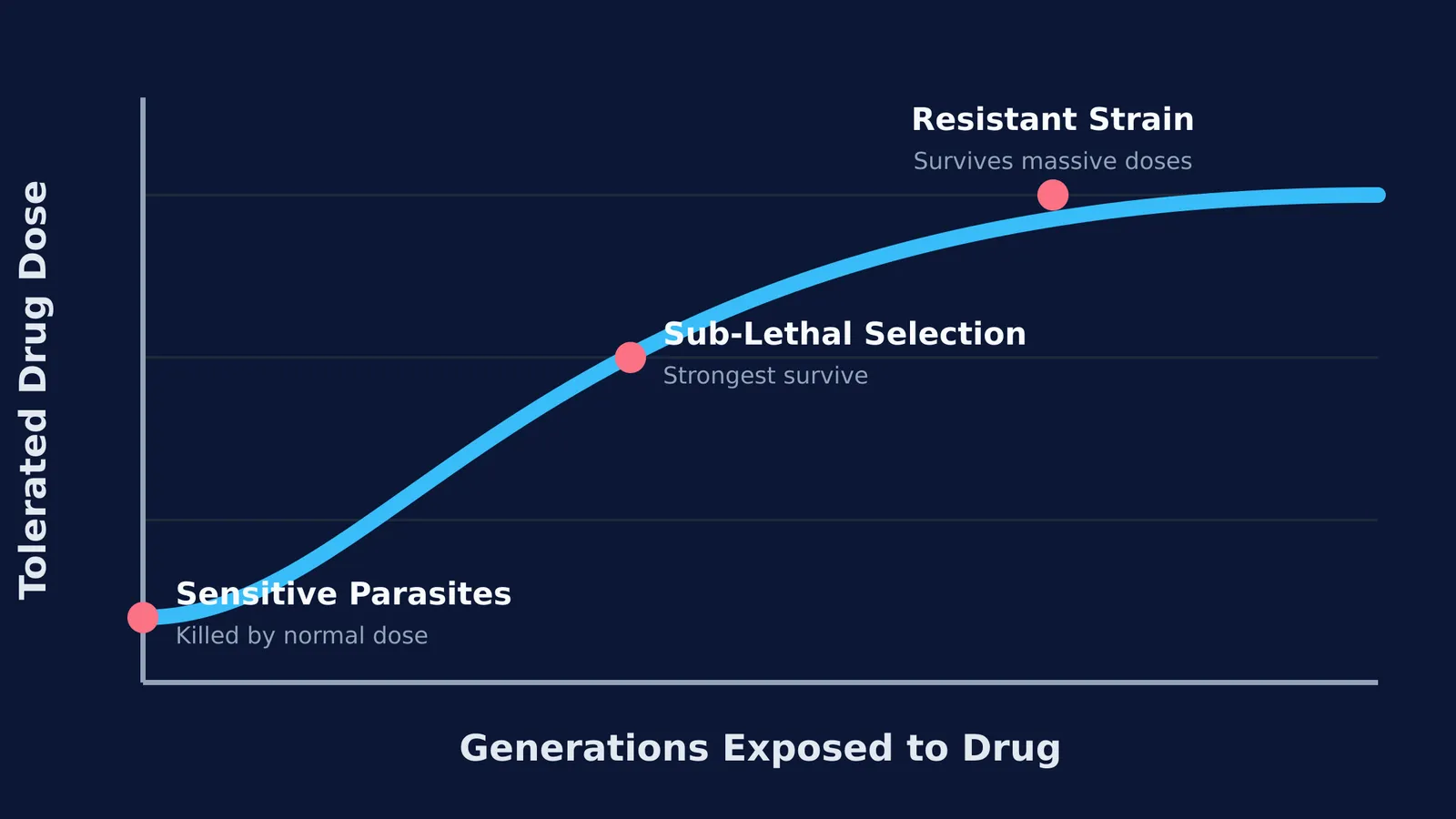
Their method was simple but profound. They infected chicks with *Plasmodium gallinaceum* and treated them with very small, sub-lethal doses of proguanil. A dose this low kills the weakest parasites but leaves the strongest alive. Those survivors multiply. Bishop then slowly increased the dose over several months. Eventually, she produced a strain of the parasite that could happily survive massive doses of the drug that would have instantly wiped out the original population (10.1038/159884a0).
She later proved that this was a permanent, inheritable change. Even after the resistant parasites were sucked up by a mosquito—similar to the transmission cycles seen in Carlos Chagas: a new parasite, its insect carrier and its disease—and transmitted to a new, untreated bird, they kept their immunity to proguanil (10.1098/rsbm.1992.0002).
She also made another crucial discovery: cross-resistance. When she tested her proguanil-resistant parasites against other related compounds, like pyrimethamine, she found they were already immune. However, they remained sensitive to completely unrelated drugs like quinine or chloroquine. Because of her work, doctors today know exactly why it is so dangerous to misuse medications, take partial doses, or rely on a single chemical class.
What can we learn from the parasite's survival?
It might seem strange to take inspiration from a disease, but the biological mechanism that makes drug resistance so terrifying is the exact same mechanism you use to learn difficult subjects like physics and mathematics.
Organisms adapt to the specific level of stress they face. If you only ever solve easy problems, your brain is receiving a "sub-lethal dose" of difficulty. You might feel productive, but you are not forcing your neural pathways to adapt and grow stronger. To build the high-level skills needed for competitive exams, you must deliberately increase the challenge, step by step.
If you find yourself stuck at a certain level and unsure how to step up the difficulty, Fermi's AI tutor can work out what you already know and build a plan for the session.
How can you apply progressive difficulty to studying?
You can apply Ann Bishop's method to your own study routine to ensure you are always adapting and improving. We call this the Progressive Overload Plan:
Find your baseline: Start your study session with concepts you understand well. This is your foundation.
Increase the dose: Move directly to problems where you make mistakes or struggle to find the first step. This is the stress that forces adaptation. You can find worked problems with a step-by-step solver that explains the reasoning rather than printing an answer in the Fermi Problem Library.
Persist and mutate: When you fail a hard problem, do not immediately drop back to easy questions. Change your approach. Review the theory—every concept in physics, chemistry, biology, mathematics and computing, each with its own lesson and its place in the map, is available in the Fermi Concept Library—and try again.
Test the new strain: At the end of the week, take a mixed mock test. Like Bishop testing her parasites in new birds, you need to prove that your new problem-solving skills survive in a fresh environment.
A biological system will never expend energy to change unless it is forced to. By carefully managing the difficulty of your study sessions, you ensure your mind is always evolving.


