On this page
On 22 October 1797, André-Jacques Garnerin stood in a basket attached to a hydrogen balloon over Parc Monceau in Paris. At a height of approximately 3,000 feet (1,000 metres), he did something nobody had ever done before: he severed the rope connecting his basket to the balloon 1.
As the balloon shot upwards, Garnerin plummeted towards the ground. Above him, a white silk canopy snapped open. It was the world's first successful jump using a parachute without a rigid frame. But while the parachute slowed his fall, it created a new, terrifying problem.
Why did the first parachute swing so violently?
Garnerin's first parachute was essentially a giant, solid umbrella. It was made of 23 feet (7 metres) of continuous fabric, with no openings except the wide rim at the bottom 2.
When an object falls through the atmosphere, gravity pulls it downwards, causing it to accelerate. As its speed increases, it collides with more air molecules per second. These collisions create an upward drag force. Eventually, the upward drag perfectly balances the downward pull of gravity. At this point, the object stops accelerating and falls at a constant speed, known as terminal velocity. The large surface area of Garnerin's 23-foot canopy was designed to catch as much air as possible, making his terminal velocity low enough to survive the impact with the ground.
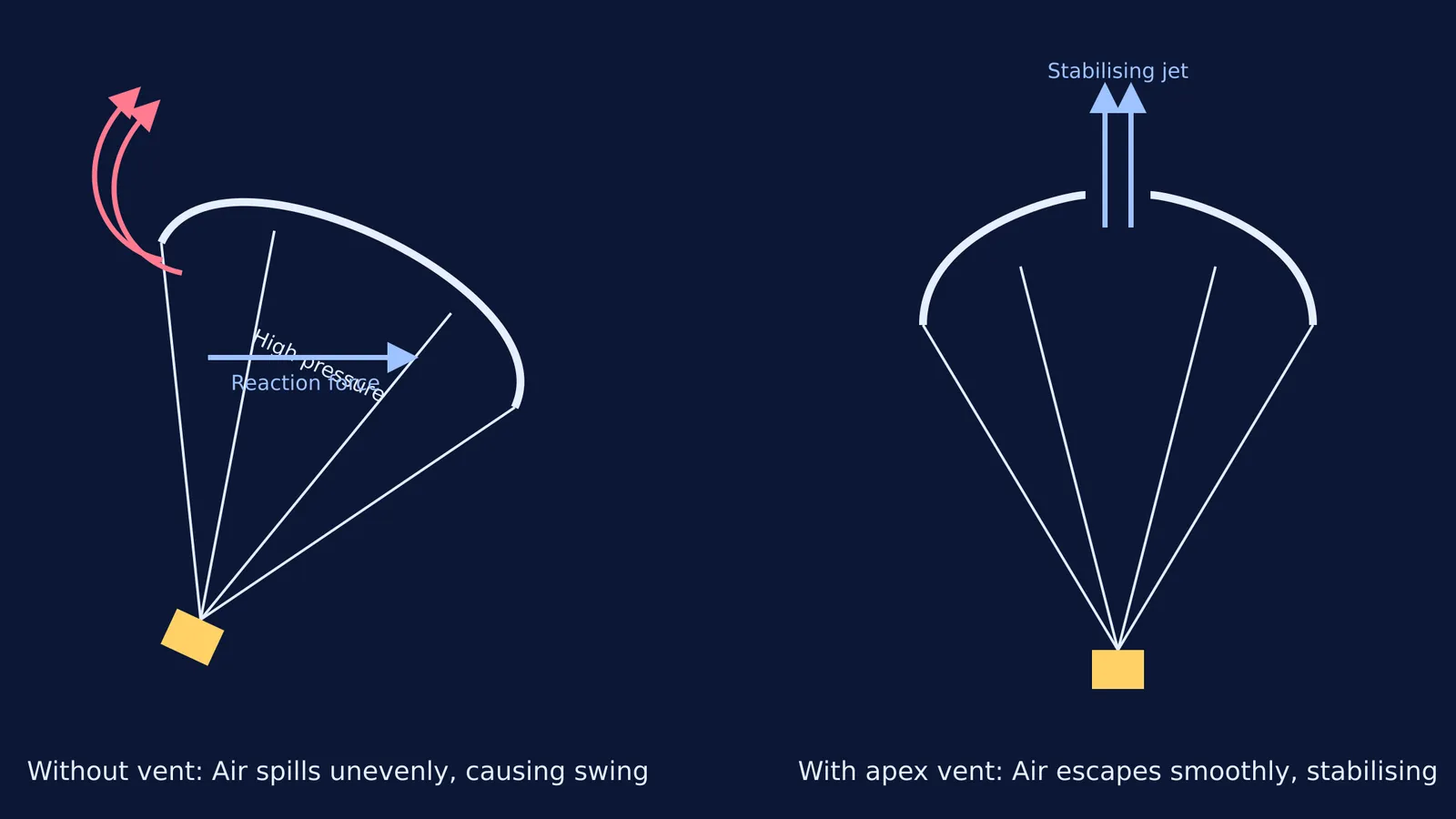
However, as he descended, the air beneath the canopy compressed. Because the canopy was solid, the trapped high-pressure air had nowhere to go but out from under the edges. When a large volume of air suddenly spills out from one side of a parachute, it creates a reaction force — like a brief jet engine burst — pushing the parachute in the opposite direction.
This caused Garnerin's basket to swing upwards. As the parachute tilted, air would build up and spill out from the opposite edge, throwing him back the other way. The result was a violent pendulum motion, swinging the basket so wildly that it reached extreme angles. The ride was so rough that the basket swung violently during descent 1.
To understand how air resistance behaves at different speeds, the Fermi Simulation Lab lets you drop objects of different shapes and watch how drag forces increase until they match gravity.
How did the apex vent fix the parachute?
Garnerin survived the rough landing, but the violent oscillations needed fixing. In 1804, the French astronomer Jérôme Lalande introduced a solution 2.
Lalande realised the issue was the uneven spilling of air from the edges. He suggested cutting a small, circular hole at the very top of the parachute.
This hole is known as an apex vent. It changed the aerodynamics completely in two key ways:
Steady escape route: Instead of building up until it violently spilled over the edge, the trapped air flowed continuously out through the vent. This eliminated the sudden, asymmetric bursts of air that were pushing the parachute sideways.
Stabilising jet: The air rushing straight up out of the top of the parachute created a stabilising column of air. According to Newton's third law of motion, the air forced upwards creates an equal and opposite downward pull on the very centre of the canopy, keeping the parachute perfectly centred over the basket.
With the vent in place, the pendulum effect vanished. The descent became smooth and stable. Garnerin went on to complete many more jumps across Europe. Even before the vent was introduced, his student and future wife Jeanne Geneviève Labrosse became the first woman to parachute on 12 October 1799, jumping from an altitude of 900 metres 1.
How do we use parachute physics today?
The principles of aerodynamic stability discovered during Garnerin's early jumps are still applied in modern engineering. The apex vent remains a standard feature on round parachutes, ranging from military airdrops to spacecraft returning to Earth. These vents ensure that heavy payloads do not swing wildly and crash into the ground at a dangerous angle.
If you have ever used a large round umbrella in a heavy storm, you might have noticed that modern golf umbrellas have a double-layered vent at the top. This lets gusts of wind pass through without tearing the umbrella from your hands or turning it inside out. By allowing the high-pressure air to escape through the apex, the umbrella remains stable, exactly like Lalande's modified parachute.
If you are learning about forces, drag and pendulum motion, Fermi's AI tutor can help you build the equations step by step. Instead of just printing the terminal velocity formula, the tutor asks questions to help you derive it, drawing the force diagrams on a board as you go.
For a deeper look into how objects fall through fluids, check out our guide to the terminal velocity simulation, or see how we measure damped and forced oscillations in physics.