

On this page
In 1856 Alfred Russel Wallace, unable to sail from Singapore straight to Makassar, stopped at two islands on the way. What he saw there gave biology one of its best-known boundaries.
What is Wallace's line?
Wallace's line is a boundary through the Indonesian islands that separates animals related to Asia's from animals related to Australia's. It runs through the Lombok Strait between Bali and Lombok, then north through the Makassar Strait between Borneo and Sulawesi (Wallace Line overview).
In The Malay Archipelago, Wallace called the two halves the Indo-Malayan and Austro-Malayan divisions.
How did Wallace discover the line between Bali and Lombok?
Wallace's own account in The Malay Archipelago says he anchored at Bileling, on Bali's north coast, on 13 June 1856, after a twenty-day voyage from Singapore. A two-day sail then took him to Ampanam on Lombok, where he collected birds during a stay he later put at three months.
The birds did not match. In his words: “In Bali we have barbets, fruit-thrushes, and woodpeckers; on passing over to Lombock these are seen no more, but we have abundance of cockatoos, honeysuckers, and brush-turkeys, which are equally unknown in Bali, or any island further west.”
He put the strait at fifteen miles wide, so that you could “pass in two hours from one great division of the earth to another, differing as essentially in their animal life as Europe does from America.” Modern figures give the Lombok Strait as about 35 km across (Wallace Line overview).
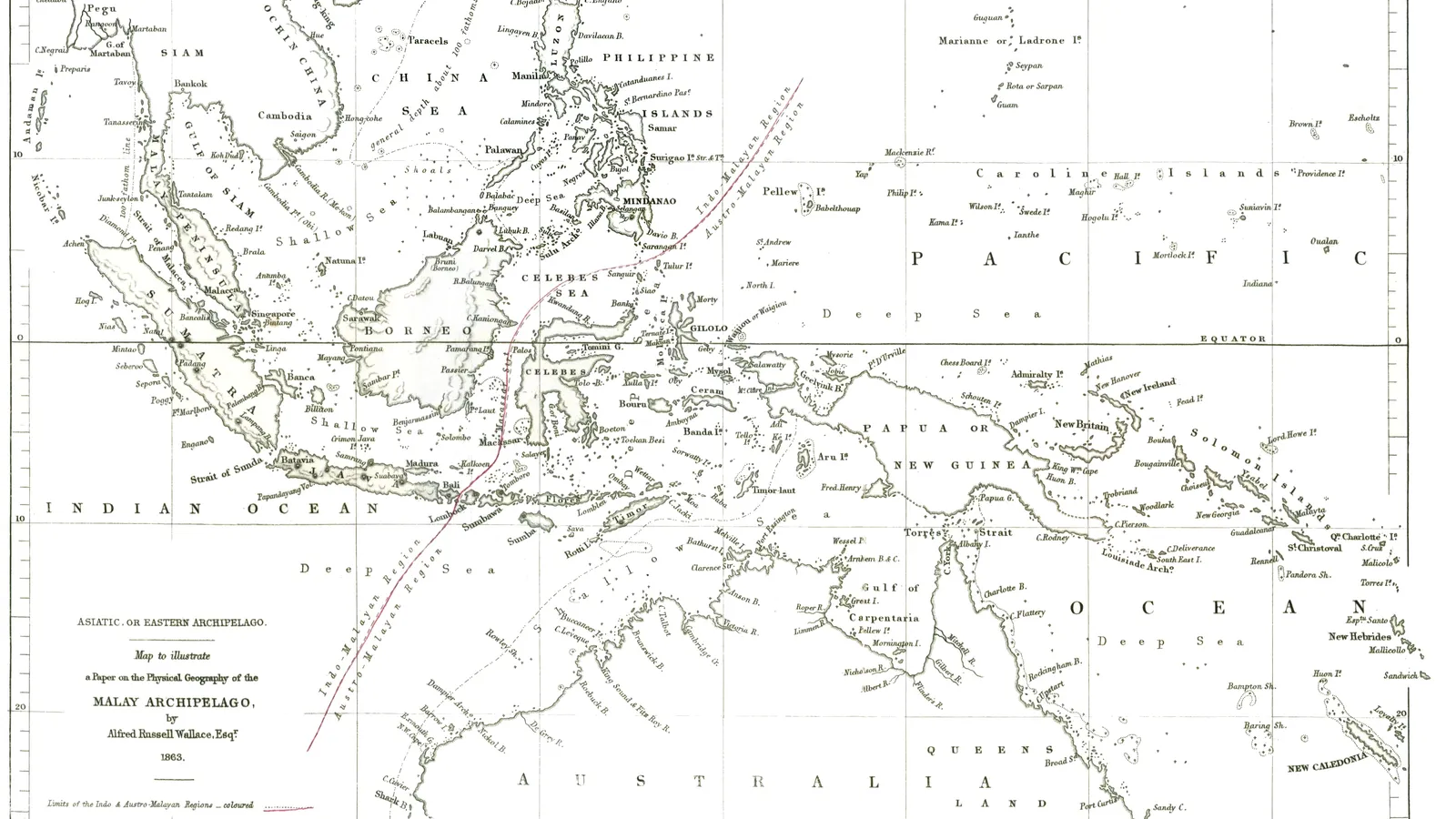
Wallace set out the idea in On the Zoological Geography of the Malay Archipelago, published by the Linnean Society in 1860. In 1863 he drew the line in red on a map for the Royal Geographical Society; that map is at the top of this page. Thomas Henry Huxley drew his own version of the divide in 1868, as a 2021 review in Biological Reviews by Jason Ali and Lawrence Heaney records.
Why do animals change so sharply at Wallace's line?
Wallace's answer was the sea floor. He credited George Windsor Earl, who had pointed out in 1845 and 1855 that a shallow sea joins Sumatra, Java and Borneo to Asia, while another joins New Guinea to Australia (The Malay Archipelago, chapter 1). Wallace argued that islands on a shallow shelf had recently been part of a continent, while the deep water between the two shelves had kept their animals apart for a very long time.
Birds can fly, but Wallace noticed that most perching birds are “as strictly limited by straits and arms of the sea as are quadrupeds themselves.”
Modern work adds climate. A 2023 study in Science analysed more than 20,000 vertebrate species and found that Asian lineages evolved in humid conditions like those of the islands in between, which helped them spread east, while Australian lineages mostly evolved in drier conditions and struggled to settle in the west.
Is Wallace's line still accurate today?
Partly. The Biological Reviews survey explains that, as Wallace himself had noted, all such lines were “to some degree permeable”, so by the 1880s transition zones were being proposed instead of a single wall; the name Wallacea for the islands in between came in 1924. Wallace's own final line of 1910 ran east of Sulawesi rather than west of it, as his 1863 line had, and modern analyses still have not agreed exactly where the boundaries lie.
Wallace went on to write The Geographical Distribution of Animals in 1876 (Natural History Museum) and is sometimes called the father of biogeography (Wallace biography), the study of where living things are found and why.
How can you reason like Wallace in a biology answer?
To explain a pattern, not just name it, Wallace's method gives you four steps:
Observe: list what lives on each side.
Compare groups, not single species: one odd animal proves little; a whole family missing proves a lot.
Find the barrier and its history: what stops crossing, and how long it has been there.
Check the exceptions: do they break the idea, or show mixing at the edges?
Worked example: why does Australia have kangaroos but no native deer or cats?
Observe: Wallace described forests in Java and Borneo full of monkeys, wild cats and deer, and wrote that Australia has marsupials instead.
Compare groups: whole groups are missing, including woodpeckers and pheasants.
Barrier: deep water separates the Australian shelf from the Asian one, so the two faunas evolved apart.
Exceptions: Wallace noted wild pigs on all the islands and deer in Sulawesi and the Moluccas that had probably been introduced recently. The exceptions have explanations, so the pattern holds.
If terms like speciation or adaptive radiation still feel shaky, the Fermi Concept Library has a lesson for every biology concept, each shown in its place on the map of related ideas. Fermi's AI tutor can also ask you questions and check your understanding as it goes, so you find the gap before the exam does.
Next, read what the 1858 Darwin–Wallace papers argued about natural selection, then Henry Walter Bates and the butterflies that copy others and E. O. Wilson's island experiments.


