On this page
In the 9th century, the Arab polymath Al-Jahiz wrote *Kitab al-Hayawan* (The Book of Animals). He described over 350 species in his seven-volume encyclopedia [[1]](https://en.wikipedia.org/wiki/Al-Jahiz). Al-Jahiz was paid 5,000 gold coins for this monumental work, reflecting the immense value placed on scientific observation during the Islamic Golden Age. However, the book went far beyond cataloguing local folklore, poetry, and anatomy. He documented the intense competition between species, giving the world its first written description of a food chain and proposing that environments physically shape the animals that live in them. By closely studying the creatures around him, Al-Jahiz laid the intellectual groundwork for ecology and evolutionary thought a millennium before they became formal scientific disciplines.
Did Al-Jahiz describe the first food chain?
Long before modern ecology mapped ecosystems and energy flow, Al-Jahiz observed that nature was built on a series of interconnected webs. He saw a direct, linear sequence of "who eats whom," noting that survival meant eating and being eaten in turn. His observations shifted the focus from looking at animals in isolation to understanding how they interact with one another.
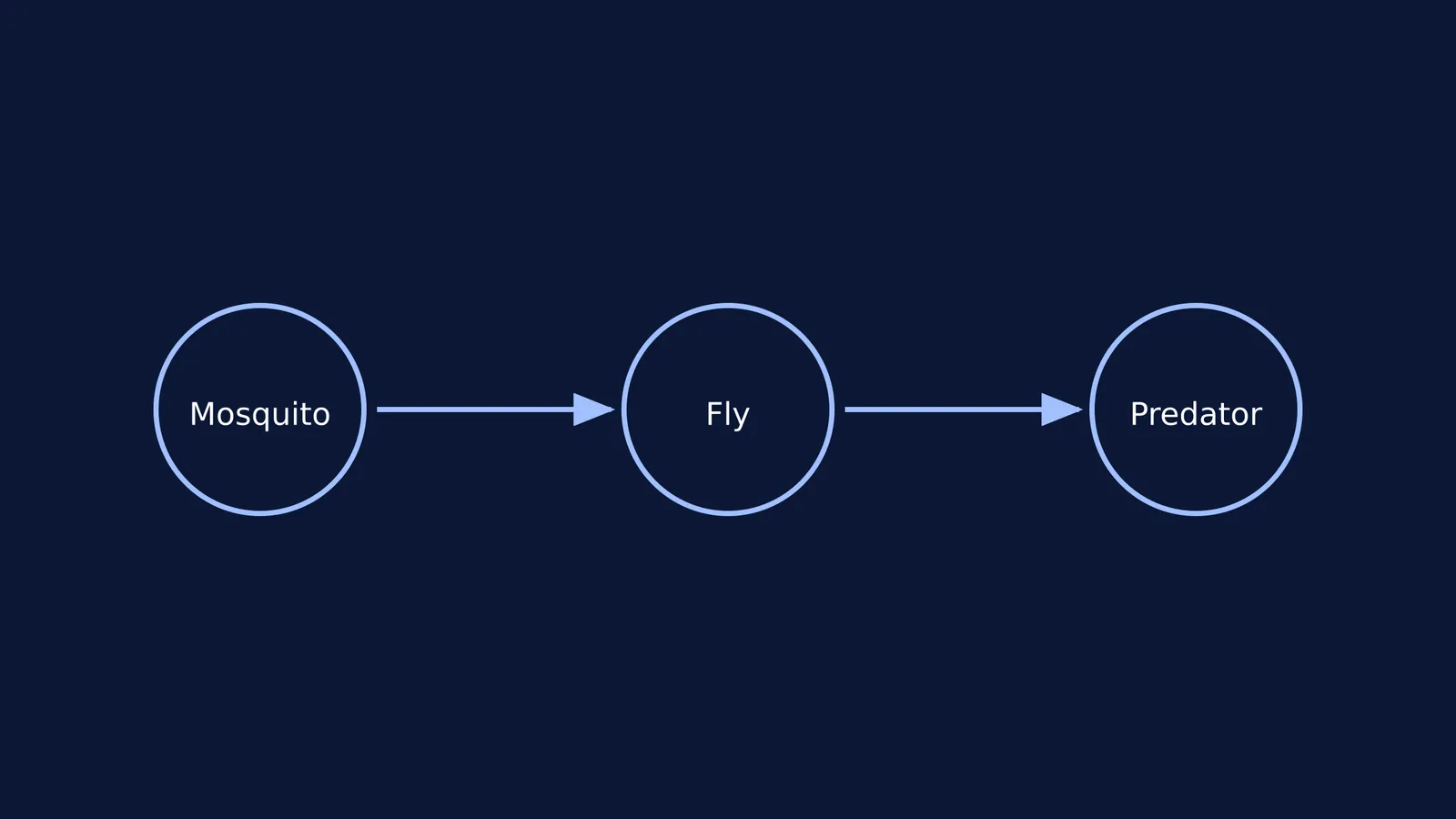
He documented this cycle clearly. "All animals, in short, can not exist without food, neither can the hunting animal escape being hunted in his turn" [[1]](https://en.wikipedia.org/wiki/Al-Jahiz). As an example, he described how mosquitoes feed on the blood of animals to survive, only to be hunted by flies. The flies are then eaten by other predators. This unbroken chain of predation is the foundational concept of a modern food web.
Al-Jahiz's three principles of ecology:
Interconnectedness: Every animal is part of a food chain, acting as both predator and prey within a larger system.
Competition: Animals are in a constant struggle for existence, fighting for resources and survival against rivals.
Adaptation: Environmental factors like heat and soil determine an animal's physical traits, allowing it to thrive in specific regions.
How did Al-Jahiz describe the struggle for existence?
Al-Jahiz recognised that the natural world was a theatre of fierce competition rather than a peaceful garden. He saw that animals were in a constant struggle for limited resources—fighting to find food, secure shelter, and avoid predators. This was a radical departure from the static views of nature held by many of his contemporaries.
He used rats to illustrate this harsh, everyday reality. He observed that a rat "eats all animals inferior to it in strength," yet must constantly "avoid snakes and birds and serpents of prey" to survive [[1]](https://en.wikipedia.org/wiki/Al-Jahiz). This relentless pressure meant that only those creatures able to adapt, escape, or fight off rivals would endure to reproduce. He even drew parallels to human behaviour, noting that men do not differ from animals in this universal struggle for dominance and survival.
If you are studying biology today, understanding these relationships is core to grasping ecology. Fermi Concept Library covers every concept in biology, from trophic levels to natural selection, each with its own lesson and its place in the map.
How does the environment shape animals?
Beyond the food chain, Al-Jahiz proposed an early form of environmental determinism—the idea that an animal's physical traits are shaped by where it lives. He argued that factors such as water, soil, distance from the sun, and heat directly dictated features like skin and coat colour [[1]](https://en.wikipedia.org/wiki/Al-Jahiz).
He pointed to the dark-coloured animals found in the Harra, a hot, volcanic region of Arabia. He observed that gazelles, ostriches, and even insects in that environment were black, perfectly suited to their surroundings. He used this same logic to explain human diversity, arguing that the dark skin of East Africans was not a punishment or defect, but a natural adaptation to a hot, sun-drenched environment.
While he wrote centuries before Charles Darwin formalized the theory of evolution, his focus on the struggle for existence and environmental adaptation laid the groundwork for how we understand biology today. His work reminds us that careful, active observation of the world can yield insights that stand the test of time. If you want to explore the mechanisms of adaptation and evolution with a tutor that checks understanding as it goes, Fermi's AI tutor can teach you the reasoning step by step.
For more on how biologists study animal behaviour and survival, read about Niko Tinbergen and the four questions of animal behaviour or explore Vladimir Vernadsky and the biosphere: life as a geological force.