On this page
In 1964, Dr Aklilu Lemma, an Ethiopian pathologist, watched women washing clothes in a stream in the town of Adwa. They were using the suds of the endod plant, a traditional soapberry (*Phytolacca dodecandra*). He noticed a curious detail: downstream from the washing area, large numbers of freshwater snails lay dead. That simple observation led to a low-cost, local method to control schistosomiasis, a debilitating parasitic disease.
What is schistosomiasis and how do snails spread it?
Schistosomiasis is an acute and chronic disease caused by blood flukes, which are parasitic worms of the genus *Schistosoma* (similar to the parasites discussed in our guide on Ascariasis, filariasis and ringworm: causes, spread and body parts). It primarily affects poor and rural communities in tropical and subtropical areas. According to the World Health Organization, an estimated 253.7 million people required preventive treatment for the disease in 2024 (WHO Schistosomiasis Fact Sheet). The scale of the problem makes finding affordable, scalable solutions a global priority.
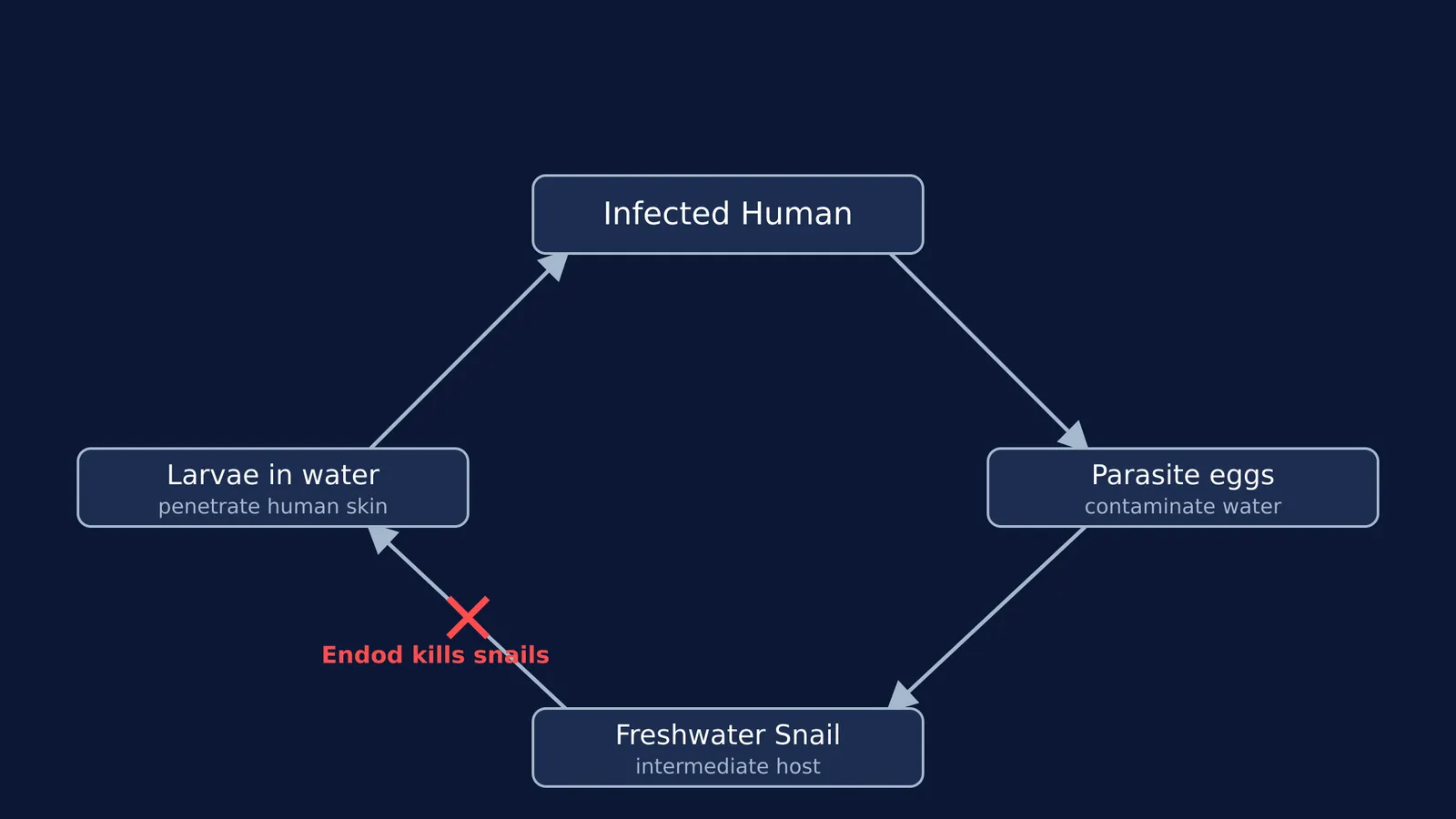
The parasite relies on a complex life cycle. Freshwater snails release the larval forms of the parasite into the water. When people wash, swim, or farm in infested water, these larvae penetrate their skin and develop into adult worms inside the body. The cycle continues when infected individuals contaminate fresh water with eggs passed in their waste. Controlling the snail population is one of the most effective ways to break this chain of transmission.
If you have concept gaps when studying parasitic life cycles, the Concept Library has every concept in physics, chemistry, biology, mathematics and computing, each with its own lesson and its place in the map.
How did Aklilu Lemma discover the endod snail cure?
When Dr Lemma saw the dead snails in Adwa, he suspected a connection to the washing suds. He collected live snails, placed them in containers, and added a small amount of the endod suds. The snails died almost instantly.
He spent the next few years systematically testing the plant. In a foundational 1970 paper, he reported that the dried berries were the most potent part of the plant and that their snail-killing (molluscicidal) properties remained stable across different temperatures and environmental conditions (Laboratory and field evaluation of the molluscicidal properties of Phytolacca dodecandra). The active ingredient was a saponin, a natural toxin lethal to snails but largely safe for mammals and plants at the concentrations used.
What were the results of the Adwa field trial?
To prove the plant's value in the real world, Dr Lemma and his team ran a five-year field trial in Adwa. The results, published in 1983, were striking (Control of schistosomiasis in Adwa, Ethiopia, using the plant molluscicide endod). The overall prevalence of *Schistosoma mansoni* infection in the treated area dropped from 61.5% to 36.4%.
The most significant decline occurred in children aged one to six, who are often the most vulnerable to the disease. The annual cost of the endod treatment was approximately US $0.06 per person, making it a highly viable alternative to imported synthetic chemicals. Much like other pioneers in public health—such as Cicely Williams and the discovery of kwashiorkor—Dr Lemma proved that affordable, community-driven interventions could save lives.
Why do local solutions matter for disease control?
Before the discovery of endod's properties, the primary way to control schistosomiasis snails was by using synthetic molluscicides. These chemicals were costly and often had to be imported, putting them out of reach for the rural communities that needed them most.
Endod, by contrast, could be grown locally and processed by the community without specialized equipment. Farmers could cultivate the plant alongside their regular crops, and the berries could be dried, crushed, and applied to local water sources by the villagers themselves. Furthermore, unlike synthetic compounds that might linger and disrupt local ecosystems, endod is rapidly biodegradable. Dr Lemma's work, which earned him the Right Livelihood Award in 1989, remains a powerful example of how indigenous knowledge and local resources can provide world-class solutions to global health challenges.
When a textbook explanation of disease transmission leaves you not knowing where to start, Fermi's AI tutor works out what you already know, builds a plan for the session, and teaches through it.