On this page
When your biology textbook says oestrogen, progesterone and testosterone control the reproductive cycle, it takes for granted that someone knew what these molecules were. In the late 1920s very little was known about them. Hormones from the ovaries and testes were known mainly by their effects on animals. Adolf Butenandt, a young chemist in Göttingen, helped turn those effects into crystals, formulas and structures.
What did Adolf Butenandt discover?
The Nobel Prize biography of Butenandt lists the main results.
1929: he isolated oestrone (estrone, a female sex hormone) in pure, crystalline form, at almost the same time as Edward Doisy in the United States.
1931: he isolated androsterone, a male sex hormone, in pure, crystalline form.
1934: he isolated progesterone, the corpus luteum hormone, from the corpus luteum. Other groups had already obtained it in crystalline form in 1931 and 1932.
Butenandt was born on 24 March 1903 in Bremerhaven and graduated from the University of Göttingen in 1927, where he studied under Adolf Windaus, according to the same Nobel biography.
The Nobel Prize's 1939 account of his work records that Butenandt and Doisy got estrone from the urine of pregnant women, and that Butenandt's androsterone work started from male urine. That work was only possible because biologists had found a quantitative test for these hormones, the "capon comb test".
How did he show that sex hormones are steroids?
The ceremony speech describes the chain of reasoning:
He found estrone's formula, C18H22O2, and showed that it was an "oxyketone", with an OH group and a C=O group.
In 1932, using spectra and the newly corrected formula of cholesterol, he proposed structures for estrone and oestriol.
By breaking oestriol down step by step, he showed that both hormones contain a phenanthrene core, the same core he got from a product of the bile acids. That tied the sex hormones to the sterols.
He gave androsterone the formula C19H30O2 and drew its full structure in 1934, again from the formula of cholesterol.
In 1934 he and Westphal produced pure progesterone, and in 1939 he made it from cholesterol by a simple route.
Did Butenandt discover testosterone?
Not first. The Nobel ceremony speech credits Ernst Laqueur's group with isolating testosterone from testicular extract in 1935. That same year, Butenandt and Leopold Ruzicka, working independently, made testosterone from a related compound, trans-dehydroandrosterone. Because testosterone was so close to androsterone, its structure followed quickly. Ruzicka shared the 1939 prize with Butenandt.
Why did Butenandt not accept the 1939 Nobel Prize?
The Nobel Prize facts page gives the motivation as "for his work on sex hormones" and notes that the authorities of his country made him decline the award. The Max Planck Society's profile of Butenandt says this followed Hitler's 1937 decree, and that Butenandt had joined the Nazi Party in 1936. He received the medal and diploma in 1949, according to the ceremony speech page. He later led the Max Planck Society from 1960 to 1972. The party membership is part of his record, alongside the chemistry.
Worked example: what the formulas tell you
You can see Butenandt's "same skeleton" idea with one standard organic chemistry tool, degrees of unsaturation (DoU). For a compound CcHhOo, DoU = c − h/2 + 1, and every ring, C=C or C=O counts as one. The formulas below are from PubChem: estrone, androsterone, progesterone and testosterone.
Androsterone, C19H30O2: 19 − 15 + 1 = 5. Four rings plus one C=O (the 17-ketone).
Testosterone, C19H28O2: 19 − 14 + 1 = 6. Four rings, one C=C and one C=O (the 3-ketone); the 17 position carries OH.
Progesterone, C21H30O2: 21 − 15 + 1 = 7. Four rings, one C=C, the 3-ketone and the C=O of the 17-acetyl group.
Estrone, C18H22O2: 18 − 11 + 1 = 8. Four rings, three C=C in an aromatic ring A, and the 17-ketone.
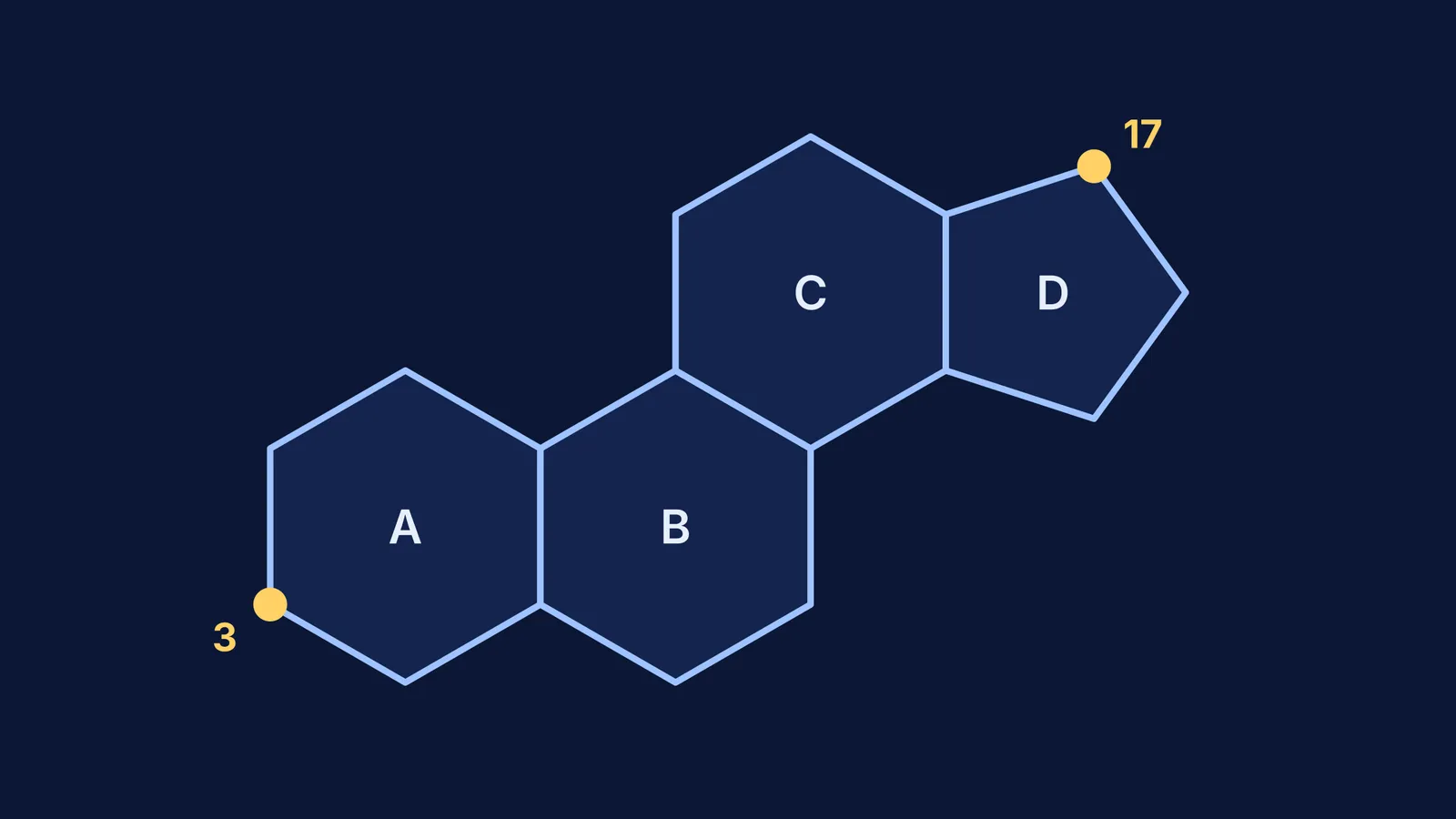
Subtract the four rings from every answer and what's left is a few double bonds plus the groups at carbon 3 and carbon 17. Estrone also has an aromatic ring and is one carbon short: it has no methyl group at carbon 10.
If you mix up which hormone has which group, or why the receptor sits inside the cell, the Fermi Concept Library has a lesson for each concept in chemistry and biology, showing where it fits on the map. To practise DoU on other formulas, the Fermi Problem Library has a step-by-step solver that explains the reasoning rather than printing an answer.
Where this fits in your syllabus
In biology, these hormones control the menstrual cycle and pregnancy; our guide to human reproduction, gametogenesis and the menstrual cycle walks through them. Because steroids pass through cell membranes, they act differently from protein hormones, as explained in how hormones act through membrane and intracellular receptors. For another chemist who built a career on steroids, read about Percy Julian and the steroid medicines he made from soybeans.
Next time you revise the menstrual cycle, sketch the four rings and mark carbons 3 and 17.