On this page
If you study trigonometry today, you are learning a system that was largely formalised in 10th-century Baghdad. The Persian mathematician Abu al-Wafa al-Buzjani was instrumental in turning trigonometry from a messy tool for astronomers into a clean mathematical discipline.
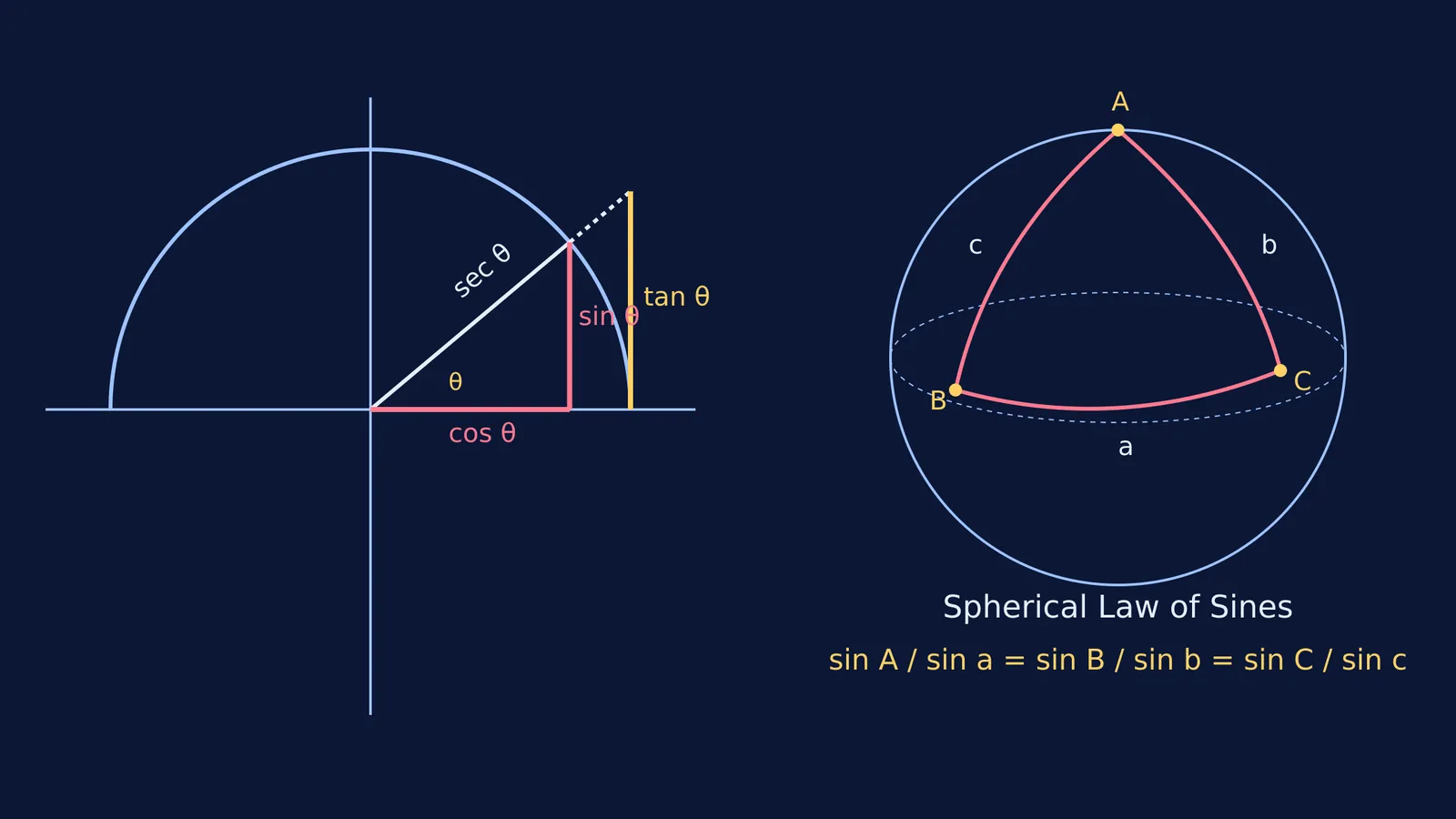
He systematised the tangent function, introduced the secant, and formulated the law of sines for spherical triangles.
Who was Abu al-Wafa al-Buzjani?
Abu al-Wafa was born in 940 CE in Buzjan, Persia, and later moved to Baghdad, which was then a global centre of scientific research. He worked extensively on astronomy, translating and refining the works of Greek mathematicians.
To make his astronomical observations more precise, he needed better mathematical tools. He computed highly accurate tables for sines and tangents at 15-minute (15') intervals. These tables allowed other scientists to look up values instantly instead of calculating them from scratch for every observation.
How did Abu al-Wafa change trigonometry?
Before Abu al-Wafa, astronomers relied heavily on chords—straight lines drawn across a circle—to calculate distances and angles in the sky. This was a cumbersome process that involved complex geometric construction. Abu al-Wafa simplified it by bringing modern trigonometric functions to the forefront.
He was the first to make systematic use of the tangent function. The geometric concept of a tangent involves a line touching the outside edge of a circle. By defining this as a formal ratio, he unlocked new ways to calculate heights and distances.
He also introduced the secant and cosecant functions to the mathematical toolkit. By defining these ratios in relation to a unit circle, he established the interrelations between all six standard trigonometric lines. This meant that if an astronomer knew just one ratio, they could easily derive the other five using simple algebraic identities.
What is the spherical law of sines?
On a flat piece of paper, you might already know Why the angles of a triangle add to 180 degrees. But when you draw a triangle on the surface of a sphere—such as mapping constellations in the night sky—the rules change.
Imagine a triangle drawn on the Earth: starting at the North Pole, going straight down to the equator, moving exactly a quarter of the way around the equator, and returning straight to the North Pole. All three corners of this triangle meet at 90 degrees. The total angle sum is 270 degrees. Because the surface bulges outwards, flat-plane trigonometry fails.
Abu al-Wafa proved the law of sines for general spherical triangles. The law states that for a spherical triangle with angles A, B, C and opposite sides a, b, c (measured as angles from the centre of the sphere), the ratio of the sine of each angle to the sine of its opposite side is constant:
sin A / sin a = sin B / sin b = sin C / sin c
This elegant formula replaced the complex and unwieldy Menelaus's theorem. Menelaus's method was a cumbersome theorem involving multiple ratios across intersecting great circles. Abu al-Wafa's law allowed astronomers to solve for unknowns using only three clean ratios, making it far easier to chart the heavens and understand phenomena like Why Mars Appears to Move Backwards in the Sky.
How do you use the spherical law of sines?
Here is a simple framework for solving a spherical triangle problem:
Identify the knowns: You need either two angles and one opposite side, or two sides and one opposite angle.
Set up the ratio: Write down the pairs of knowns and unknowns using the formula.
Cross-multiply: Solve for the sine of the unknown value.
Find the inverse: Use the inverse sine (arcsin) to find the final angle or side length.
For example, if you know angle A = 60°, side a = 45°, and angle B = 75°, you can find side b:
sin 60° / sin 45° = sin 75° / sin b 0.866 / 0.707 = 0.966 / sin b 1.225 = 0.966 / sin b sin b = 0.789 b ≈ 52°
If you find it hard to picture great circles intersecting in three dimensions, you can rotate the models in the Fermi Simulation Lab to see how the angles change.
How can you learn trigonometry deeply?
Trigonometry can feel like an endless list of identities to memorise. Instead of rote learning, focus on where the rules come from. Drawing the functions on a unit circle—just as Abu al-Wafa did—makes the relationships between sine, tangent and secant visual and logical.
When applying these rules to a tricky problem, the Fermi Problem Library offers a step-by-step solver that explains the reasoning rather than printing an answer.