

On this page
For more than a century, naturalists wondered why zebras wear conspicuous black-and-white coats. Charles Darwin thought the pattern assisted social recognition, while Alfred Russel Wallace argued it offered camouflage. In analyzing such evolutionary puzzles, biologists often apply the framework established by Niko Tinbergen and the four questions of animal behaviour, distinguishing immediate physical mechanisms from long-term survival value.
Over decades of fieldwork, researchers evaluated five distinct hypotheses: camouflage, predator confusion, social cohesion, thermoregulation, and ectoparasite defense. In 2014, evolutionary biologist Tim Caro and colleagues mapped all seven living equid species against environmental variables in Nature Communications. Across Africa, striping correlated strongly with the presence of biting tabanid and tsetse flies, while showing no consistent link to predator ranges or regional temperatures.
Why does the biting fly hypothesis have the strongest evidence?
The advantage of stripes lies in how they disrupt insect vision. Biting flies, especially horseflies (Tabanidae), are polarotactic: they seek hosts by detecting horizontally polarized light reflecting from dark hides. Gábor Horváth and colleagues demonstrated in the Journal of Experimental Biology that alternating black-and-white bands break up these polarization signals, with narrow stripes falling into the exact width range that horseflies find least attractive.
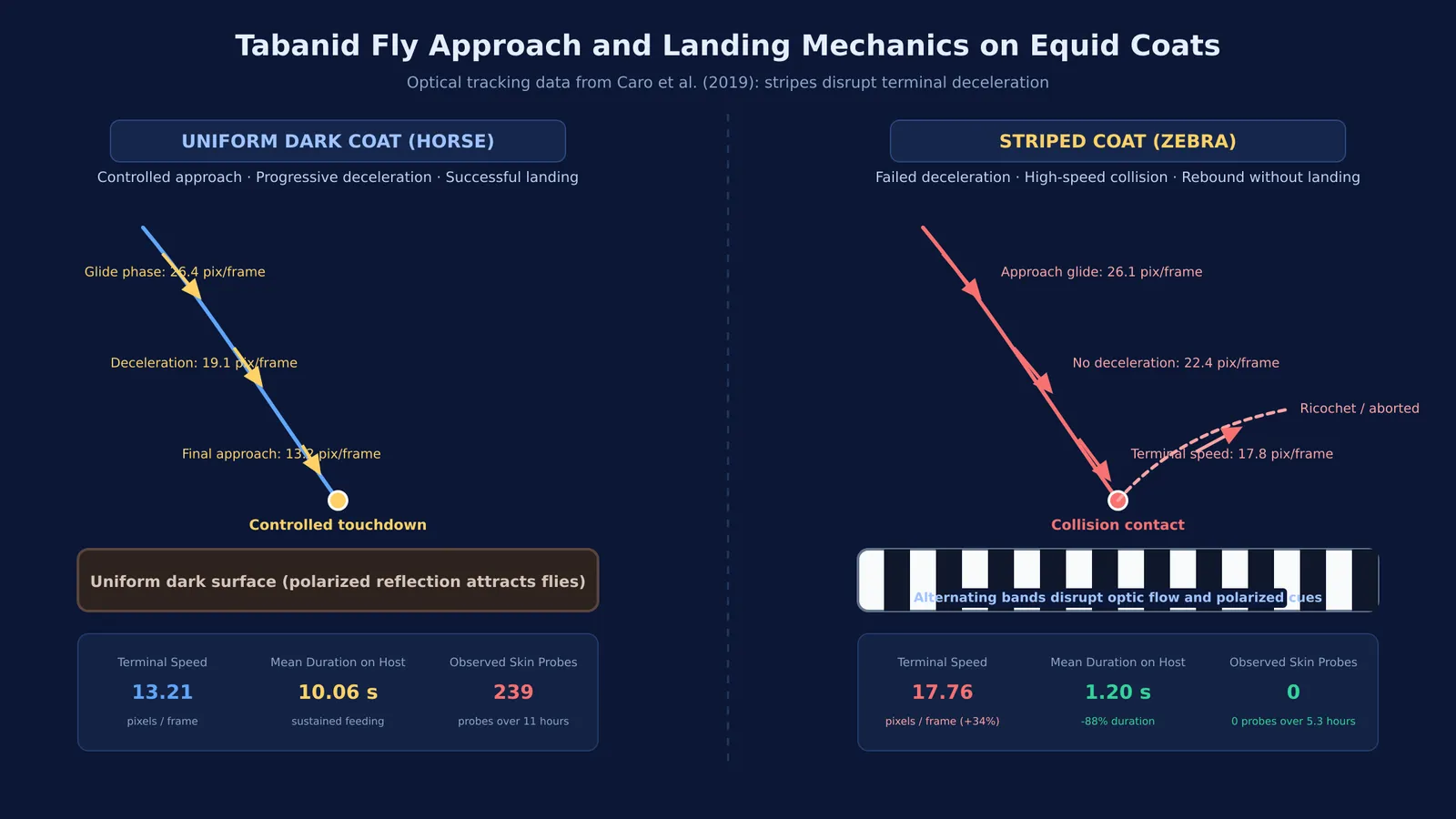
To evaluate flight mechanics, Tim Caro, Martin How, and co-authors published a 2019 field experiment in PLOS ONE. Researchers dressed domestic horses in striped coats alongside zebras and plain-coloured horses. High-speed video showed that tabanid flies approached striped coats at a median speed of 17.76 pixels per frame compared to 13.21 pixels per frame near horses. Flies failed to decelerate before contact, repeatedly colliding with striped coats and bouncing off.
These insect attacks impose severe costs: biting flies carry lethal pathogens like trypanosomiasis, and zebras have shorter hair than other African herbivores. In the same PLOS ONE field trials, tabanids remained on zebras for an average of just 1.20 seconds compared to 10.06 seconds on domestic horses. Observers recorded 0 skin probes on zebras across 5.3 hours of observation, compared to 239 probes on horses over 11 hours.
Agricultural tests confirmed the effect. In a 2019 study in PLOS ONE, Tomoki Kojima and colleagues painted 4–5 cm wide stripes on Japanese Black cattle. Striped cows experienced 50% fewer biting flies, and fly-repelling behaviors dropped from 53.0–54.4 actions per 30 minutes to 39.8 actions.
Did stripes evolve to confuse lions and other predators?
A classic textbook idea suggests stripes confuse chasing predators through motion dazzle. Amanda Melin and colleagues tested carnivore optics in PLOS ONE by filtering photographs through spatial models of lion and hyena vision.
The PLOS ONE spatial vision model showed that human vision overestimates predator perception. In daylight, humans resolve stripes up to 180 metres away, while lions resolve them only up to 80 metres, and spotted hyenas up to 48 metres. At twilight, lions resolve stripes only within 46 metres, and hyenas within 26 metres. On moonless nights, the threshold drops to 11 metres for lions and 7 metres for hyenas. At these ranges, carnivores detect prey by scent and hearing long before seeing stripes. Although protective coloration often evolves in complex ways, as seen in Henry Walter Bates and the butterflies that copy others, lions kill zebras in direct proportion to their abundance.
Do zebra stripes create cooling convective air currents?
Another popular proposal is thermoregulation: alternating black and white bands might create micro-convection currents that cool the skin. Brenda Larison and colleagues noted in Royal Society Open Science that across 29 environmental variables, regional temperature predicted stripe definition across plains zebra populations.
However, direct thermal tests contradicted this mechanism. In Scientific Reports, Gábor Horváth and colleagues monitored water-filled metal barrels wrapped in zebra, horse, and cattle hides over four months in open sunlight. Striped barrels showed no significant core temperature difference compared to uniform grey barrels of matched reflectance, and gentle breezes dismantled simulated eddies. Natural selection balances such competing pressures, illustrating the trade-offs found in stabilising, directional and disruptive selection.
How can students evaluate competing scientific claims?
When evaluating competing evolutionary hypotheses, students can apply a four-step framework:
Map geographic covariance: Verify whether the trait's variation aligns with the geographic intensity of the proposed selective agent.
Model receiver sensory acuity: Examine the trait through the eyes and senses of the target organism rather than human perception.
Test physical interventions: Isolate variables using artificial covers, paint, or physical models while holding others constant.
Quantify terminal fitness costs: Measure tangible survival outcomes, such as parasite feeding duration or disease exposure.
When exploring complex evolutionary adaptations and isolating multiple interacting variables, the Fermi Concept Library covers every concept in physics, chemistry, biology, mathematics and computing, each with its own lesson and its place in the map. For practice analyzing ecological data and multi-step genetics problems, the Fermi Problem Library provides worked problems with a step-by-step solver that explains the reasoning rather than printing an answer.


