

On this page
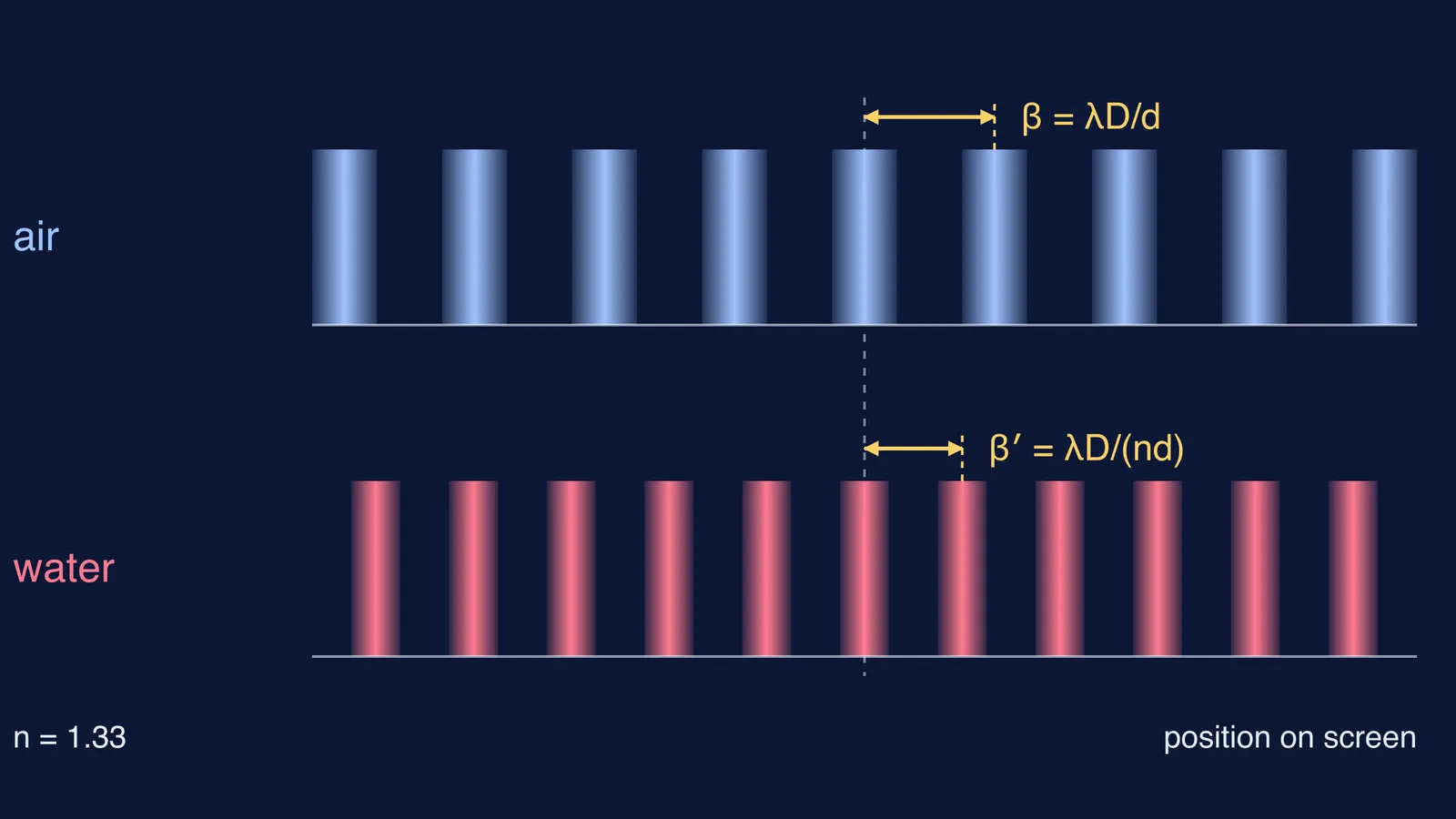
Put the whole Young's double-slit experiment in a tank of water and the bright and dark bands on the screen move closer together. Nothing about the slits or the screen changed. The light did: inside water its wavelength is shorter, and fringe width is proportional to wavelength. Here is the derivation in three lines, a worked number, and the traps that turn this into a JEE question.
What is fringe width in YDSE?
In NCERT's Class 12 Wave Optics chapter, bright fringes sit at x = mλD/d, where d is the slit separation, D the slit-to-screen distance and m = 0, ±1, ±2 and so on (Eq. 10.13; NCERT writes the order as n, but in this post n is the refractive index). Neighbouring bright fringes are therefore λD/d apart, and the same chapter notes that bright and dark fringes are equally spaced. That spacing is the fringe width: β = λD/d.
Why does fringe width decrease when YDSE is immersed in water?
Because the wavelength in water is shorter. The same NCERT Wave Optics chapter shows, using Huygens' construction, that v₁/λ₁ = v₂/λ₂ (Eq. 10.7): when a wave enters a denser medium, its speed and wavelength decrease but its frequency stays the same. With refractive index defined as n = c/v (Eq. 10.4), light of vacuum wavelength λ has wavelength λ/n in a medium of refractive index n.
Swap λ for λ/n in the fringe-width formula:
β′ = (λ/n)D/d = λD/(nd) = β/n
Nothing else in the formula changes. D and d are lengths of the apparatus, and water does not move the slits.
There is a second way to see it that helps with harder problems. In a medium, what matters is the optical path difference: n times the geometric path difference. A bright fringe needs n(S₂P − S₁P) = mλ, so the geometric path difference for each fringe is n times smaller than in air, and so is each fringe's distance from the centre.
Worked example: how much narrower do the fringes get in water?
Take λ = 600 nm, d = 0.5 mm and D = 1.0 m, and use n = 1.33 for water, the value listed in Table 9.1 of NCERT's Class 12 Ray Optics chapter.
In air: β = λD/d = (600 × 10⁻⁹ m × 1.0 m) / (0.5 × 10⁻³ m) = 1.2 × 10⁻³ m = 1.2 mm.
In water: β′ = β/n = 1.2 mm / 1.33 ≈ 0.90 mm.
Fractional change: 1 − 1/1.33 ≈ 0.25, so each fringe is about 25% narrower.
Counting fringes: a 12 mm strip of screen holds 10 fringe widths in air and about 13 in water (12 / 0.90).
The central bright fringe stays at the centre, where the path difference is zero in any medium.
Two things an examiner may slip in: the refractive index written as μ instead of n (same thing), and a question about angular fringe width, which is λ/d in air, becomes λ/(nd) in water and shrinks by the same factor.
If the picture still feels abstract, the Fermi Simulation Lab has interactive simulations for ideas that are easier to see than to read.
What if only part of the apparatus is in water?
Questions often fill just one region. Ask yourself where the path difference between the two waves is created.
Slits to screen in water, source side in air: β′ = λD/(nd). The waves from S₁ and S₂ build up their path difference on the way to the screen, so this is the region that counts.
Source to slits in water, slits to screen in air, source on the central line: β is unchanged. Both waves cover equal distances through the water, are delayed equally, and are back to wavelength λ after the slits.
A thin glass or mica sheet over one slit: the width stays λD/d, but the whole pattern shifts. Our guide to fringe shift from a glass sheet in YDSE works through the direction and size of that shift.
How do you avoid mistakes in YDSE-in-a-medium questions?
Run this checklist before you write a single formula:
Mark which region holds the liquid.
Replace λ with λ/n only in that region.
Divide, never multiply: fringes in a denser medium are narrower.
Keep D and d as given; the medium does not change the geometry.
If the question asks how many fringes fit in a fixed width, the count goes up by a factor of n, the same reasoning as how many fringes fit when the wavelength changes.
For more variations on this setup, see our set of Young's double-slit fringe width problems and traps.
When you want to check your own working on a numerical like this, the Fermi Problem Library has worked problems with a step-by-step solver that explains the reasoning rather than printing an answer.


