

On this page
It is a common scenario: you are sitting in the back of a car or a bus, trying to read a book or look at your phone. Within minutes, a cold sweat breaks out, and a wave of nausea hits. Yet, the person driving the car feels perfectly fine.
Motion sickness is an evolutionary quirk. Your body is incredibly good at tracking its position in space, but modern transport feeds it conflicting data.
Why do some people feel sick in a moving car or bus?
You feel sick because of a sensory mismatch. When you sit in a moving car, your vestibular system—the balance centre inside your inner ear—detects the acceleration, braking, and turning of the vehicle. However, if your eyes are fixed on the seat in front of you or a book, your visual system reports that you are completely stationary.
Your brain is forced to process two conflicting signals: one saying "we are moving" and the other saying "we are still." About 1 in 3 people are highly susceptible to motion sickness, according to the US National Institutes of Health (MedlinePlus).
How does the inner ear sense motion?
The secret to balance lies deep inside your skull. The inner ear contains three fluid-filled loops called the semicircular canals, each oriented in a different dimension. As the car corners or goes over a bump, the fluid inside these canals sloshes around, bending tiny hair cells.
These hair cells send electrical impulses to the brain, detailing your exact acceleration, as part of the body's control and coordination system. (You can read more about how the brain processes these signals in our guide to the parts of the human brain). Your muscles and joints also chip in, feeling the mechanical pressure of the seat as the vehicle turns. All of this confirms physical motion.
Why does it cause nausea?
If the brain simply noted a mismatch, why does it trigger such a violent physical reaction?
Scientists explain this using the "toxin hypothesis." For most of human history, the only time our eyes and our inner ears violently disagreed was when a person had ingested a neurotoxin. The brain interprets the conflicting sensory signals as a hallucination brought on by poisoning. To protect you, it triggers an immediate defensive response: nausea and vomiting to clear the suspected toxin from your stomach.
Is there a specific motion that makes it worse?
Not all movement is equally nauseating. The slow, heaving sway of a ship or the winding turns of a coach bus are far more likely to make you sick than the rapid vibrations of a train.
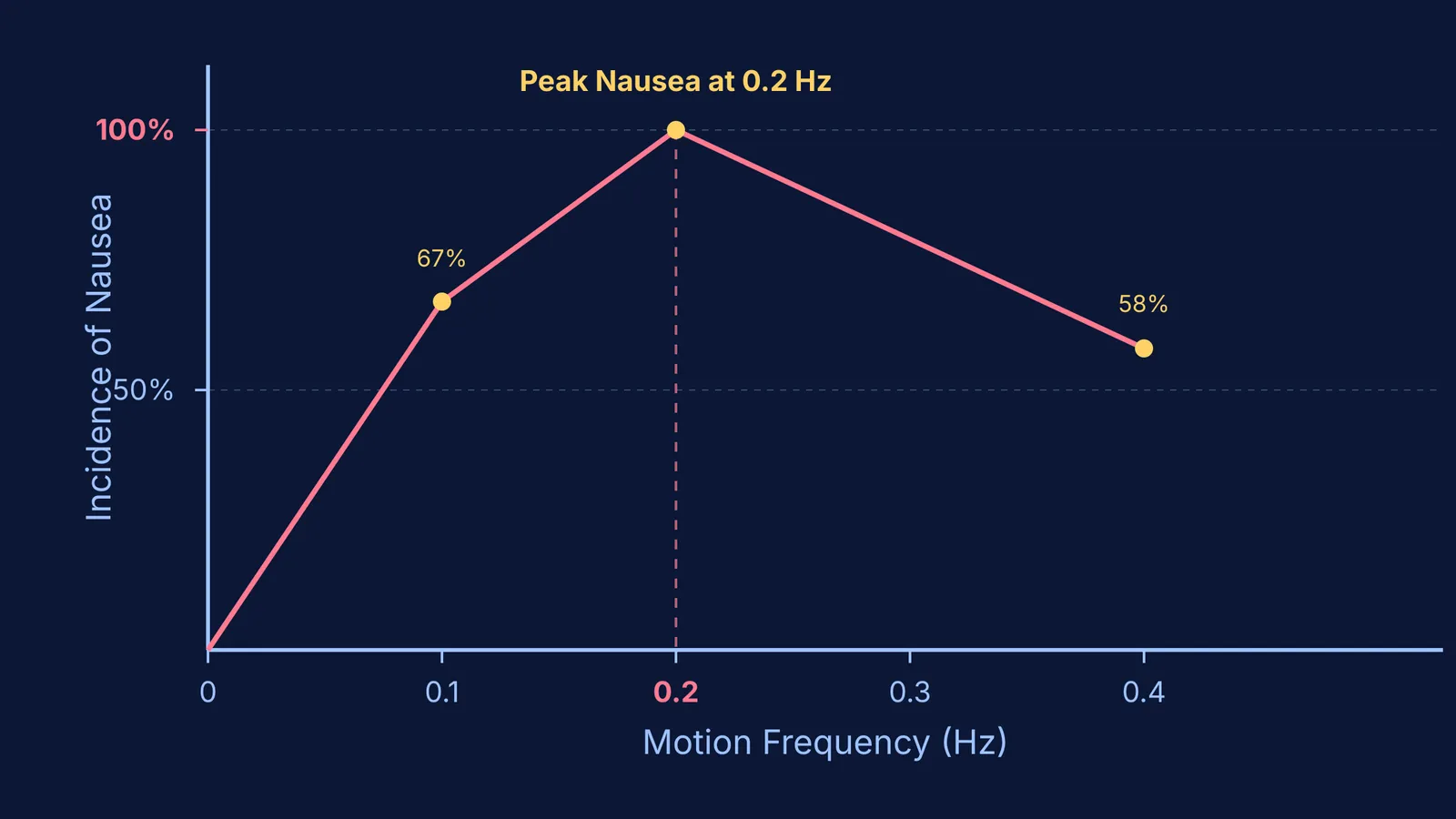
In a landmark study, researchers found that the frequency most likely to induce sickness is exactly 0.2 Hz—which translates to one full cycle of motion every five seconds (Golding et al., 2001). In their experiment, 100% of participants exposed to a 0.2 Hz rocking motion reached moderate nausea in an average of just 11.2 minutes.
This is exactly the frequency of a large boat riding ocean swells, or a bus navigating wide mountain curves. When you study mechanics, you realise that acceleration is not just about changing speed; it is also about changing direction. The Fermi Simulation Lab lets you explore the physics of acceleration, so you can see why the forces on a body change even when a vehicle's speed is constant.
How to stop the sensory mismatch
If you understand the biology, you can outsmart the nausea. The goal is to align what you see with what you feel.
Look at the horizon: Staring at a distant mountain or the road ahead gives your eyes the visual proof of motion that your inner ear is feeling.
Sit in the front: The front seat of a car or bus offers the widest field of view, helping your brain predict the turns before they happen.
Put the screens away: Reading a book or looking at a phone forces your eyes to focus on a stationary object, maximising the sensory conflict.
Be the driver: Drivers rarely get motion sickness because their visual focus is entirely on the road, and their motor commands anticipate every movement.
The next time you feel a wave of nausea on a road trip, remember that you are not actually sick. Your brain is simply trying to protect you from a poison that does not exist, triggered by the physics of a moving vehicle.


