

On this page
Why does a temple bell keep ringing for so long?
Strike a suspended steel rod or a brass plate, and the sound dies within two or three seconds. Strike a heavy bronze temple bell (*ghanta*), and as acousticians Neville H. Fletcher and Thomas D. Rossing document in The Physics of Musical Instruments, a single strike rings for 15 to 30 seconds, accompanied by a rhythmic, pulsating hum.
This persistence results from three physical factors:
Low material damping: High-tin bell bronze loses almost no energy to internal friction in its crystal lattice.
Acoustic radiation mismatch: The fundamental flexural vibration mode acts as an acoustic quadrupole, which radiates sound into the air very slowly at low frequencies.
Large stored energy: The massive bronze shell stores substantial vibrational energy from the clapper impulse, releasing it only at a trickle.
How does bell metal bronze prevent vibrational damping?
When any metal vibrates, cyclic deformation causes internal friction: dislocation motion and thermoelastic heat transfer convert mechanical energy into heat. Most metals, such as mild steel or lead, damp vibrations within a few cycles.
Temple bells avoid this through metallurgy. As documented by Sharada Srinivasan in South Asian Studies, traditional Indian bell metal (*kāṁsa*) is a high-tin bronze of approximately 78% copper and 22% tin by weight. Hot-forging and rapid quenching retain a fine beta-phase microstructure with remarkably low internal friction.
In The Physics of Musical Instruments, Neville H. Fletcher and Thomas D. Rossing show that bell bronze achieves a mechanical quality factor Q between 1,000 and 3,000. Because Q represents 2π times the stored energy divided by the energy lost per cycle, a Q of 1,000 means the bell loses under 0.1% of its vibrational energy each cycle. A study by D. Cekus and M. Nadolski in the Archives of Metallurgy and Materials confirmed that increasing tin content up to 20% by weight significantly enhances elastic modulus in cast bells.
To explore how mechanical damping corresponds to electrical resistance, the Fermi Concept Library explains quality factor and resonance bandwidth across oscillatory systems.
Why does the bell radiate its sound energy so slowly?
Even with low internal friction, a bell would silence quickly if it radiated all its vibrational energy into the air at once. The delay comes from shell vibration geometry.
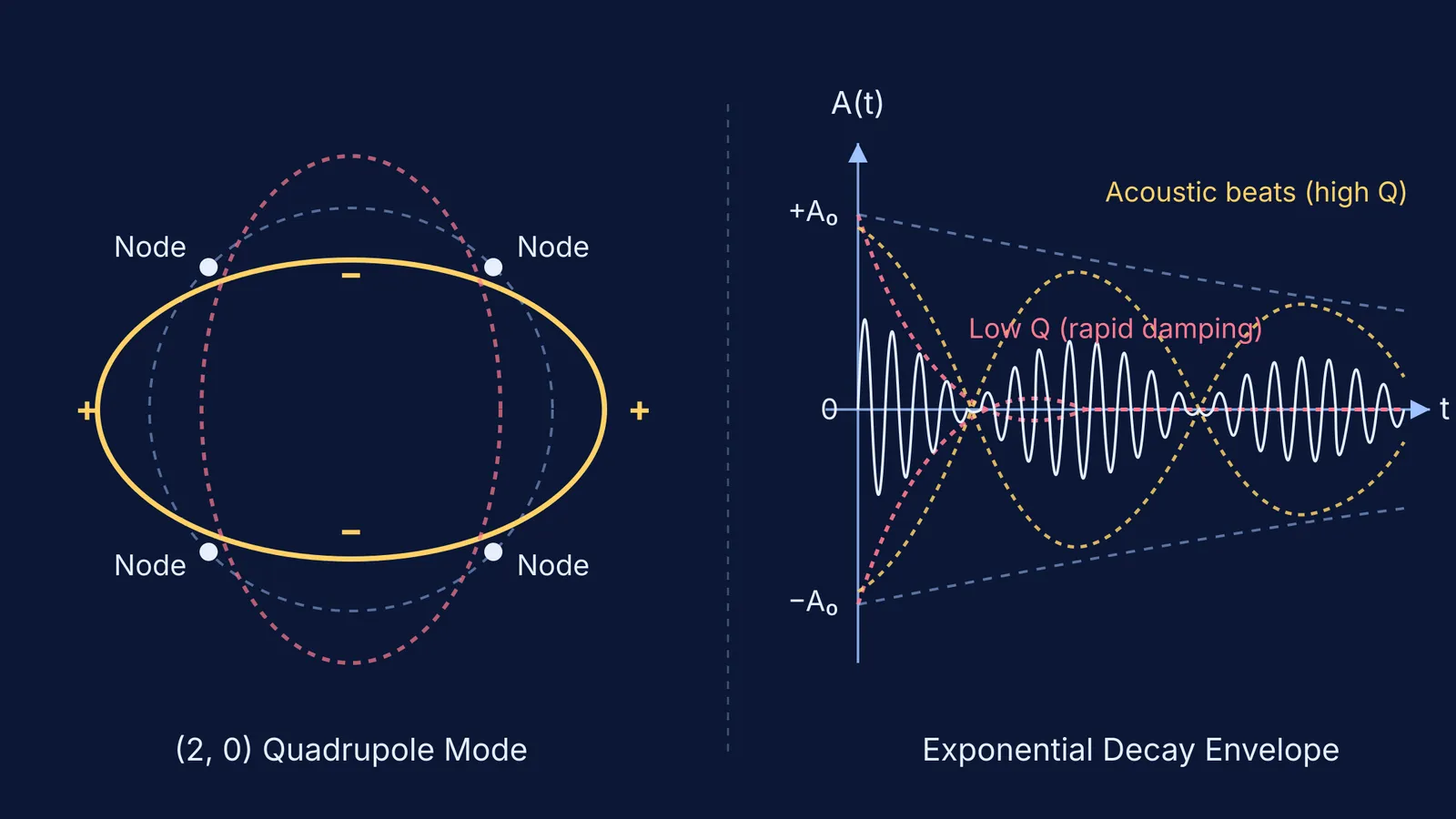
When struck, the bell vibrates in flexural standing modes. As Thomas D. Rossing showed in the Journal of the Acoustical Society of Japan, bell modes are indexed as (m, n), with m nodal meridians and n nodal rings, forming nodal lines akin to Ernst Chladni's nodal figures on vibrating surfaces.
The bell's longest-lasting resonance is the (2, 0) hum tone:
The rim distorts into an ellipse, oscillating between perpendicular orientations twice per cycle.
Four stationary nodal lines space 90° apart along the circumference, separated by four antinodes.
Adjacent quadrants oscillate in anti-phase: one quadrant moves outward to compress air while neighbors move inward.
At 200 Hz, the acoustic wavelength (λ ≈ 1.7 meters) exceeds the circumference of a typical temple bell (0.5 to 1.2 meters). Out-of-phase quadrants cancel each other in the near field, causing air to slosh back and forth rather than launching an efficient sound wave.
This quadrupole cancellation suppresses radiation damping. While higher modes radiate quickly and fade within 1 to 3 seconds, the hum leaks energy at only a few milliwatts, sustaining audible sound long after impact.
Interactive models in the Fermi Simulation Lab let you visualize how quadrupole standing waves deform and interact with air.
What causes the pulsing acoustic beats in a temple bell?
A ringing temple bell does not fade monotonically. Instead, its volume swells and subsides rhythmically—a rolling warble occurring once or twice every second.
This pulsation arises from acoustic beats between adjacent frequencies. In a perfectly symmetrical bell, both orthogonal orientations of the (2, 0) mode share an identical frequency. As Thomas D. Rossing explains in the Journal of the Acoustical Society of Japan, millimeter-scale variations in casting thickness break this rotational symmetry, splitting the mode into an acoustic doublet with two distinct frequencies, f₁ and f₂. When struck, their superposition yields:
s(t) = 2 A(t) cos(2π × [(f₁ − f₂) / 2] t) cos(2π × [(f₁ + f₂) / 2] t)
The ear hears the mean pitch, while amplitude pulses at the beat frequency f_beat = |f₁ − f₂|. For doublet modes near 216.0 Hz and 217.5 Hz, beating occurs at 1.5 Hz, preventing auditory fatigue and sustaining perceived presence.
How to calculate the decay time of a ringing bell?
As detailed in Fletcher and Rossing's The Physics of Musical Instruments, a vibrating system's amplitude decays exponentially:
A(t) = A₀ e^(−π f t / Q)
where f is the oscillation frequency and Q is the quality factor.
In acoustics, sustain is measured by reverberation time T₆₀—the time required for sound energy to drop by 60 decibels (a factor of 10⁻⁶ in energy, or 10⁻³ in amplitude):
T₆₀ ≈ (6.908 Q) / (π f) ≈ 2.2 Q / f
Worked decay calculation:
Consider a bronze temple bell with:
Fundamental hum frequency f = 200 Hz
Loaded quality factor Q = 1,800 (combining material and radiation damping)
Using the decay formula:
T₆₀ = 2.2 × 1,800 / 200 = 19.8 seconds
The sound takes nearly 20 seconds to drop by 60 decibels. Because an initial strike generates peak levels of 85 to 95 decibels, the residual hum remains audible above a quiet 30-decibel background for well over 20 seconds.


