

On this page
When you watch a 100-metre sprint, you are seeing a delicate balance between muscular power and track friction. A runner's top speed is not just limited by how hard their legs can push, but by how well their shoes grip the track.
Without enough grip, the explosive force of a sprinter's leg simply causes the foot to slide backwards, wasting energy. This is where track spikes come in. They alter the physics of the foot-to-ground interaction, allowing athletes to convert more of their effort into forward motion.
Why do sprinters wear spiked running shoes?
The primary advantage of spiked shoes is traction. Standard running shoes rely entirely on surface friction between the rubber sole and the track. Sprint spikes, however, feature small metal pins that penetrate the synthetic track surface.
This penetration creates a mechanical interlock. The runner is no longer just resting on the track; their shoe is physically anchored into it. A 2018 study published in RICYDE analysed the biomechanics of male sprinters and found that wearing spikes improved 40-metre sprint times by 2.6% compared to standard running trainers.
The researchers broke this improvement down into two factors. The "cleat effect"—the superior grip provided by the pins—accounted for a 1.8% increase in performance by allowing a longer stride length without slipping. The remaining 0.8% came from the "mass effect," as track spikes are significantly lighter than standard shoes, making it easier to swing the leg forward.
How does Newton's third law apply to sprinting?
To understand why that grip is necessary, we have to look at the forces involved in running. Newton's third law of motion states that for every action, there is an equal and opposite reaction.
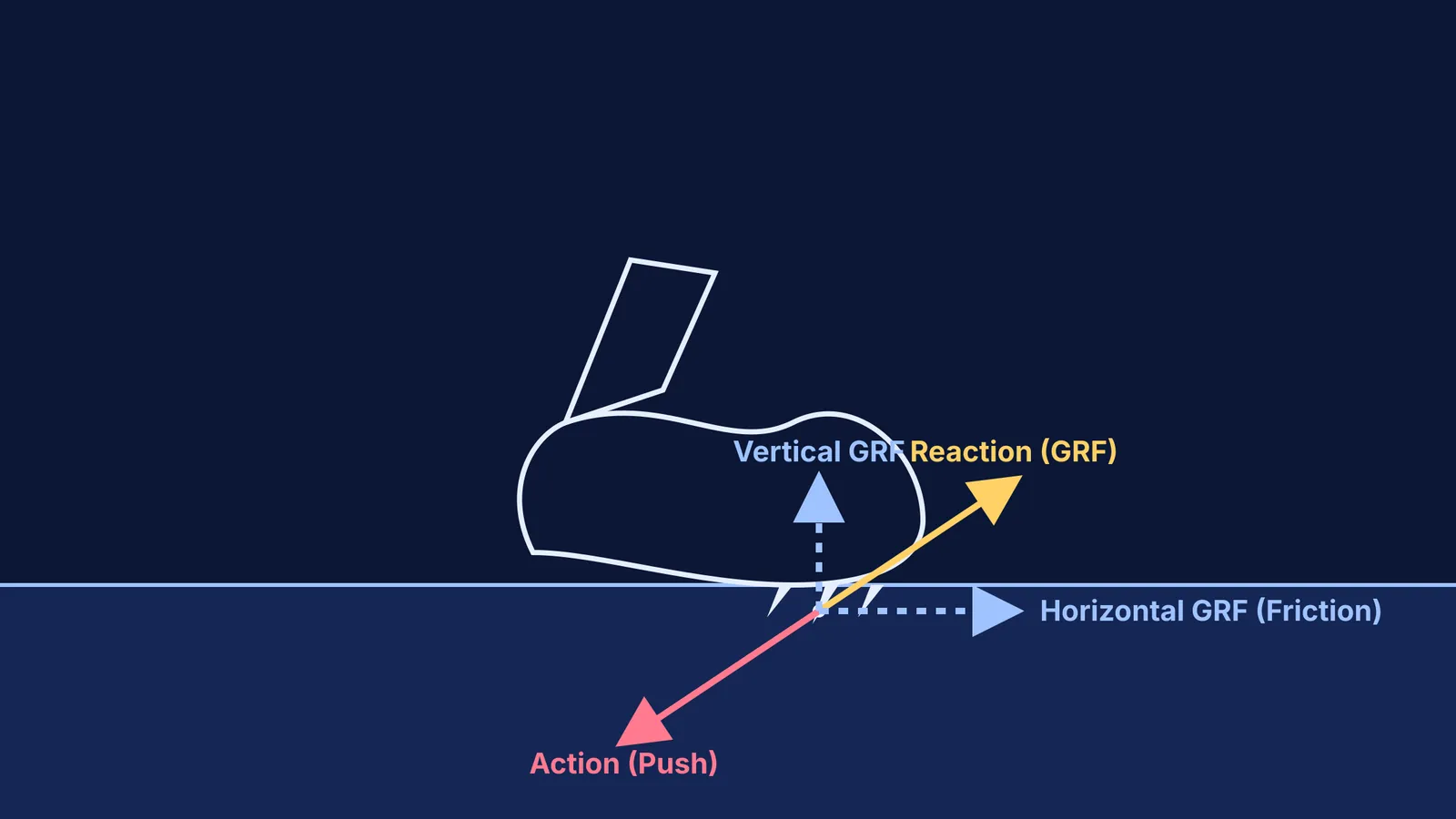
When a sprinter accelerates, their foot pushes downwards and backwards against the track. This is the action force. The track immediately pushes upwards and forwards against the foot. This opposite push is called the ground reaction force (GRF), and it is what actually propels the runner down the track.
The GRF has two components:
Vertical Ground Reaction Force (vGRF): The upward force that supports the runner's body weight and counters gravity.
Horizontal Ground Reaction Force (hGRF): The forward force that causes acceleration.
To speed up quickly, a sprinter must maximize their hGRF. They do this by leaning forward and driving their feet backwards at a steep angle. If you are struggling to visualise hard physics ideas like resolving force vectors into horizontal and vertical components, drawing a free-body diagram of the foot is the best place to start.
What is the required coefficient of friction?
In physics, the coefficient of friction (μ) is the ratio of the friction force to the normal force. For a sprinter, the friction holding the foot in place must perfectly match the horizontal force they are applying.
We call this the Required Coefficient of Friction (RCOF). It is calculated by dividing the horizontal force by the vertical force:
RCOF = hGRF / vGRF
During the first few steps out of the starting blocks, elite sprinters lean forward aggressively to direct the majority of their power horizontally. Because the horizontal force is so high relative to the vertical force, the RCOF can exceed 1.0.
A standard rubber shoe on a synthetic track typically has an available friction coefficient of roughly 0.5 to 0.8. If a runner needs an RCOF of 1.1 to accelerate without slipping, a rubber sole will fail. The metal spikes bypass this surface limit by hooking into the track, providing an effective friction coefficient high enough to handle the sprinter's immense power.
If you want to explore how varying the coefficient of friction changes an object's acceleration, the Fermi Simulation Lab has interactive simulations for the ideas that are easier to see than to read.
Worked example: Checking friction limits
To see how this works in practice, imagine a 75 kg sprinter launching from the blocks. Suppose their foot strikes the ground applying a vertical force of 800 N and a horizontal backward thrust of 960 N.
Identify the forces: The track must provide a vGRF of 800 N and an hGRF of 960 N to match the sprinter's push.
Calculate the RCOF: Divide the horizontal component by the vertical component.
RCOF = 960 / 800 = 1.2.
Compare with the surface limit: A standard shoe has a friction coefficient of 0.8. Since 1.2 is greater than 0.8, the runner's foot will slip backwards.
Because they are wearing spikes, the mechanical grip easily provides the necessary 1.2 coefficient, and the full 960 N of force is successfully converted into forward acceleration. (Sometimes a problem asks you to use energy conservation instead of Newton's laws, but for traction and slipping, resolving forces is always the correct method).
If you are stuck on a mechanics question like this one, the Fermi Problem Library has worked problems with a step-by-step solver that explains the reasoning rather than printing an answer.


