

On this page
When you look up at the night sky, you see a dark void dotted with stars. But during the day on Earth, the sky is a brilliant blue. Given that the Sun is a star shining continuously in space, it seems natural to expect interplanetary space to be just as bright. The reason it is not comes down to how light behaves when it travels through a vacuum without matter to intercept it.
Why is space black even though the Sun is shining?
Light travels through space in straight lines as electromagnetic waves. You can only see a beam of light if photons enter your eye directly from a source or reflect off an object into your pupil. According to NASA's Space Place, light continues in a straight path unless something gets in the way to reflect it, bend it, or scatter it.
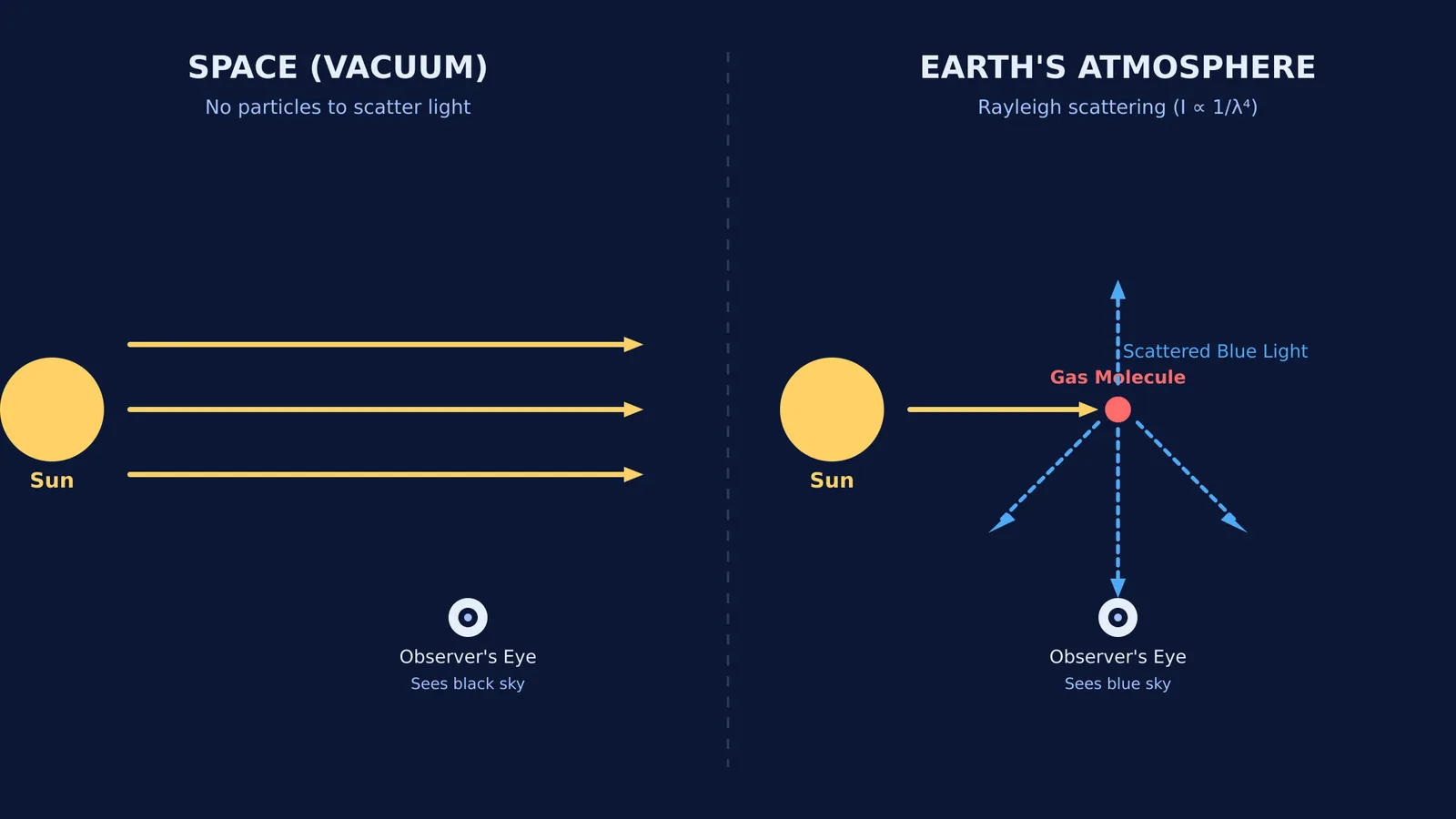
If you stood on the Moon during the lunar day and looked away from the Sun, the sky above you would appear pitch black. The Sun's rays stream continuously through the surrounding space, but because the Moon has no substantial atmosphere, there is no air, water droplet, or dust layer to redirect those rays toward your eyes. Without photons bouncing toward your line of sight, the background of space registers as pure darkness.
Because light travels invisibly until it encounters matter, picturing how rays propagate through a vacuum versus a scattering medium can be challenging. For the ideas that are easier to see than to read, the Fermi Simulation Lab provides interactive simulations that show ray propagation and scattering in real time.
How empty is the vacuum of space?
Space is often described as empty, but it is technically an extremely dilute gas and dust mixture known as the interstellar medium. According to Ohio State University's astronomy lectures, the interstellar medium consists of roughly 99% gas and 1% dust, and its lowest-density regions contain just 0.1 atoms per cubic centimetre.
By comparison, the air we breathe at sea level on Earth contains roughly 10¹⁹ molecules in every cubic centimetre. This vast difference in density explains why sunlight behaves so differently on Earth compared to space. Within Earth's atmosphere, every beam of sunlight passes through billions of gas molecules in every centimetre of its path. In deep space, particle density is so low that starlight travels astronomical distances without encountering enough matter to produce perceptible scattering.
How does atmospheric scattering make the sky bright?
Earth's bright daytime sky is created by our dense atmosphere redirecting sunlight. Sunlight comprises a continuous spectrum of visible wavelengths, from longer red wavelengths to shorter violet wavelengths. When these electromagnetic waves enter the atmosphere, they interact with nitrogen and oxygen molecules that are much smaller than the wavelength of light.
This interaction causes Rayleigh scattering. In 1871, Lord Rayleigh published a foundational derivation in the *Philosophical Magazine* demonstrating that the intensity of scattered light is inversely proportional to the fourth power of its wavelength (I ∝ 1/λ⁴). Because blue and violet wavelengths are roughly half the length of red wavelengths, they scatter roughly ten times more strongly.
This preferential scattering redirects blue light across the sky in all directions. Wherever you look during a clear day, scattered blue photons enter your eyes, creating the impression of a bright blue ceiling. You can explore this further in our overview of the scattering of light and how the sky gets its colour, or examine related phenomena in our guide to C. V. Raman and the Raman effect.
Is space actually filled with invisible light?
Although space appears pitch black to human vision, it is not completely devoid of radiation. The cosmos is permeated by the Cosmic Microwave Background (CMB), the relic thermal radiation released after the Big Bang.
Because the universe has expanded, this primordial radiation has cooled, shifting into the microwave band. Human photoreceptors detect only the narrow visible spectrum. If our eyes were sensitive to microwaves, the night sky would glow with nearly uniform brightness in every direction.
How can you demonstrate light scattering at home?
You can demonstrate why light remains invisible without scattering particles using a simple classroom or home demonstration:
Turn off the lights in a room until it is completely dark.
Direct the beam of a bright torch horizontally across the room, ensuring the beam does not hit furniture or walls near you.
Observe the beam from the side. Through clean air, the path of the light beam itself is faint or virtually invisible.
Clap two dusty chalk erasers together or spray a light aerosol mist across the path of the beam.
A bright shaft of light instantly appears along the beam's trajectory.
The chalk dust or water droplets act like an artificial atmosphere, scattering photons out of the primary beam and directly into your eyes. When the dust settles, the beam disappears from view again, mimicking the clear emptiness of space. Learn more about ray-tracing in our guide on reflection and refraction of light in Class 10.


