On this page
Why is yellow more visible than red to the human eye?
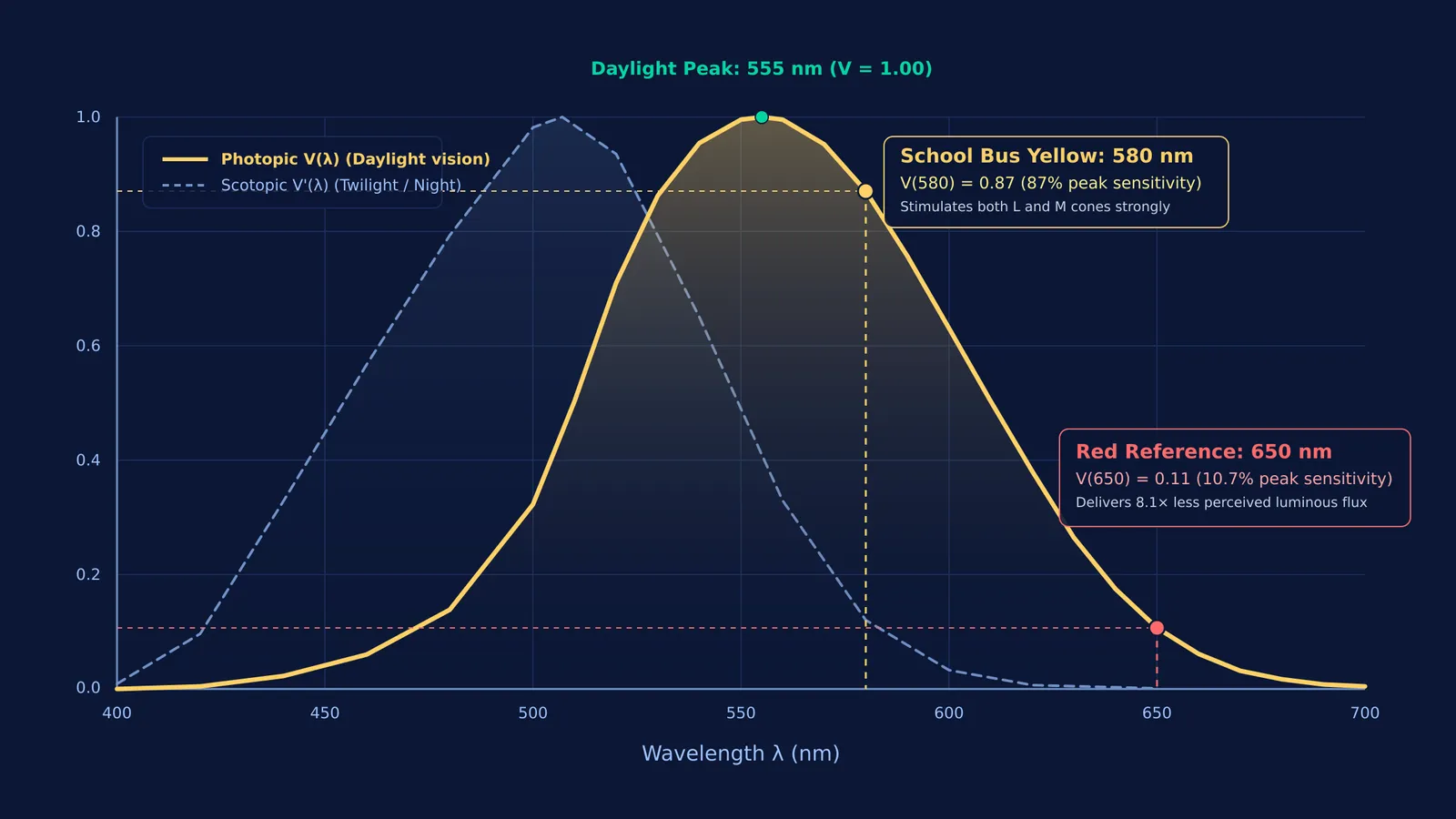
Most people assume red is the most conspicuous colour on the road, but human daylight vision is governed by the photopic spectral luminous efficiency function V(λ) standardized by the CIE. Peak daytime sensitivity occurs at 555 nm in the yellow-green band. At 580 nm—the wavelength of school bus yellow—the eye's relative luminous efficiency is 0.8700 (87% of peak sensitivity). In contrast, red light at 650 nm drops to 0.1070 (10.7%). As research on cone photoreceptors in Vision Research00021-3) demonstrates, color vision depends on long-wavelength (L) cones peaking near 564 nm and middle-wavelength (M) cones peaking near 534 nm. Yellow light stimulates both L and M cones simultaneously, generating an intense combined luminance signal.
A luminous flux calculation shows the difference. For two vehicle panels reflecting 1.0 W/m² of radiant power—one yellow at 580 nm and one red at 650 nm:
Flux formula: Φv = 683 × P × V(λ) lm/m², with maximum efficacy 683 lm/W.
Yellow panel: 683 × 1.0 × 0.870 = 594.21 lm/m².
Red panel: 683 × 1.0 × 0.107 = 73.08 lm/m².
Ratio: 594.21 / 73.08 = 8.13.
The yellow panel delivers over 8 times more perceived brightness than red for identical radiant power. Our guide on how retinal photoreceptors process light wavelengths explains how cone genetics shape this sensitivity.
How does peripheral vision detect school buses faster?
A school bus must alert drivers approaching from side streets or glancing away from the road. While the central fovea provides sharp color vision, cone density drops sharply in the periphery. Research on peripheral colour mechanisms in Vision Research90249-2) demonstrates that rod signals increasingly modify chromatic perception outside the fovea. Rod photoreceptors have near-zero sensitivity to long red wavelengths above 650 nm. A study in the Journal of Vision found that large chromatic stimuli drive cone-opponent pathways out to 50 degrees eccentricity. Under direct central fixation, reaction-time trials published in Clinical Optometry show that red and yellow light elicit the fastest responses (averaging 208 ms and 216 ms respectively, compared to slower times for green and blue). In peripheral vision, however, because yellow activates both L and M cone mechanisms and peripheral luminance channels, lateral peripheral detection of yellow is roughly 1.24 times greater than for red.
Timing also matters. School buses run in early morning twilight (around 6:30 AM to 8:00 AM), when vision transitions toward rod-dominated scotopic sight. Red darkens rapidly in dim light, while yellow maintains higher mesopic visibility. Yellow wavelengths also scatter less in morning mist than shorter blue waves, an effect detailed in our post on Rayleigh scattering and atmospheric transmission.
Who chose the yellow color for school buses?
In the 1930s, American pupils rode in unstandardised vehicles painted in arbitrary colours, including patriotic red, white, and blue. In April 1939, Dr. Frank W. Cyr, a professor at Columbia University's Teachers College, organised a seven-day national conference in the Grace Dodge Room, funded by a $5,000 grant from the Rockefeller Foundation's General Education Board, as recorded in The New York Times. Cyr gathered officials from 48 states, automotive engineers, and paint chemists from DuPont to review 50 paint strips ranging from pale lemon to deep orange-red.
They selected "National School Bus Chrome" (now National School Bus Glossy Yellow, Federal Standard 595a Color 13432), maintained by the National Highway Traffic Safety Administration (NHTSA) under Highway Safety Program Guideline No. 17. The shade maximized contrast against black lettering in pre-dawn light.
When students study optics, seeing how light waves interact with matter makes abstract formulas concrete. The Fermi Simulation Lab provides interactive simulations for the ideas that are easier to see than to read, allowing learners to test reflection, refraction, and wave phenomena directly.
What are the school bus safety standards in India?
India mandates a similar high-visibility standard. Following the 1997 Wazirabad bridge accident, the Supreme Court of India established binding safety directives in *M.C. Mehta v. Union of India* (AIR 1998 SC 190), codified for schools on the official CBSE portal. Under Automotive Industry Standard AIS-063:
The bus exterior must be painted "Golden Yellow" conforming to Indian Standard IS 5:1994 Shade No. 356.
A horizontal band 150 mm (±10 mm) wide in "Golden Brown" (IS 5 Shade No. 414) must run below the window sill.
Fitted speed governors must limit transit speed to 40 km/h.
Horizontal window grills, an emergency door, fire extinguishers, and an adult attendant are mandatory.
Families reinforcing road awareness can also review safety habits for teens walking during evening commutes. To connect practical vehicle engineering to syllabus optics, the Fermi Concept Library covers every concept in physics, chemistry, biology, mathematics and computing, each with its own lesson and its place in the map.