

On this page
Many teenagers in India travel to and from coaching classes after sunset. Between heavy traffic, poor street lighting, and isolated routes, parents naturally worry when their child walks home in the evening. Building a structured safety routine removes the guesswork from their daily commute.
Why is safety for a teen going to coaching in the evening a major concern?
Pedestrians face significant risks on Indian roads, especially after dark when visibility drops. According to the Road Accidents in India 2022 report published by the Ministry of Road Transport and Highways (MoRTH), pedestrian fatalities reached a record 32,825 in a single year. That averages to approximately 90 pedestrians killed every day, accounting for 19.5% of all road accident deaths.
When a teenager walks home from coaching in the evening, they navigate the exact conditions the report flags: inadequate footpaths, high-speed vehicles, and crowded crossings. Two-wheelers are the vehicles most often involved in these pedestrian accidents, making busy intersections particularly dangerous.
What do the 2024 guidelines for coaching centres say?
In January 2024, the Ministry of Education released the Guidelines for Regulation of Coaching Centers to address student stress and physical safety. To protect students commuting late at night, these guidelines state that coaching classes should not run excessively late in the evening.
The guidelines also mandate that total coaching hours should generally be capped at five hours per day, and that centres must have adequate CCTV coverage, fire safety certificates, and first-aid facilities. When evaluating a coaching institute, checking their adherence to these late-night operating limits and surveillance rules is a concrete way to protect your child.
How to plan the safest route and commute?
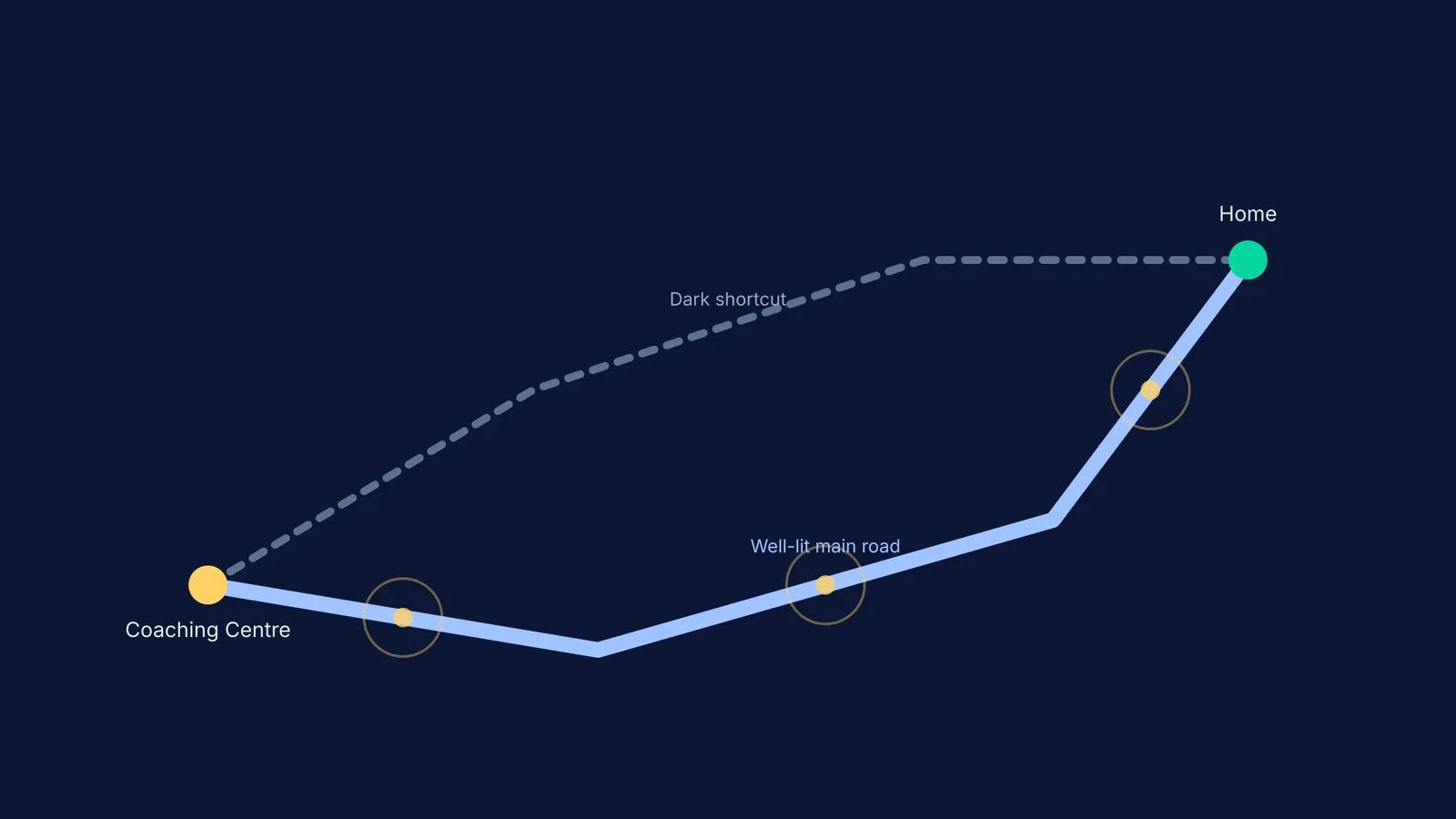
Relying on a standard map app's shortest route is not enough when it gets dark. You and your teenager should plan the commute based on lighting and crowd density.
Stick to main roads: A longer route on a well-lit, busy street is always safer than a quick shortcut through a dark, isolated alley.
Walk facing traffic: If there is no footpath available, walk facing oncoming vehicles so you can see them approaching and step aside if necessary.
The buddy system: Arrange for your teen to walk or commute with classmates who live in the same direction, especially during your child's first year of JEE preparation when they are new to the routine.
Verify cabs and autos: If taking a ride-hailing app, teach your teen to verify the vehicle number before getting in and to use the app's "Share Trip" feature immediately.
Which check-in habits and emergency contacts work best?
An evening routine should ensure you always know where your teenager is without needing constant phone calls.
Share live location: Ask your teen to share their live location via WhatsApp or Google Maps the moment they leave the centre.
Identify safe spots: Map out 24/7 pharmacies, hospitals, or police booths along their route. If they ever feel followed, they should know exactly where they can step inside a public, well-lit space to ask for help.
Speed dial emergency numbers: Ensure 112 (Universal Emergency), 1098 (Childline), and 181 (Women's Helpline) are saved on their phone's speed dial. The official 112 India app also allows users to send an instant SOS with their location.
Finding study momentum after an evening commute
By the time a teenager gets home from an evening class, they are often too tired to decide what to study next. Rather than staring at a blank page, they need a clear starting point. Fermi's AI tutor can work out what you already know and build a plan for the session, so you sit down to a clear next step.
If they are stuck on homework they brought back from coaching, the Fermi Problem Library has worked problems with a step-by-step solver that explains the reasoning rather than printing an answer.
A reliable evening commute removes daily anxiety for both you and your teenager. Sit down together this weekend, trace their route on a map, and program the emergency numbers into their phone.


