

On this page
Open a salt jar in July and you may find one hard block. The salt has pulled water out of humid air, and the main culprit is usually not sodium chloride at all.
Why does salt become wet and lumpy in the monsoon?
Much of India's salt starts as sea or subsoil brine dried in open solar pans, so it carries other salts from the brine along with the sodium chloride. A patent from India's Council of Scientific and Industrial Research (CSIR) on making purer salt in solar pans cites a 1974 study: sea salt as produced in solar pans contains 0.3 to 0.4% magnesium and 0.16 to 0.18% calcium. The same document says the caking of stored salt "is attributed to the hygroscopic nature of the magnesium impurities present in salt."
Cleaner salt has far less of it. The same study found rain-washed salt down to 0.06% magnesium, and the CSIR process, which treats the brine before the salt crystallises, brought it to about 0.03%.
What is the difference between hygroscopic and deliquescent?
Hygroscopic: a substance that attracts and holds water vapour from the air around it.
Deliquescent: a substance that absorbs so much water vapour that it dissolves in it and becomes a solution.
IUPAC describes deliquescence as what happens when the vapour pressure of a substance's saturated solution is lower than the vapour pressure of water in the surrounding air. In plain words: if the air is wetter than the salt's own solution, water moves from the air into the salt.
Magnesium chloride and sodium chloride are both deliquescent, but at very different humidities, and that gap explains the lumps.
At what humidity does salt start absorbing water?
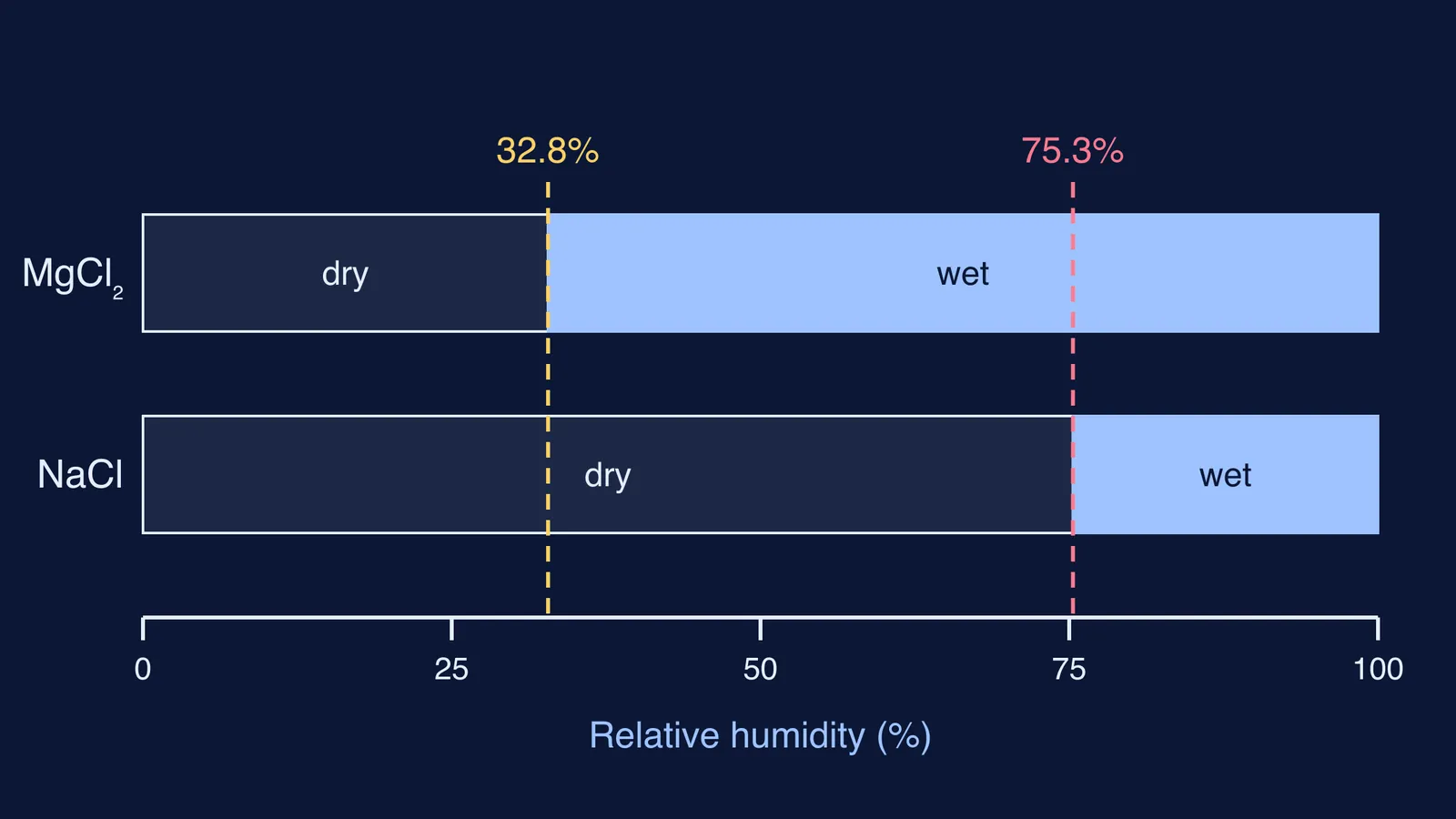
Each salt has a threshold relative humidity: above it, the salt pulls water from the air and dissolves; below it, the salt stays dry. It equals the humidity of air sitting over a saturated solution of that salt. Lewis Greenspan of the US National Bureau of Standards (now NIST) compiled these values for 28 salts in 1977 (Journal of Research of the NBS, vol. 81A).
Magnesium chloride: 32.8% relative humidity at 25 °C.
Sodium chloride: 75.3% relative humidity at 25 °C.
Both barely change between 20 °C and 30 °C, in the same paper's table.
What happens to salt on a humid morning?
At 8:30 am on 1 November 2026, the India Meteorological Department recorded 77% relative humidity at Mumbai-Santacruz. That is an outdoor reading, but compare it with the two thresholds from Greenspan's table:
77% is above 32.8%, so the magnesium chloride in the salt takes up water and forms a thin brine on the grains.
77% is also just above 75.3%, so even pure sodium chloride at the grain surfaces starts to dissolve into that film.
When the air near the jar dries a little, say near a hot stove or in the afternoon, the water evaporates and the dissolved salt crystallises again where the grains touch. Those new crystals act as bridges that turn loose salt into a lump.
Now picture a day at 50%. Pure sodium chloride would stay dry, but magnesium chloride is well past its threshold. That is why impure salt can cake on days when you would not call the air wet.
How do you stop salt from going lumpy?
You cannot change the weather, but you can keep humid air away from the salt.
Keep salt in a jar with a tight lid, and close it right after use.
Store it away from the stove and kettle, where steam keeps the air very humid.
Use a dry spoon. A wet spoon adds water directly.
In the monsoon, refill a small jar from a sealed packet.
Check the label. India's food regulations list additives permitted in salt, including silicon dioxide, sodium aluminosilicate and ferrocyanides (FSSAI food additive standards, Table 12); the same FSSAI document describes ferrocyanides as an anticaking agent in salt.
Salt that has only clumped can be broken up or ground. If it has picked up a smell or colour, throw it away.
Try it: a two-saucer experiment
You can watch the impurity effect at home.
Put one level teaspoon of loose crystal salt on one saucer and one of refined table salt on another.
Write down which one you expect to get damp first, and why.
Leave both in the bathroom after a hot shower, or near (not on) a pot of boiling water, for an hour.
Press each with a dry spoon. Note which feels damp or sticks together first, then check again for a crust the next morning.
Then explain the result in your own words using the two thresholds.
When an idea is easier to see than to read, the Fermi Simulation Lab has interactive simulations to explore it. To revise the terms properly, the Fermi Concept Library gives each chemistry concept its own lesson.
Next time the jar turns into a block, you will know which salt in it started the trouble.


