

On this page
You find a rubber band at the back of a drawer, stretch it round a stack of notes, and it snaps. Or it is already sticky, or covered in fine cracks. Nothing hit it. The air did. Oxygen, ozone and light slowly cut the long molecules that make rubber stretchy, and once enough are cut, the band fails.
This is school alkene and polymer chemistry, happening on your desk.
What is a rubber band made of?
Natural rubber is a polymer of isoprene, and the double bonds along its chains all have the Z (cis) configuration, as this LibreTexts organic chemistry chapter on diene polymers/14%3A_Conjugated_Compounds_and_Ultraviolet_Spectroscopy/14.07%3A_Diene_Polymers-_Natural_and_Synthetic_Rubbers) explains. Each repeat unit carries one C=C double bond.
In 1839 Charles Goodyear found that heating rubber mixed with sulfur made it tougher and more durable. The process, called vulcanization, builds sulfur bridges between chains (LibreTexts/14%3A_Conjugated_Compounds_and_Ultraviolet_Spectroscopy/14.07%3A_Diene_Polymers-_Natural_and_Synthetic_Rubbers)).
The stretch comes from coiled chains: pulling straightens them, and they spring back because the coiled state is more disordered. Rubber stays elastic only while its chains stay long and connected.
Why do old rubber bands crack and snap?
Three things in ordinary air and light attack those chains.
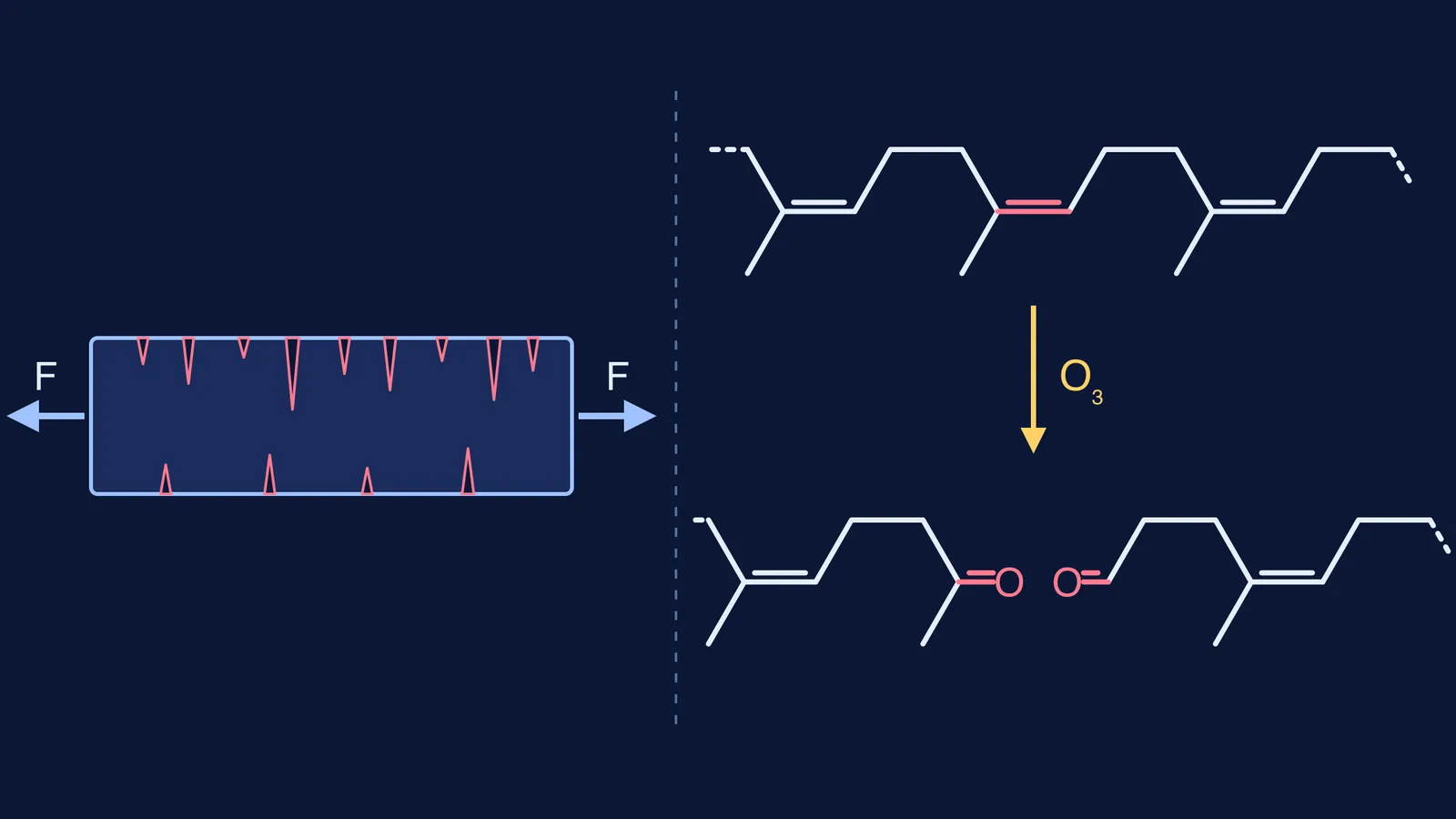
The first is ozone, which cuts the double bonds. Ozone (O3) is present in air in tiny amounts: a 2025 study in Polymers by Kim, Kim and Cho took 0.02 parts per million as the typical level for coastal conditions (Kim et al., Polymers 2025). The same paper states that ozone reacts with the C=C double bonds in rubber and splits the large molecules. In their accelerated tests on a blend of natural and chloroprene rubber, at 0.5 parts per million of ozone, hardness rose markedly over the first 10 days and levelled off after day 12. The authors suggest this was because the reactive double bonds had been used up.
A chemistry-teaching experiment from the University of Wuppertal shows how fast this can be when ozone is made on purpose. Stretched strips (a 1 newton pull for natural rubber, 10 newtons for the others) were exposed to ozone from a UV lamp. Natural rubber turned white, cracked and tore after 10 to 15 minutes. Silicone rubber showed no change, because silicone chains have no C=C double bonds for ozone to attack.
The second and third are light and oxygen, which start a chain reaction. In a second Wuppertal experiment, stretched natural rubber under a mercury lamp for 30 minutes tore under load, turned whitish and went tacky. The explanation given is autoxidation: UV light breaks C-H bonds, the free radicals react with oxygen, and the unstable peroxides that form break down further. The same page notes that the material turns soft and tacky, and can later become brittle.
A 2002 study in Polymer International used atomic force microscopy on natural rubber films exposed to UV light and found the surface became softer, which the authors say is likely due to chain scission (Blach et al., Polymer International).
The end result is a perished band. The Institute of Making's materials library sums it up: over time rubber loses its ability to stretch and becomes hard and brittle, because light and air change the polyisoprene chemically.
Why does a stretched rubber band crack faster?
The Wuppertal ozone experiment explains that an unstretched rubber surface builds up a thin ozonated layer that slows further attack. Tension breaks that layer, exposing fresh rubber to more ozone, and the cracks run at right angles to the pull. A stretched band on a sunny windowsill faces all three attackers at once.
How can you test this at home?
Take four identical bands from one new packet and run this experiment for a few weeks.
Band A: stretched round a jar, on a sunny windowsill.
Band B: loose, on the same windowsill.
Band C: stretched round a jar, inside a closed drawer.
Band D: loose, in a closed box.
Each week, check every band with your phone camera at full zoom: cracks, stickiness, and whether it still stretches as far as a fresh band from the same packet. Wear glasses, as old bands can snap back.
Write your prediction first. The chemistry predicts A fails first and D last. Comparing B with D mainly tests light, and C with D tests stretching, because each pair differs mostly in one thing. That is the controlled-variable reasoning practical exams ask for.
Coiled chains straightening and recoiling are hard to picture from a textbook diagram; the Fermi Simulation Lab has interactive simulations for ideas that are easier to see than to read. If ozonolysis or polymer structure is the gap, the Fermi Concept Library gives each chemistry concept its own lesson.
Next time a band snaps, look at the broken end. The cracks you see are where polymer chains were cut, one double bond at a time.


