On this page
Rajma chawal is a Sunday staple in many Indian homes, and almost every family has a rule about it: soak the beans overnight, cook them until they are completely soft. That rule is not just about taste. It is a piece of protein chemistry that you will meet again in your Class 12 textbook.
What makes raw rajma harmful?
Rajma is the red kidney bean, *Phaseolus vulgaris*, and it carries a natural defence protein called phytohaemagglutinin, or PHA. Lectins are sugar-binding proteins, and PHA is a lectin that can be toxic at high levels, according to the US Food and Drug Administration's Bad Bug Book.pdf), its handbook on foodborne illness.
The same FDA chapter gives the key numbers:
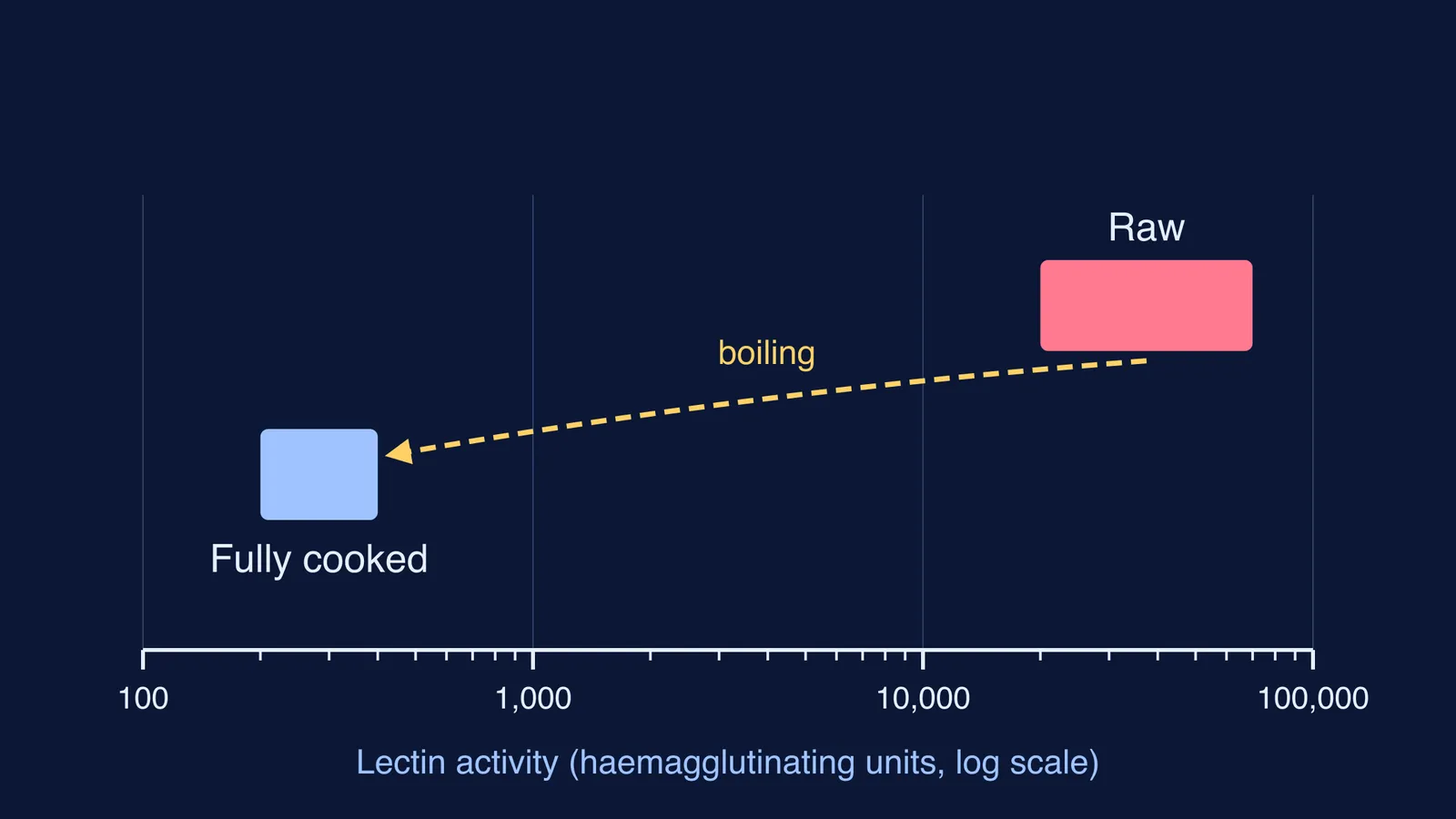
Raw red kidney beans contain 20,000 to 70,000 haemagglutinating units (hau) of PHA, while fully cooked beans contain 200 to 400 hau.
As few as four or five raw beans can trigger symptoms.
Extreme nausea and vomiting usually start 1 to 3 hours after eating, with diarrhoea developing later in that window; some people also report abdominal pain.
Recovery is usually quick, within 3 to 4 hours of the first symptoms, but some cases have needed hospital care.
This is not a rare curiosity. A study of 50 suspected incidents of red kidney bean poisoning reported in the UK between 1976 and 1989 (Rodhouse and colleagues, *Epidemiology and Infection*, 1990) found that in many of the outbreaks the beans had been eaten raw or after an inadequate heat process. Nine incidents were confirmed by finding the haemagglutinin in the beans themselves.
Why does boiling make rajma safe?
Because PHA is a protein, and heat changes proteins. NCERT's Class 12 Chemistry chapter on biomolecules (section 10.2.4) defines denaturation: when a protein is heated or its pH changes, its hydrogen bonds are disturbed, the globules unfold, the helix uncoils and the protein loses its biological activity. The secondary and tertiary structures are destroyed while the primary structure, the amino acid sequence, stays intact.
That is the idea at work in the pot. The FDA says PHA is destroyed by adequate cooking, and a protein losing its biological activity when heated is exactly what NCERT describes, just as egg white sets when you boil an egg, the example NCERT uses. The FDA also notes that the exact way PHA harms the body is not yet known.
How long should rajma be boiled to be safe?
Here temperature matters more than time. A 1983 study by Thompson, Rea and Jenkins in the Journal of Food Science heated red kidney beans at different temperatures and measured the lectin left behind:
At 65°C, there was no significant drop in lectin activity even after 12 hours.
At 80°C, presoaked beans needed 2 hours to fall below detectable levels.
At 100°C, presoaked beans got there in 15 minutes.
Pressure cooking at 15 psi for 45 minutes did the same for beans that had not been soaked.
The FDA's Bad Bug Book.pdf) adds a warning: casseroles cooked in slow cookers often reached internal temperatures of only 75°C or less, which is not enough to destroy the toxin, and several outbreaks have been linked to slow-cooked beans. It also cites an earlier study in which 10 minutes of boiling at 100°C destroyed the toxin, yet it advises at least 30 minutes so the beans reach a high enough temperature for long enough.
The lesson: a long, gentle heat is not a proper boil. In Thompson's study, 12 hours at 65°C brought no significant drop in lectin activity.
How should you soak and boil rajma at home?
Use this checklist next time. Steps 1 to 4 follow the consumer advice in the FDA's Bad Bug Book.pdf), which draws on studies by British scientists.
Soak the dried beans in water for at least 5 hours; overnight is easiest.
Pour the soaking water away.
Boil the beans in fresh water for at least 30 minutes.
Do not cook dried rajma in a slow cooker.
Do not add raw or soaked but uncooked beans to salads or chaat; the FDA says the illness is usually caused by eating raw, soaked beans, alone or in salads or casseroles.
If you pressure-cook, Thompson's team found that 45 minutes at 15 psi brought lectin below detectable levels even without soaking. They also found canned beans had lectin levels similar to beans pressure-cooked for 30 minutes.
What can you take from this into your exams?
Rajma is a good way to remember that a protein's job depends on its shape; NCERT uses boiled egg white and curdled milk as its examples of denaturation. If unfolding feels abstract, the Fermi Simulation Lab has interactive simulations for ideas that are easier to see than to read. To revise protein structure, each concept has its own lesson in the Fermi Concept Library.
Next time you soak rajma overnight, you will know what the heat is doing to it.