

On this page
A popcorn kernel is a sealed container of water and starch. Heat it, and the water becomes steam that cannot escape. Pressure builds until the shell fails, and the starch puffs into the white flake you eat. That one snack covers three topics from your physics and chemistry syllabus: phase change, vapour pressure and stress in a pressurised wall.
What happens inside a kernel when you heat it?
The kernel has a hard outer shell, the hull, around soft starch and a little water. The Popcorn Board says popcorn needs between 13.5% and 14% moisture to pop. Physicists Emmanuel Virot and Alexandre Ponomarenko measured kernels for their 2015 study and found an average radius of about 3.1 mm and a hull about 160 micrometres thick. Citing an earlier reference book, they put the water inside a kernel at around 20 mg.
When you heat the kernel, three things happen in order:
The water warms up. In an open pan it would boil at 100 °C and drift away, but the hull holds it in.
The trapped steam pushes harder as the temperature rises, so the pressure inside keeps climbing.
The hull tears. The starch, softened by the heat, foams up as the steam expands and sets into a flake.
The authors estimate in the full text of the study that the hull gives way at about 10 bar, roughly ten times normal air pressure. They measured the finished flake at about twice the kernel's radius and about eight times less dense. Their synchronised sound and video recordings suggest the familiar pop comes from the steam rushing out, rather than from the hull cracking.
Why does popcorn pop at about 180 °C?
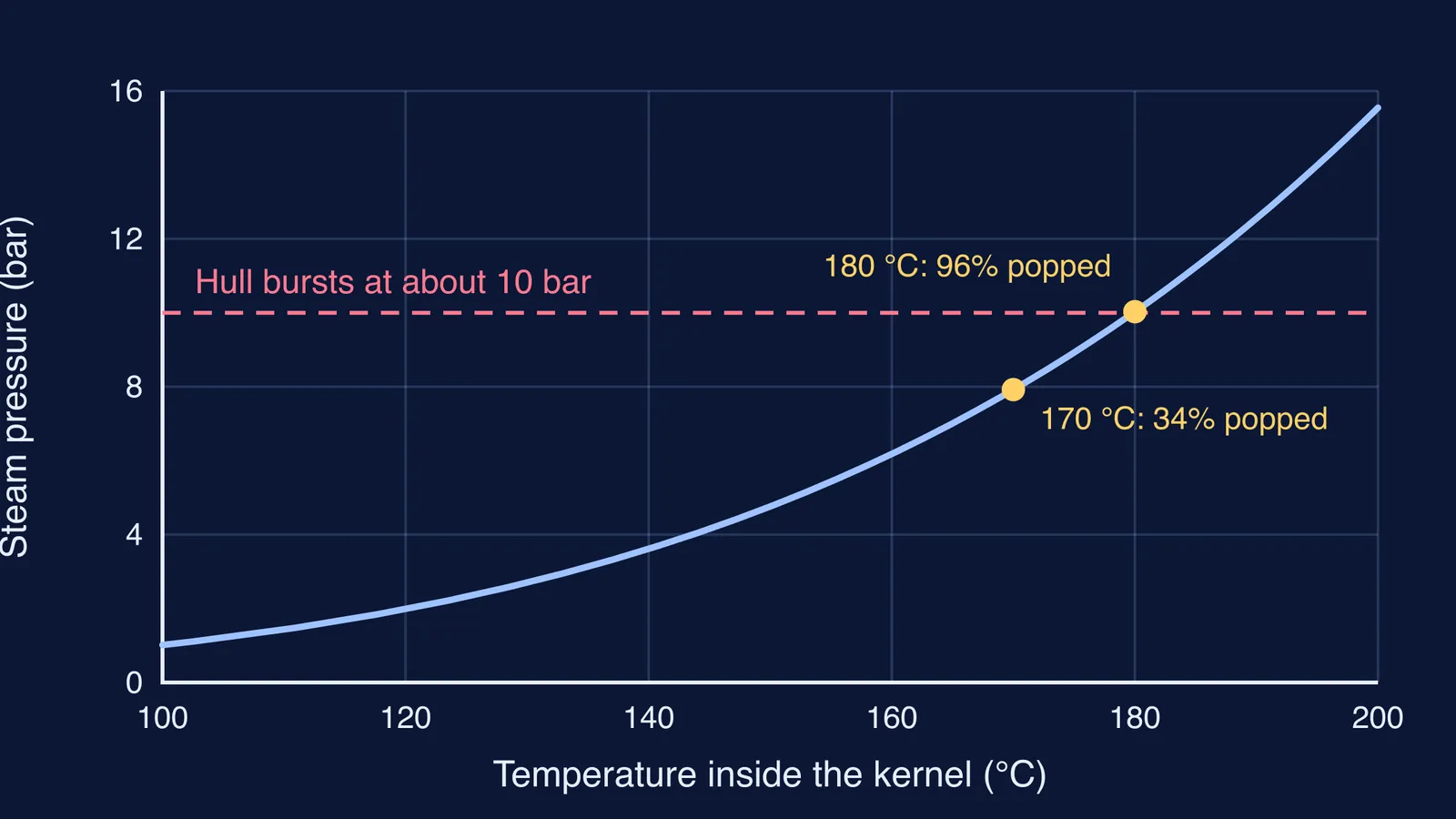
Water's boiling point depends on the pressure above it. The NIST steam tables give a boiling point of about 100 °C at 1 bar and about 180 °C at 10 bar. So the steam inside a kernel only reaches the 10 bar the hull can hold once the kernel is close to 180 °C.
The experiments match. In the authors' oven tests, 96% of kernels (48 of 50) popped at 180 °C, but only 34% (17 of 50) popped at 170 °C. At 170 °C, the NIST data puts the steam pressure near 8 bar, which is not enough for most hulls.
If you grew up with a pressure cooker in the kitchen, you already know this physics. Trap steam, and the boiling point rises: NIST gives about 120 °C at 2 bar, which is why food cooks faster inside. A kernel has no valve, so it bursts.
Why does the hull break at about 10 bar?
Treat the kernel as a thin spherical shell, the same model engineers use for gas tanks. The stress in the wall of a thin pressurised sphere is σ = pR / 2t, where p is the pressure inside, R the radius and t the wall thickness.
Put in the numbers from the Virot and Ponomarenko paper:
p = 10 bar = 1,000,000 Pa
R = 3.1 mm = 0.0031 m
t = 160 micrometres = 0.00016 m
σ = (1,000,000 × 0.0031) ÷ (2 × 0.00016) ≈ 9,700,000 Pa, or about 10 MPa.
The paper takes the hull's breaking strength as about 10 MPa, from earlier studies, and runs this same calculation the other way to estimate the 10-bar burst pressure. So at about 10 bar, the wall stress reaches what the hull can take.
Why do some kernels stay unpopped?
A kernel needs enough water to make steam, and the Popcorn Board puts that at 13.5% to 14% moisture, so kernels that have dried out have less to work with. A hull that leaks lets steam out before the pressure builds. The Popcorn Board also says popcorn's hull has just the right thickness to burst open, which it gives as the difference between popcorn and other types of corn.
How can you test it in your kitchen?
Turn the explanation into a prediction, then check it. Do this with an adult, using a covered pan and very little oil.
Count three batches of 50 kernels.
Batch A: fresh from the packet.
Batch B: spread on a plate and left uncovered to dry for a few days.
Batch C: nick each hull gently with a nail file.
Before cooking, write down which batch you expect to leave the most unpopped kernels, and explain why in terms of water, steam and pressure.
Pop each batch the same way for the same time, and count what is left.
If the link between temperature and pressure is hard to picture, the Fermi Simulation Lab has interactive simulations for ideas that are easier to see than to read. To go back over phase change and latent heat, the Fermi Concept Library gives each concept its own lesson.
Next time a pan of popcorn starts rattling, listen for the moment it gets busy: that is the kernels reaching their popping point, close to 180 °C.


