

On this page
Peanuts, or groundnuts as they are widely called in India, do not start life underground. The flowers open in the air. The surprise comes after fertilisation, when the plant buries its own fruit.
Why do peanuts grow underground if the flowers are above ground?
A 2019 review in Frontiers in Plant Science by Kumar and colleagues describes the peanut as a member of the legume family (Fabaceae) that "develops aerial cleistogamous flowers but subterranean geocarpic fruit". Cleistogamous means pollination happens inside the closed flower bud, so the flower fertilises itself. Geocarpy is the name for fruit that develops beneath the soil.
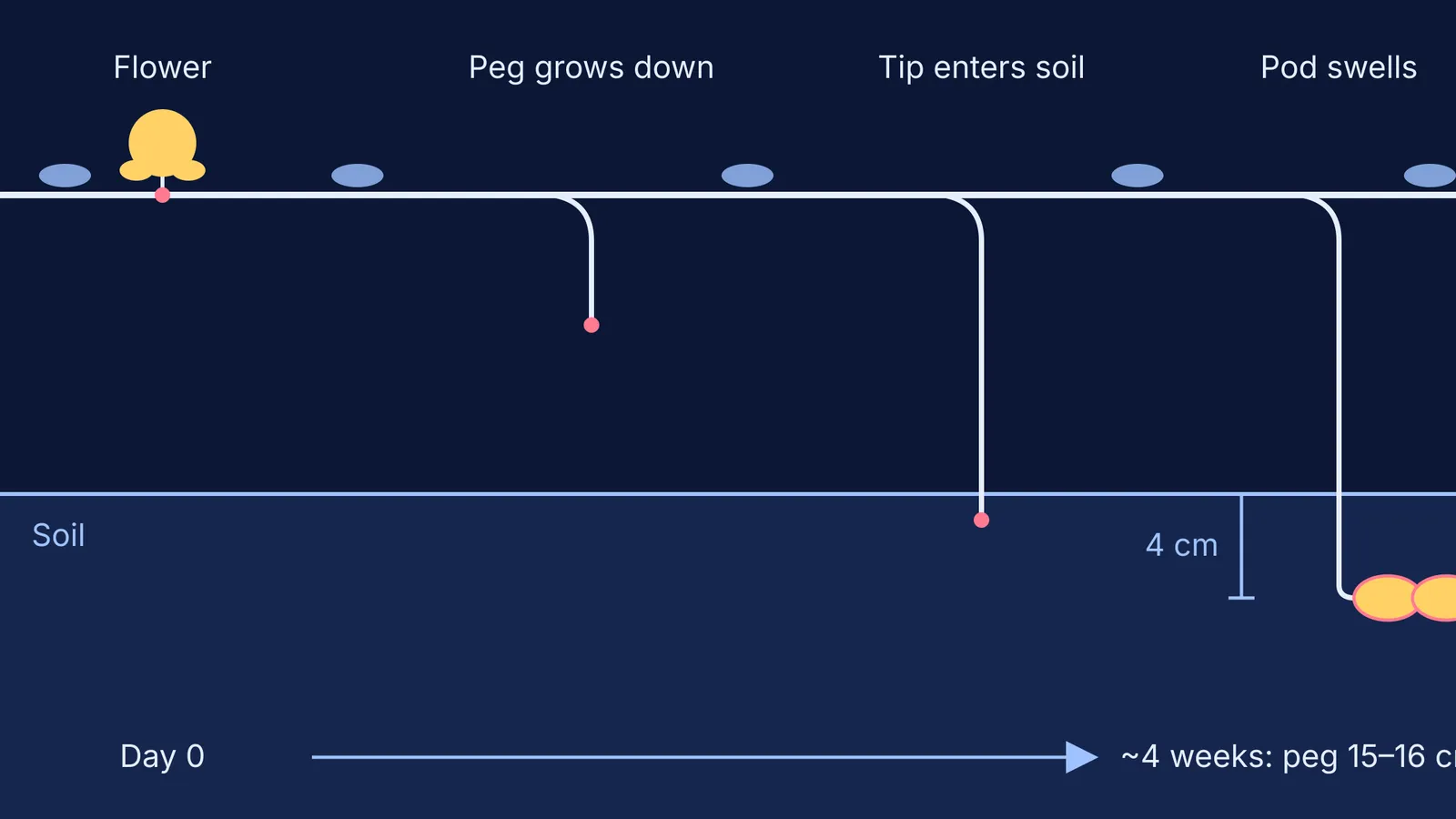
The link between the two is a structure called the peg, or gynophore. According to the same review, after double fertilisation the cells at the base of the ovary start dividing fast and form a tube-like stalk. The peg shows positive gravitropism: it grows towards gravity, carrying the fertilised ovary at its tip, until it pushes into the ground.
What is a peanut peg, and how far does it grow?
The clearest numbers come from experiments by Yoshitaka Ono at Japan's Upland Farming Research Center, published in JARQ in 1979.
Peg growth became noticeable from about a week after flowering.
Pegs reached a final length of 15–16 cm about four weeks after flowering.
Growth under the soil stopped about 4 cm below the surface, so pods form in the top layer of soil.
Why does the pod need to be in the soil?
The embryo waits. The Kumar review explains that after fertilisation, cell division in the embryo is arrested at the proembryo stage. Once the peg tip enters the soil, it turns horizontal, and the darkness and mechanical pressure of the soil signal the embryo to start dividing again. If the peg never gets into the soil, the embryo aborts, and the plant is left with hard, green pods above ground.
Soil conditions then decide how well the pod grows. In Ono's experiments, with the pod zone held at 32°C, the ovaries began to swell two days after the pegs entered the soil, and pods reached full size three weeks after entry. At 15°C, swelling took more than two weeks to begin. The best soil temperature for pod development was 31–33°C.
How does this link to fertilisation and fruit formation?
The peanut follows the same rules you learn for any flowering plant. It just adds one step. Use this four-step method to trace the ovary for any fruit question:
Find the flower. Where is the ovary, and how is it pollinated? (Peanut: above ground, self-pollinated.)
Fertilisation. Which structure starts growing once the egg is fertilised? (Peanut: the peg grows from the base of the ovary.)
Fruit formation. The ovary wall becomes the fruit wall, and the ovules become seeds. (Peanut: the shell and the nuts.)
Location. Where does the fruit ripen, and why? (Peanut: about 4 cm underground, because darkness and soil contact restart the embryo.)
Here is a worked example. Question: "Peanuts are found underground. Are they roots or stems?" A good answer: "Neither. A peanut pod is a fruit, because it develops from the fertilised ovary of a flower. The ovary is pushed into the soil by the peg, a stalk that grows from the base of the ovary after fertilisation. Roots and stems do not come from an ovary, and they do not contain seeds."
If you can trace each step out loud like this, you can handle the twists examiners like to add. For any idea in this chain that still feels shaky, the Fermi Concept Library gives every concept in biology its own lesson and its place in the map.
How can you watch a peanut peg grow at home?
You need a deep pot, loose soil and a few raw, unroasted groundnuts with their thin skin intact. Then follow this plan:
Sow three or four seeds a few centimetres deep and keep the pot in a warm, sunny spot.
Watch for small yellow flowers. In Ono's growth-cabinet trials, the first flowers appeared 25 to 38 days after planting, sooner when it was warmer.
A week or so after a flower fades, look for a thin stalk pointing down. Tie a loose thread next to it so you can find it again.
Measure it with a ruler every three days and note the date.
About four weeks after flowering, gently scrape away soil next to one peg to see the tip turned sideways and starting to swell.
The bending peg is easier to understand once you have seen it move, not just read about it. The Fermi Simulation Lab has interactive simulations for the ideas that are easier to see than to read.
Next time you crack open a groundnut, look at the shell: it is a fruit wall that a stalk pushed about 4 cm into the ground.


