

On this page
Pick up a peacock feather and turn it slowly. The eye shifts between blue, green and bronze. Ordinary paint does not do that. Most of the feather's colour comes from its structure, and the physics is the interference of light you meet in wave optics.
What is inside a peacock feather that makes colour?
A feather has a central shaft, side branches called barbs, and tiny branches on the barbs called barbules. In 2003, researchers led by Jian Zi at Fudan University in Shanghai published Coloration strategies in peacock feathers in PNAS, after studying the eye pattern of a male green peafowl (Pavo muticus) feather.
They found that the colour comes from the outer layer (cortex) of each barbule, which holds a two-dimensional photonic crystal: a regular array of melanin rods held together by keratin, with air holes in between (full paper). The paper reports:
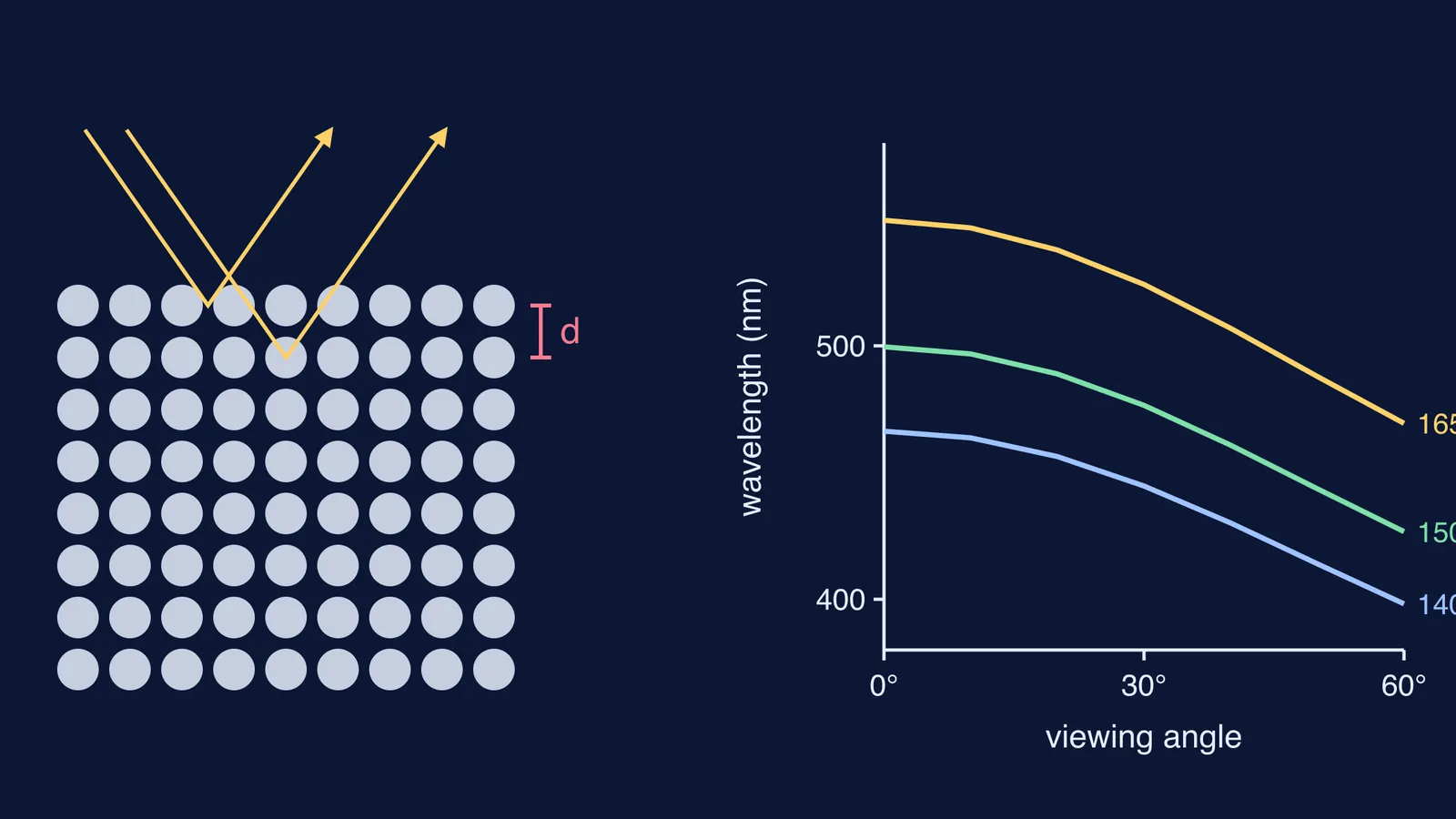
The rod spacing (lattice constant) is about 140 nm in blue barbules, 150 nm in green and 165 nm in yellow.
The rods form about 9 to 12 layers in blue and green barbules, about 6 in yellow and about 4 in brown.
Brown barbules have a less regular lattice, spaced about 150 nm and 185 nm in the two directions.
So the feather changes colour mostly by changing one number: the spacing. As the HyperPhysics page on peacock colours puts it, the role of pigments may be minimal.
How does interference of light make the colour?
Light entering the barbule is partly reflected at every layer of rods. Waves reflected from deeper layers travel a little further before they come back out. When that extra distance is a whole number of wavelengths, crest meets crest and the reflection of that colour gets stronger (constructive interference). Other colours fall out of step and mostly cancel.
Zi's team describe this as a partial photonic bandgap: a range of frequencies for which light is strongly reflected (PNAS abstract). More layers give a stronger, purer colour. Fewer layers add extra side colours, which the authors say produce the mixed colouring of the yellow and brown parts of the eye.
An oil film on a wet road works the same way: its colour depends on the film's thickness and your viewing angle, as HyperPhysics explains.
Why does the colour change when you tilt the feather?
Tilting changes the path difference between the waves from neighbouring layers. The PNAS paper reports that the bandgap shifts to higher frequencies as the angle of incidence increases, which produces iridescent colours (full paper). Higher frequency means shorter wavelength, so colours slide towards blue as you tilt.
Can you predict the colour from the spacing?
Yes, roughly, with the rule for reflection from evenly spaced layers: wavelength ≈ 2d × √(n² − sin²θ), where d is the layer spacing, n the average refractive index and θ the viewing angle measured from the perpendicular.
We estimated n from the numbers in the PNAS paper: it takes the refractive index of melanin as 2.0 and of keratin as 1.54, with rod radius 0.4 times the spacing and air-hole radius 0.25 times the spacing. By area that is about 50% melanin, 20% air and 30% keratin; weighting the three indices by their exact areas gives n ≈ 1.665.
Blue barbule, d = 140 nm, viewed straight on: 2 × 140 × 1.665 ≈ 466 nm, which is blue light.
Green barbule, d = 150 nm: 2 × 150 × 1.665 ≈ 500 nm, blue-green.
Yellow barbule, d = 165 nm: 2 × 165 × 1.665 ≈ 549 nm, yellow-green.
Green barbule viewed at 45°: √(1.665² − 0.5) ≈ 1.508, so 2 × 150 × 1.508 ≈ 452 nm. Tilting has pushed the colour towards blue.
This model gets the order of the colours and the direction of the shift right, but it is rough: the authors used full simulations of the lattice. Treat these numbers as estimates.
If path difference is hard to picture, watch it instead. The Fermi Simulation Lab has interactive simulations for ideas that are easier to see than to read.
How do you explain this in an exam answer?
A good short answer on iridescence or structural colour covers five points:
Name the effect: structural colour from interference, seen as iridescence.
Say what is regular: layers of melanin rods in the barbules, spaced about 140 to 165 nm (Zi et al., PNAS).
Give the condition: reflections from successive layers reinforce when the path difference is a whole number of wavelengths.
Explain the angle: tilting changes the path difference, so a different wavelength is reinforced.
Contrast with pigment: pigment colour comes from absorption and looks the same from every angle.
If the wave optics behind point 3 feels shaky, the Fermi Concept Library covers every concept in physics, chemistry, biology, mathematics and computing, each with its own lesson. Next time you see a peacock, tilt your head and watch the physics change colour.


