

On this page
You flip a page of your chemistry notes, feel a tiny sting, and for the next hour that hair-thin line on your finger hurts more than a scraped knee. Three facts of skin biology help explain it: where the cut lands, how deep it goes, and what it leaves open.
Why do fingertips feel so much?
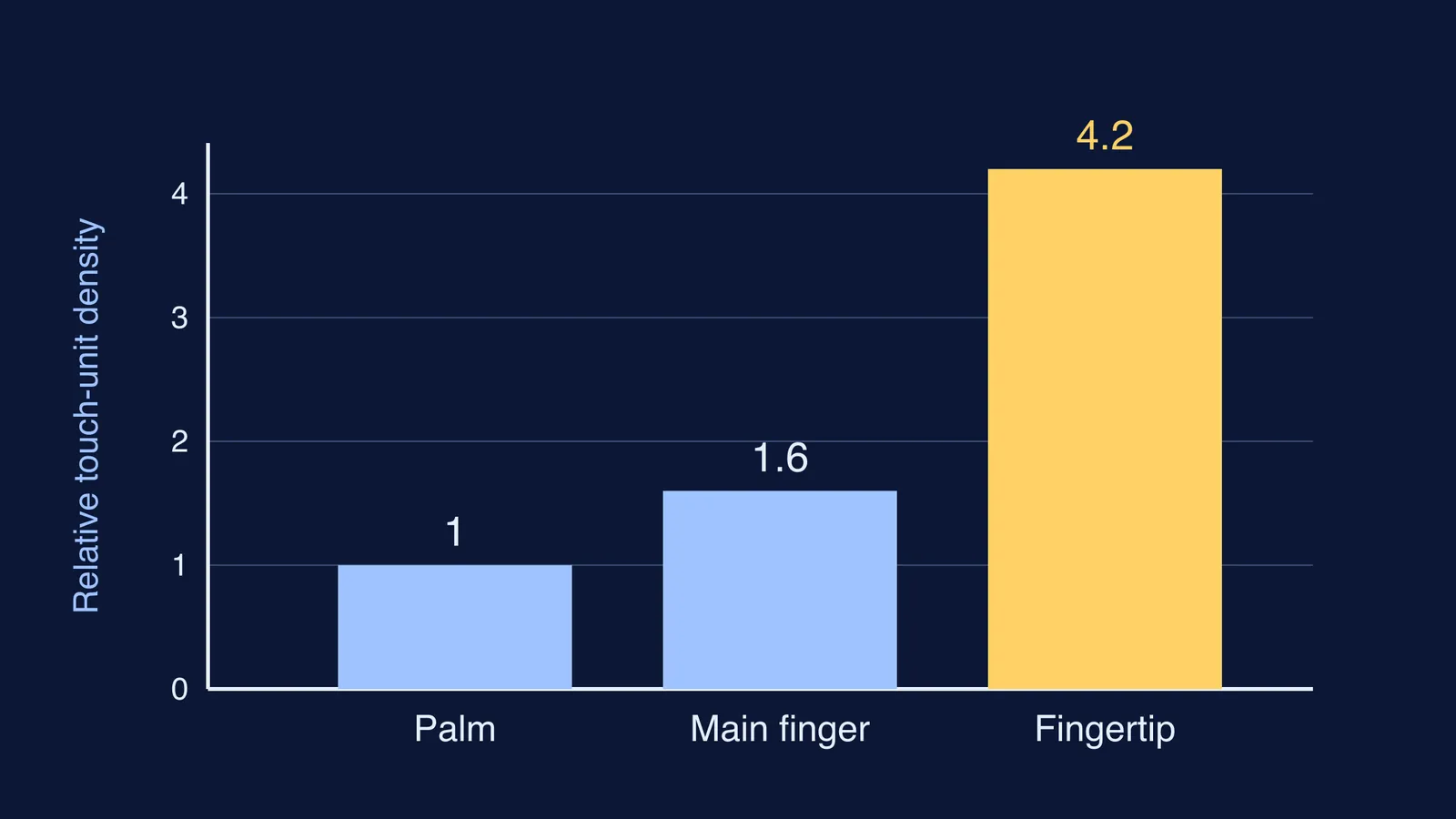
Your fingertips are built for detail. In a classic study, Johansson and Vallbo (1979) in The Journal of Physiology recorded 334 single touch-sensing nerve units supplying the hand in awake volunteers. From a model based on nerve fibre counts, they estimated about 241 low-threshold touch-sensing units per square centimetre at the fingertip and only 58 in the palm. Taking the palm as 1, the density rose to 1.6 in the main part of the finger and 4.2 at the tip.
Those are touch receptors, not pain receptors, so the study does not count pain nerves directly. What it shows is how heavily the fingertip is wired to report what happens to it.
What actually makes a cut hurt?
Pain starts with nociceptors. A review in the Journal of Clinical Investigation by Dubin and Patapoutian (2010) defines them as specialised sensory neurons that detect extremes of temperature and pressure and injury-related chemicals, then send electrical signals on to the brain.
Their endings are not wrapped in a capsule. The same review describes them as free nerve endings that can reach into both the dermis and the epidermis, the outermost layer of skin. So even a very shallow cut can reach them.
After an injury, substances released in the damaged tissue feed back onto these nerve endings and make them more sensitive, according to the same review. That helps explain why a small cut can stay sore, and why pressing or bending the finger can make it flare again.
Why don't paper cuts bleed much?
The answer is in the layers. The epidermis does not have any blood vessels in it; the blood vessels and most nerves sit in the dermis below (OpenStax Anatomy and Physiology 2e). The usual explanation is that a paper edge makes a very shallow cut, through the epidermis and only just into the dermis. We found no study that measured it, so treat this as the likely picture.
If so, it creates the worst of both worlds:
Deep enough to reach pain-sensing nerve endings.
Too shallow to bleed much, so there is little blood to form a clot and seal the gap.
On a fingertip, which you use all day, so the edges keep pulling apart and the exposed endings get poked again.
How can you see this for yourself?
Here is a five-minute experiment you can do at your desk with a friend or a parent. It tests the same idea as the 1979 study: some skin has far more sensors than other skin.
Bend a paper clip into a U so the two tips are about 1 cm apart.
Ask your partner to close their eyes.
Touch either one tip or both tips, at random, to their fingertip. Ask: one point or two?
Repeat ten times, then do the same on the palm and on the back of the forearm.
Squeeze the tips closer together and repeat until they cannot tell one from two on each spot.
Write down the smallest gap that still felt like two points for each spot.
You should find the fingertip tells two points apart at a much smaller gap than the forearm. Press gently. For a biology practical, this makes a neat table: body site, gap, number of correct answers out of ten.
If you want to link this to the bigger picture of how receptors turn a stimulus into a nerve signal, the Fermi Concept Library has a lesson for every concept in biology, each with its place in the map. Ideas like this, which are easier to see than to read, are what the Fermi Simulation Lab is for, with interactive simulations you can explore.
What should you do when you get a paper cut?
For a small cut that has stopped bleeding, the NHS advice on cuts and grazes is simple:
Wash and dry your hands.
Rinse the cut with tap water, or clean it with sterile wipes.
Pat it dry and cover it with a plaster or sterile dressing, then keep it clean and dry.
A plaster may also make it less sore, since it protects the edges every time you grip a pen.
The same NHS page says to get medical help if a cut is swollen, red and getting more painful or pus is coming out of it, and to get emergency help if you cannot stop the bleeding.
Next time a page bites back, you will know which layer it probably reached and why your brain is making such a fuss about it.


