

On this page
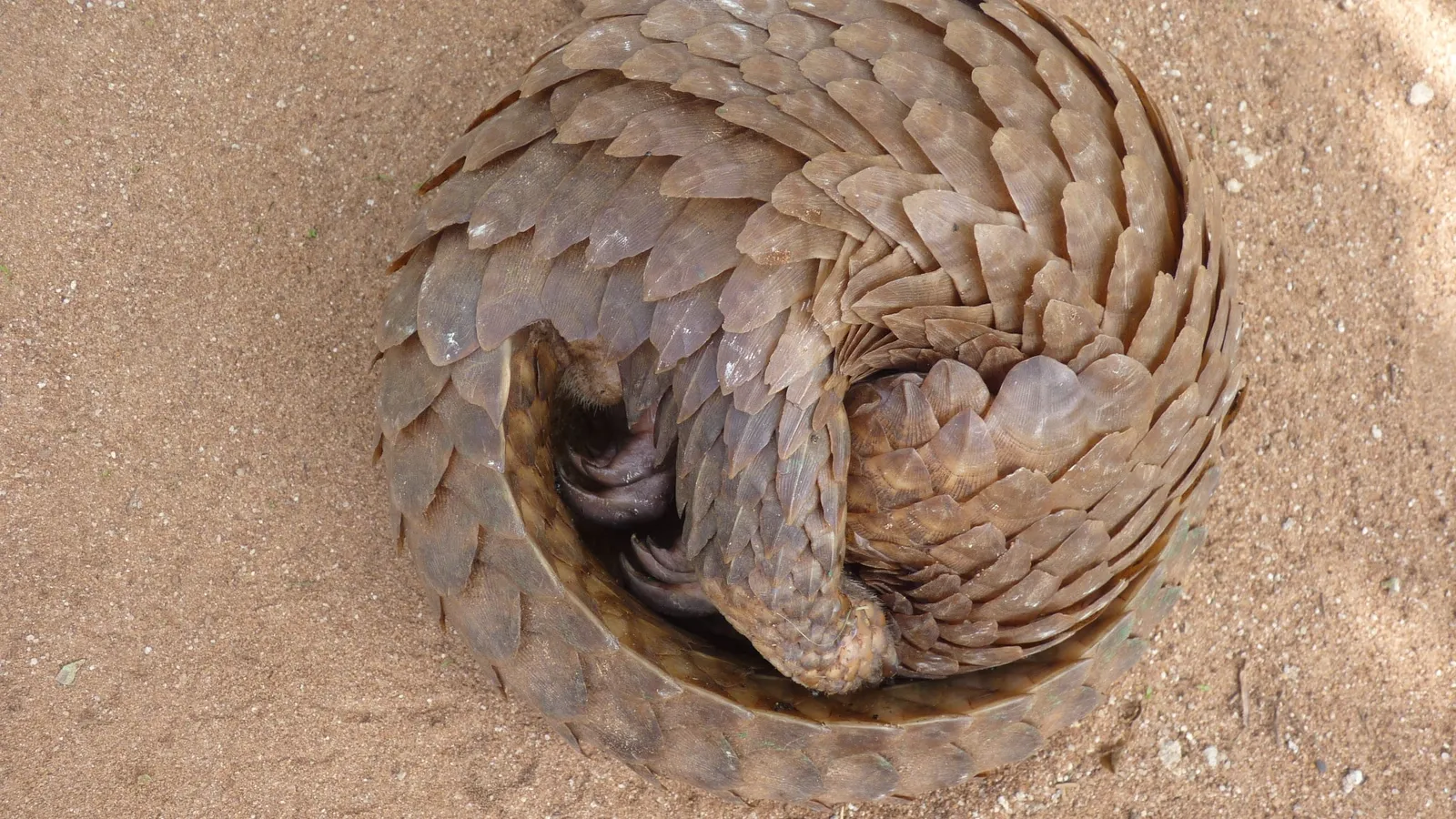
A frightened pangolin tucks in its head, wraps its tail around itself and becomes a tight, scaly ball. That one move packs in a lot of biology: what the scales are made of, why they overlap, and why the belly is the weak point it has to hide.
Why does a pangolin roll into a ball?
The short answer is that its armour does not cover its underside. Materials scientists Bin Wang, Wen Yang, Vincent Sherman and Marc Meyers, working at the University of California, San Diego, studied the scales in a 2016 paper in Acta Biomaterialia. They describe the pangolin as the only known mammal with a flexible armour of overlapping keratin scales, and note that a pangolin threatened by a predator such as a lion curls into a ball with only the hard, sharp-edged scales facing out.
The same paper lists where the scales are missing: the underside of the head, the belly, the inner surface of the limbs and the foot pads. These are exactly the parts that end up inside the ball. Even the name fits: the paper notes that "pangolin" comes from a Malay word meaning "something that rolls up".
What are pangolin scales made of?
Pangolin scales are made of keratin, the same family of proteins as your hair and fingernails. The UC San Diego team reports that the scales keep growing throughout life, like hair and nails, replacing what wears away.
In the Chinese pangolin, one of India's two species, the study measured scales 10 to 30 mm wide, 20 to 40 mm long and 0.4 to 3 mm thick. The paper also cites earlier work finding that scales and skin together make up about 25% of a pangolin's body mass.
How do overlapping scales stay closed when it curls?
When a body bends into a ball, its outer surface stretches, and plates that only just touched would pull apart.
The 2016 study found that each scale sits in the middle of its neighbours in a hexagonal pattern. Its underside partly covers three scales below it, and its top is partly covered by three scales above it. The authors write that this lets the scales fully cover and protect the skin when the body moves or even curls into a ball, and that overlapping scales can slide and shift against each other to form a flexible surface.
Try it at your desk. Lay six playing cards in a row, each covering half of the next, and bend the row over a water bottle. The cards slide, but the overlap keeps the table hidden. Lay them edge to edge and bend again: gaps open at once.
Some ideas are easier to see than to read, which is what the interactive simulations in the Fermi Simulation Lab are for.
How do you explain an adaptation in a biology answer?
Biology questions often ask how a feature helps an animal survive. A four-step frame keeps your answer complete:
Structure: what the feature is and what it is made of.
Function: what it does.
Threat: what it protects against, or what problem it solves.
Trade-off: what it costs the animal.
Here it is as a short three-mark answer, using facts from the 2016 Acta Biomaterialia paper:
Structure: most of the body is covered in hard, overlapping keratin scales; the belly, inner limbs and foot pads have none.
Function: when threatened, the pangolin rolls into a ball so the scales face out and the soft parts are tucked inside; the overlapping scales can slide over each other, so the skin stays covered.
Threat and trade-off: this guards against predators such as lions, but the armour is a lot to carry, with scales and skin about a quarter of body mass.
If one step leaves you stuck, the Fermi Concept Library has a lesson for every concept in biology.
Why does rolling up not protect pangolins from people?
Curling up helps against teeth and claws. It does not help against a net, trap or snare, and in India pangolins are netted, trapped or snared mostly for their scales, used in traditional medicines, and for meat, according to a 2023 TRAFFIC factsheet.
From 342 seizure incidents reported between 2018 and 2022, TRAFFIC estimated that at least 1,203 pangolins were in India's illegal wildlife trade, converting seized scales and other parts into numbers of animals. Scales turned up in more than 40% of those seizures.
The same factsheet notes that the IUCN Red List assesses the Indian pangolin as Endangered and the Chinese pangolin as Critically Endangered. Both are on Schedule I of the Wildlife (Protection) Act, 1972, so hunting them or trading their parts is banned, and since 2017 all pangolin species have been on CITES Appendix I, which prohibits commercial trade.
So the scales that help keep a pangolin safe from a lion are also why people hunt it. That is worth a line at the end of your answer.


