

On this page
When an old remote control or wall clock stops working, opening the battery compartment often reveals a powdery, crusty white residue caked around the metal springs. Many people assume this deposit is dried "battery acid." In standard household alkaline cells, however, the chemistry is the exact opposite. Cylindrical alkaline batteries do not contain acid; they rely on a concentrated alkaline base—aqueous potassium hydroxide (KOH)—to conduct electricity between their electrodes.
What is inside an alkaline battery?
In a standard alkaline cell, the cylindrical outer steel container acts as the cathode collector. Inside, a dense outer ring of manganese dioxide (MnO₂) surrounds a central porous separator sleeve. Inside this separator lies the anode: a zinc powder suspension dispersed in an alkaline gel of aqueous potassium hydroxide. According to industrial technical manuals from manufacturers such as Energizer, cylindrical cells rely on this conductive electrolyte to deliver steady current at a nominal 1.5 volts. You can explore how these components interact in our guide to batteries and fuel cells.
Why do old batteries leak inside devices?
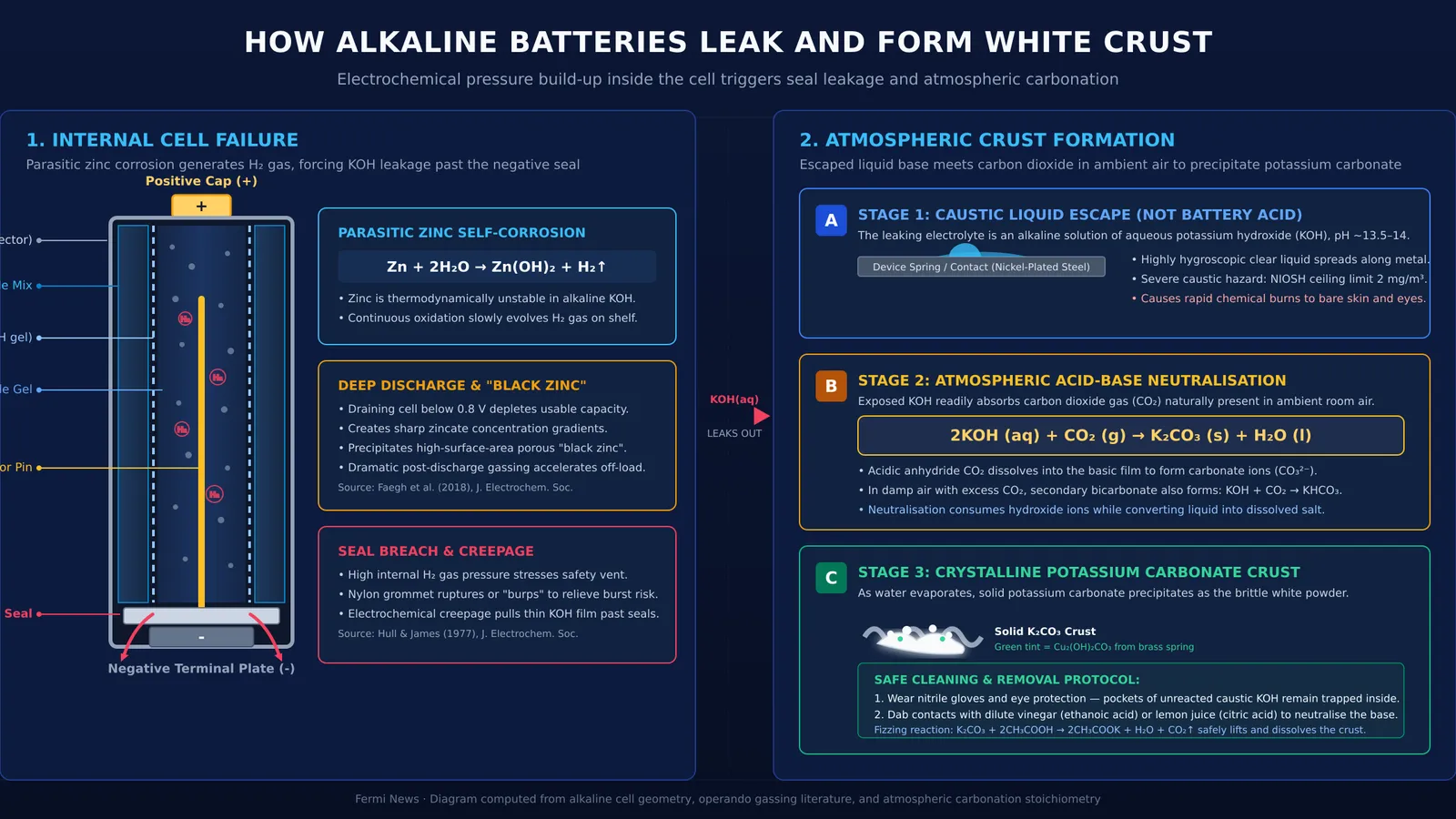
Battery casings are sealed tightly with metal crimps and nylon grommets, so why does the liquid escape? Two distinct electrochemical phenomena drive battery leakage: internal hydrogen gas evolution and electrolyte creepage.
Even when a battery sits idle on a shelf or remains inside an unpowered device, zinc is thermodynamically unstable in concentrated aqueous alkali. A slow parasitic reaction occurs between the zinc powder and water in the electrolyte:
Zn + 2H₂O → Zn(OH)₂ + H₂
This reaction continuously generates hydrogen gas. In an investigation published in the *Journal of The Electrochemical Society*, Faegh et al. (2018) used operando pressure cells to show that when alkaline cells undergo deep discharge, steep concentration gradients cause high-surface-area "black zinc" to precipitate, which dramatically accelerates hydrogen gas production once the device is turned off. Technical guidance in the Energizer Application Manual notes that draining a cell below 0.8 volts exhausts over 95% of its usable energy while multiplying internal gassing pressure. When pressure exceeds the mechanical limit of the safety vent, the nylon grommet ruptures or burps, expelling hydrogen gas along with liquid potassium hydroxide.
Yet batteries sometimes leak without venting violently. In their foundational study in the *Journal of The Electrochemical Society*, Hull and James (1977) discovered that alkaline electrolytes naturally exhibit "electrochemical creepage" along negatively polarised metal surfaces. Reduction reactions near the negative terminal generate a high concentration of hydroxyl ions (OH⁻), which pulls a thin film of water and dissolved potassium hydroxide along the metal-insulator boundary. Over time, this alkaline film creeps past the plastic seals and spreads across the negative terminal contacts. This process mirrors the electrochemistry explored in corrosion as electrochemistry.
How does the white crust form on battery terminals?
Once potassium hydroxide escapes into open air, the familiar white crust begins to grow. The escaping liquid is initially a clear, viscous, caustic solution. However, potassium hydroxide is intensely hygroscopic and chemically reactive toward carbon dioxide (CO₂) present in the atmosphere.
As the leaking solution meets ambient air, it rapidly absorbs gaseous carbon dioxide in an acid-base neutralisation:
2KOH(aq) + CO₂(g) → K₂CO₃(s) + H₂O(l)
The product of this reaction is potassium carbonate (K₂CO₃), a white crystalline salt. As water evaporates in room air, potassium carbonate precipitates out as the chalky, brittle crust encrusting the battery terminals. In damp conditions, excess carbon dioxide can further convert part of the crust into potassium bicarbonate (KHCO₃). If the alkaline solution also attacks the brass or nickel-plated contact springs, secondary copper corrosion products may add a greenish tint to the white deposit. This atmospheric salt formation demonstrates the principles covered in Class 10 chemistry on acids, bases, and salts.
Understanding these chemical transformations helps students connect textbook electrochemistry with physical devices. To build intuition for how ions migrate and how potentials evolve inside cells, the Fermi Simulation Lab provides interactive simulations for ideas that are easier to see than to read. For students preparing for board exams or competitive tests who need to balance redox half-reactions and calculate standard cell potentials, the Fermi Problem Library offers worked problems with a step-by-step solver that explains the reasoning rather than printing an answer.
How can you safely clean battery corrosion?
Because many people mistake the crust for harmless chalk or simple dust, they often scrape it off with bare fingernails. This is dangerous. According to the CDC NIOSH Pocket Guide, potassium hydroxide is a severe caustic agent with a ceiling exposure limit of 2 mg/m³ that can produce serious chemical burns to skin and irreversible damage to the eyes. Even after turning into potassium carbonate, pockets of unreacted, concentrated potassium hydroxide often remain trapped within the crust.
Follow this protocol to clean corroded battery compartments safely:
Put on protective nitrile or rubber gloves and safety glasses before opening a compartment containing leaked cells.
Remove the old batteries carefully and place them into a sealed plastic bag for electronic waste disposal.
Apply a mild household acid to neutralise the base. Dip a cotton bud into distilled white vinegar (which contains dilute ethanoic acid) or fresh lemon juice (which contains citric acid), and gently dab the encrusted terminal contacts.
Listen and watch for mild fizzing: the ethanoic acid reacts with potassium carbonate (K₂CO₃ + 2CH₃COOH → 2CH₃COOK + H₂O + CO₂), neutralising the base and releasing carbon dioxide gas bubbles while loosening the crust.
Wipe the contacts clean with a slightly damp cotton swab, followed by a wipe with isopropyl alcohol to displace residual moisture and prevent contacts from rusting. Allow the compartment to dry completely before inserting fresh cells.
To prevent battery leakage in household gadgets, keep these preventive measures in mind:
Remove alkaline cells from devices like remote controls, game controllers, and wall clocks whenever you plan to leave them unused for extended periods.
Never mix old batteries with new ones in the same device; the weaker cell discharges first and can be driven into reverse polarity, accelerating hydrogen gassing.
Avoid mixing different chemistries or brands within the same battery bank.
Store unused alkaline batteries in a dry, room-temperature environment, avoiding extreme heat that speeds up spontaneous zinc self-corrosion.


