

On this page
In winter, a resident of Delhi might layer up in heavy woollens to survive temperatures dropping to 7°C or lower (Wikipedia). Meanwhile, someone in Mumbai is comfortable in a light t-shirt at night, as temperatures rarely dip below 17°C (Wikipedia). Come summer, Delhi bakes in 40°C heat, while Mumbai sweats through a humid but steady 33°C.
The reason for this significant difference lies not just in their latitude, but in the physics of heat. Water and land absorb solar energy very differently, creating distinct climate zones.
Why does Mumbai have mild weather while Delhi has extremes?
The answer comes down to a property in physics called specific heat capacity. This is the amount of heat energy required to raise the temperature of one kilogram of a substance by one degree Celsius.
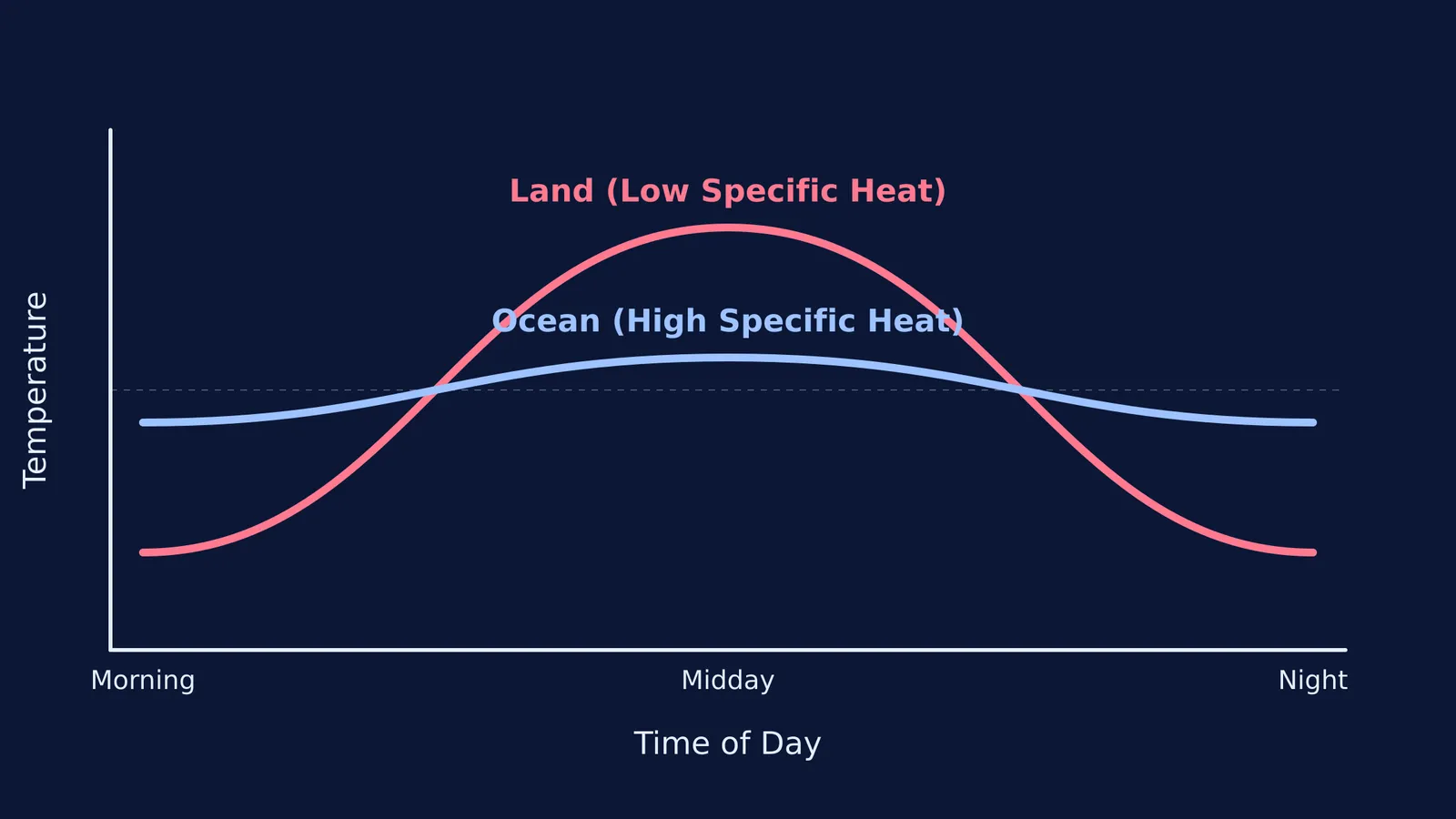
Water has a specific heat capacity of about 4,186 J/kg·°C, whereas dry soil and sand have a specific heat capacity of only about 800 J/kg·°C (National Oceanic and Atmospheric Administration). Because water's specific heat is roughly five times greater than that of land, the ocean takes five times more energy to heat up by the same amount, and it cools down five times slower.
At a molecular level, water's high specific heat capacity is primarily due to hydrogen bonding. Water molecules are strongly attracted to each other by these bonds. When solar energy hits the ocean, a significant portion of that energy is used to weaken these hydrogen bonds rather than increasing the kinetic energy (and thus the temperature) of the molecules. In contrast, dry land, which is mostly composed of rock, sand and soil, lacks these strong intermolecular forces, so the sun's energy immediately increases its temperature.
Mumbai is a coastal city on the Arabian Sea. The large body of water next to the city acts as a thermal buffer. During the day, the ocean absorbs the sun's intense heat without getting too hot. At night, it releases this stored heat slowly, preventing the air temperature from plummeting. Delhi, however, is a landlocked city in North India. Without a nearby ocean to regulate the temperature, the land heats up rapidly during summer days and loses heat rapidly during winter nights, leading to large seasonal swings.
Understanding this difference in heat capacity is also the key to knowing Why metal feels colder than wood at the same temperature.
What is continentality in Class 9 geography?
In geography, this effect is known as continentality. Places located far inland experience a continental climate, which is characterised by large variations in temperature between day and night, and between summer and winter. Coastal places experience a maritime climate, which is far more moderate.
This maritime influence is a global phenomenon. Cities located deep within large landmasses, far from the moderating effects of the oceans, consistently experience more intense seasons. The solid ground cannot hold onto heat for long, so as soon as winter arrives and solar radiation decreases, the local temperature drops rapidly. The ocean, holding onto the heat it gained during the summer, continues to warm the coastal air well into the winter months.
The difference in temperature range is stark:
Delhi (Inland): The difference between the mean temperatures of the hottest summer month and the coldest winter month is about 19°C (Wikipedia).
Mumbai (Coastal): The difference between the mean temperatures of the hottest and coldest months is only about 6°C (Wikipedia).
How do sea breezes and humidity affect Mumbai?
The high specific heat capacity of water also drives the daily coastal winds that keep Mumbai from overheating. During a summer day, the land in Mumbai heats up faster than the Arabian Sea. The hot air above the land rises, and the cooler, denser air from over the ocean rushes in to replace it. This creates a refreshing sea breeze. At night, the cycle reverses into a land breeze.
The trade-off for this moderate temperature is high humidity. The constant evaporation from the Arabian Sea means Mumbai's air is loaded with water vapour. This is why a 33°C day in Mumbai can feel incredibly uncomfortable, as sweat cannot evaporate quickly from your skin to cool you down. You can read more about this effect in our guide on Why humid heat feels far worse than dry heat.
Learning heat transfer with an AI tutor
Visualising how different materials absorb and release heat can be tricky when you only read it from a textbook. The Fermi Simulation Lab allows you to run virtual experiments, comparing how water, sand, and other materials change temperature over time.
If you are studying specific heat capacity, latent heat, or thermodynamics for exams, Fermi's AI tutor can guide you through the reasoning. Instead of just giving you the formula, the tutor asks questions to help you build the concept from scratch—such as figuring out why a puddle takes so long to dry on a cold morning.


