

On this page
A mountain goat on a cliff looks like it is breaking the rules of physics. It isn't. It uses two ideas from Class 11 physics, friction and stability, with feet and a body built for both.
How do mountain goats climb steep cliffs?
It starts with the feet. The Alaska Department of Fish and Game describes mountain goat hooves as having “a hard keratinous sheath and a soft embedded pad” that let goats “gain purchase on the smallest of granite cracks while simultaneously gripping maximum surface area.”
Each hoof is also split in two. The US National Park Service says mountain goats have ankle bones that make their feet flexible, “split hooves that can grip in small spaces, and soft inner pads that act like grippy climbing shoes.” A National Wildlife Federation feature adds that the two toes on each front foot splay outward and act as brakes when the goat moves downhill.
So one foot does three jobs:
The hard outer sheath catches cracks and small ledges.
The soft pad grips over as much of the rock's surface as it can.
The split toes grip in small spaces and brake on the way down.
Why don't mountain goats slip?
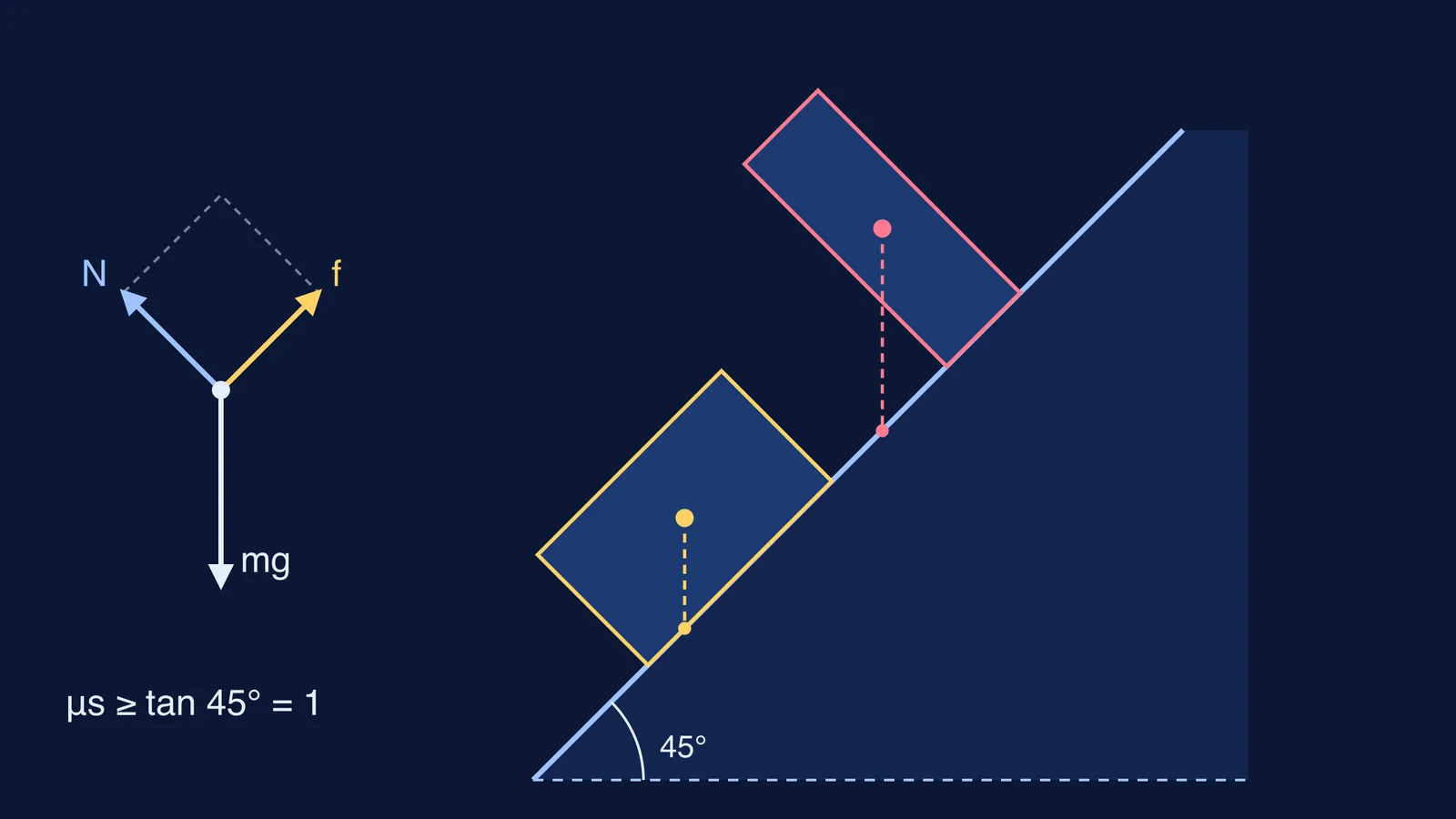
Static friction acts between surfaces that are not sliding, and it can grow only up to μs × N, where μs is the coefficient of static friction and N is the normal force (OpenStax University Physics).
Worked example: on a slope at angle θ, weight mg splits into mg sin θ pulling down the slope and mg cos θ pressing into it, which is N. To stay put, mg sin θ ≤ μs mg cos θ. The mass cancels.
OpenStax lists μs as about 1.0 for rubber on dry concrete, 0.5 to 0.7 for rubber on wet concrete, and 0.1 for shoes on ice (OpenStax friction table).
At 30°, tan 30° ≈ 0.58. Rubber on dry concrete holds easily; shoes on ice slide.
At 45°, tan 45° = 1.0. Even rubber on dry concrete is right at its limit.
At 60°, tan 60° ≈ 1.73. Nothing in that table is enough.
So a grippy pad alone is unlikely to explain the goat. One likely reason the hard sheath matters on the steepest faces: a small ledge or crack edge is far flatter than the cliff, so the local tan θ is small and little friction is needed. We did not find a published friction coefficient for goat hooves, so these numbers illustrate the physics rather than measure the goat.
How does a low centre of gravity stop a goat toppling?
Not sliding is half the problem; the other half is not tipping. The textbook Body Physics by Lawrence Davis/05%3A_Maintaining_Balance/5.08%3A_Human_Stability) puts it simply: “Structures with a low center of gravity compared to the size of the support area are more stable.” An object topples when the vertical line through its centre of gravity falls outside its base of support.
Mountain goats are built low: their legs are short, “providing the low center of gravity essential for death-defying leaps” (National Wildlife Federation).
Second worked example, drawn in the diagram above: on a slope at angle θ, the vertical line from a centre of gravity at height h lands h × tan θ down the slope from the middle of the base. If that shift exceeds half the base width w, the object tips. So it stays upright only if tan θ ≤ w ÷ 2h.
A low, wide body: base 40 cm, centre of gravity 12 cm up. At 45° the line shifts 12 cm, inside the 20 cm half-base. It stays upright.
A tall, narrow body: base 16 cm, centre of gravity 22 cm up. At 45° the line shifts 22 cm, past the 8 cm half-base. It tips.
Ryan Lewinson and Darren Stefanyshyn of the University of Calgary analysed video of a mountain goat climbing a 45° incline in the Canadian Rocky Mountains (Zoology, 2016; abstract on PubMed; Science News report). As it pulled itself up, the goat held its elbow close to its whole-body centre of mass, then straightened its elbow and wrist joints to lift that centre of mass up the slope. It was one young goat in one video, and the authors present their observations as hypotheses for future controlled studies.
How can you use the mountain goat in a physics exam?
Any “will it slip or tip?” question, from a block on a ramp to a truck on a hill, follows the same checklist:
Draw the free-body diagram: mg down, N perpendicular to the surface, friction along it.
Slip test: compare μs with tan θ.
Tip test: compare h × tan θ with half the base width.
Whichever test fails at the smaller angle happens first as the slope steepens.
Forces on a slope are easier to see than to read, and the Fermi Simulation Lab has interactive simulations for ideas like that. If friction or centre of gravity still feels shaky, the Fermi Concept Library gives every physics concept its own lesson.


