

On this page
When the monsoon arrives, bare brick walls, concrete pavements and stone pathways quickly turn into lush green carpets. The plants responsible for this sudden burst of growth are mostly bryophytes, commonly known as mosses, a group comprising about 12,000 species worldwide.
Mosses are often called the "amphibians of the plant kingdom". Much like the evolutionary leap from green, brown and red algae in aquatic environments to complex terrestrial plants, mosses can grow on land but remain completely dependent on water for sexual reproduction.
Why do mosses need water to reproduce?
Mosses do not produce flowers, pollen or seeds to propagate. Instead, the dominant green part of the plant that you see (the gametophyte) produces dedicated male and female sex organs. This process drives an alternation of generations between the independent gametophyte and a dependent sporophyte phase.
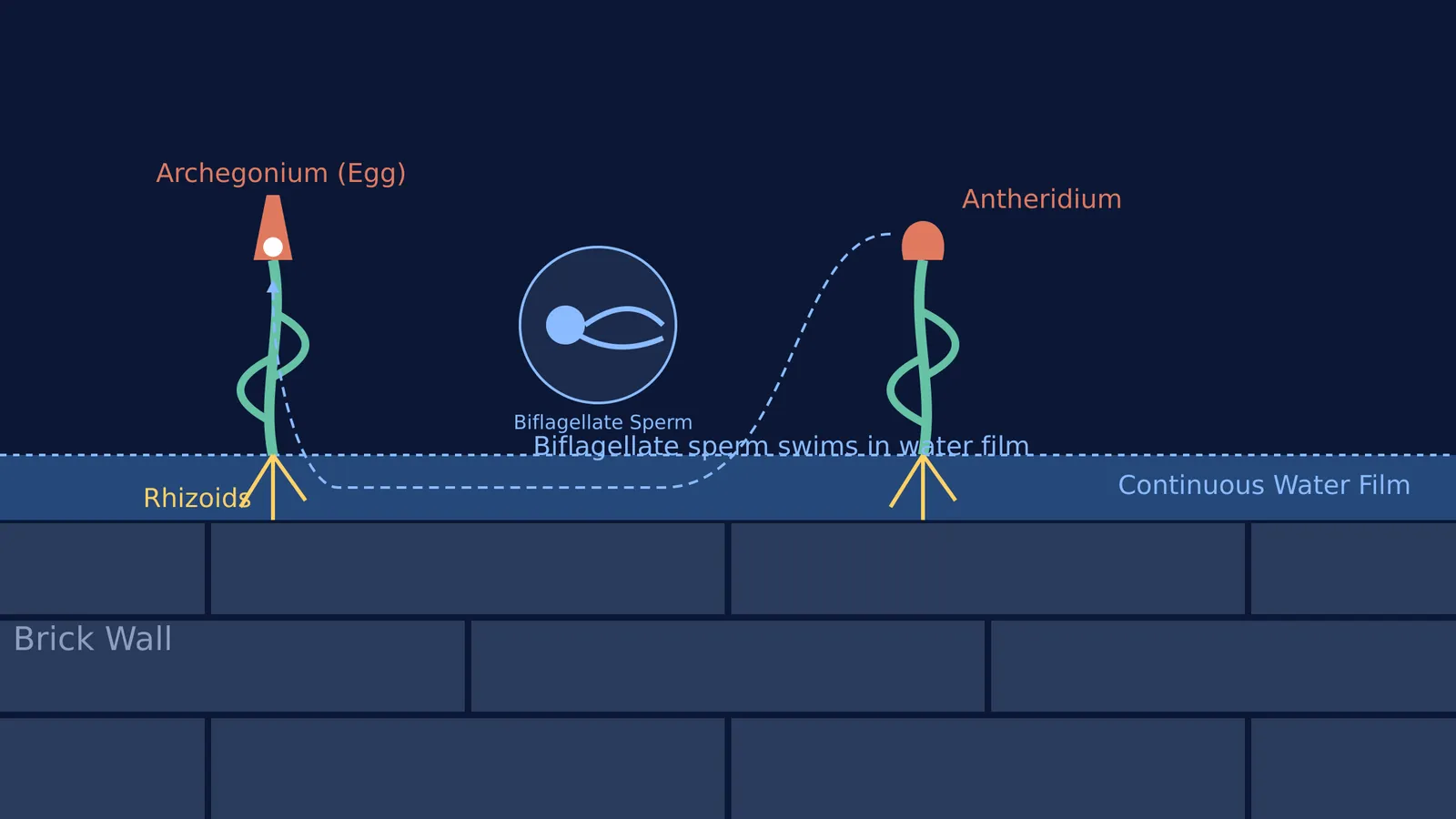
The male sex organ, called the antheridium, produces male gametes known as antherozoids. These antherozoids are distinctly biflagellate, meaning they have two whip-like tails that propel them. Because they are not light enough to be carried by the wind like pollen grains, they must physically swim through a layer of water to reach the female sex organ (the archegonium) to fertilize the single egg held securely inside.
This dependence on water is a defining feature of bryophyte biology. When a raindrop hits a cluster of moss, it splashes and splatters, sometimes carrying the microscopic sperm short distances. However, for successful fertilization, the local environment must remain wet long enough for the sperm to swim the final distance. The archegonium releases chemical attractants, often sugars or organic acids, which create a concentration gradient in the water film. The flagellated sperm use this chemical trail to navigate directly to the egg, a process called chemotaxis. If the water film breaks or evaporates before the sperm reaches its destination, the reproductive effort fails. This makes the prolonged dampness of the monsoon season absolutely critical for the survival of the moss population.
A dry brick wall halts this reproductive process completely. Without a continuous film of moisture linking the male and female organs, the flagellated sperm simply cannot travel. The heavy, continuous rains and extremely high humidity of the monsoon provide exactly the wet, connected layer that these tiny gametes need to complete the plant's life cycle.
Why does moss grow on walls instead of deep soil?
If you look closely at a dense patch of moss, you will notice that it clings easily to solid rock or a vertical brick surface. This is possible only because mosses completely lack true roots.
Instead of deep root systems that dig into the earth to draw up underground water, bryophytes possess simple, root-like structures called rhizoids. In mosses, these multicellular rhizoids primarily serve to anchor the plant to the solid substratum, acting more like gripping cables than drinking straws. Because they cannot draw water from deep beneath the surface, mosses must absorb moisture directly from their immediate environment. A damp wall in the monsoon acts as a perfect sponge, holding surface moisture for the rhizoids and the delicate leaves to soak up immediately.
Unlike higher plants that pull nutrients and water from deep within the earth using complex vascular tissues, mosses must absorb everything they need through their delicate leaves. The leaves of a moss gametophyte are typically only a single cell thick, providing an enormous surface area relative to their volume. This structural adaptation allows them to rapidly absorb water and dissolved minerals directly from the rain or humid air. However, this same adaptation makes them extremely vulnerable to water loss on hot, sunny days. A porous brick wall, which stays cool and holds a significant amount of water long after the rain stops, creates an ideal microclimate. It buffers the plant against rapid evaporation and provides a steady, immediate supply of moisture.
When the monsoon retreats and the walls dry up, the moss does not instantly die. It enters a dormant state, drying out entirely and waiting for the next rain—a survival strategy known as desiccation tolerance. As soon as the water returns, the moss rehydrates and resumes its reproductive cycle.
How do you predict a plant's habitat from its structure?
When you study plant biology for competitive exams, memorising the habitats of hundreds of plant species can feel endless. Instead, use a simple framework to deduce where a plant must live based on its anatomy:
Check the gametes: Does the plant produce motile, flagellated sperm? If yes, it strictly requires a continuous film of water to breed, heavily restricting it to wet, shaded or monsoon-heavy environments.
Check the roots: Does the plant have true roots or just simple rhizoids? True roots allow a plant to tap into deep soil water reserves during a drought. Rhizoids primarily offer physical anchorage, meaning the plant must rely entirely on immediate surface moisture.
Check the vascular tissue: Does the plant possess xylem and phloem? Without internal transport pipes, the plant cannot grow tall and must remain small, hugging damp surfaces tightly to prevent rapid drying.
Applying this checklist to a bryophyte makes its sudden appearance on a damp monsoon wall entirely predictable rather than a random fact to memorise.
If you struggle to picture how plant reproduction works in three dimensions, the Simulation Lab offers interactive simulations for the ideas that are easier to see than to read. Seeing the continuous water film and the swimming gametes in motion makes the core biological concept intuitive.


