

On this page
During Shravana, temple courtyards and streets across India see snake charmers presenting live cobras for Nag Panchami. Devotees pour milk into earthen saucers or over the reptiles, believing the animals welcome the offering. When a snake lowers its snout to drink, onlookers see an auspicious omen. Biologically, that scene is not an act of divine appetite; it is the final stage of prolonged dehydration and physical trauma.
Why do snakes drink milk on Nag Panchami?
Snakes in the wild are obligate carnivores that drink only water. They never consume dairy. A cobra or rat snake drinks milk during festival rituals solely because weeks of deliberate deprivation leave it acutely parched.
Snake handlers capture wild snakes—predominantly the Indian cobra (*Naja naja*) and Indian rat snake (*Ptyas mucosa*)—weeks before the festival. Handlers keep them in dark baskets or boxes without food or water for 30 to 45 days, according to rescue investigations by Wildlife SOS. By festival morning, the snake is severely dehydrated. Presented with any liquid, survival reflex compels it to drink.
To handle them safely, poachers rip out the snake's venom fangs with pliers, tearing gum tissue and causing necrotic infections. Many also sew the lips shut with nylon thread, leaving only a tiny gap for fluids. The snake drinks not from hunger or devotion, but from desperation.
What happens inside a snake's digestive tract when it drinks milk?
Snakes belong to Class Reptilia, an ancient amniote group that diverged from synapsid ancestors long before lactation evolved. As outlined in our guide to parturition and lactation hormones, milk synthesis is a specialized mammalian adaptation.
Mammals digest milk sugar using the brush-border enzyme lactase, which splits lactose into glucose and galactose, as detailed by Rings and colleagues80212-X). Snakes produce no lactase. Studies on python digestion by Cox and Secor in the *Journal of Experimental Biology* show that reptiles upregulate pepsin, trypsin, and maltase for whole prey, but lack dairy enzymes. As explained in our guide to enzymes for NEET biology, catalytic active sites are substrate-specific, and reptiles never evolved lactase.
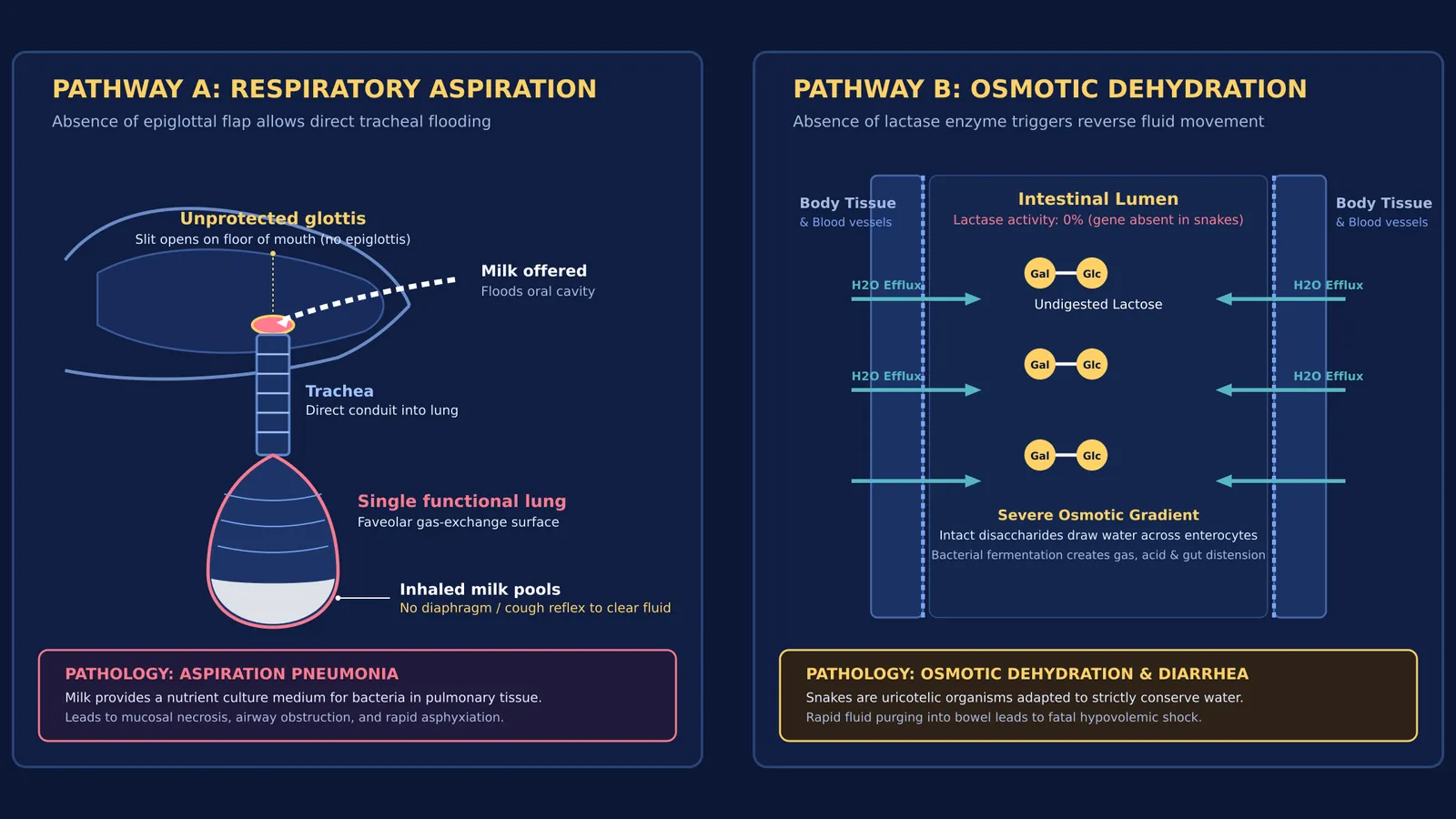
In the stomach, gastric acid curdles milk casein into dense, indigestible rubbery masses. The intact lactose then reaches the lower bowel, exerting an osmotic pull that draws water out of body tissues into the gut lumen. Gut bacteria ferment the sugar into gas and acids, triggering severe bloating and osmotic diarrhea. Because snakes are uricotelic animals adapted to conserve water by producing dry uric acid paste, rapid fluid loss through diarrhea causes fatal dehydration.
How does the lack of an epiglottis cause fatal lung infections?
Milk feeding also brings immediate respiratory peril. In mammals, swallowing causes the epiglottis to fold over the larynx, blocking liquid from entering the airway. Snakes have no epiglottis.
A snake's glottis is an exposed slit on the floor of the mouth, positioned forward so the reptile can breathe while slowly swallowing whole prey. Reptiles also lack a muscular diaphragm and cannot cough forcefully to clear fluid, as documented by veterinary specialist Juergen Schumacher.
When milk is poured over a snake's head or forced down its throat, fluid easily spills into the open glottis. Most snakes possess only one functional lung—the right lung. Inhaled milk coats the delicate lung tissue, creating a culture medium for bacteria that sparks severe aspiration pneumonia and respiratory failure.
How does vertebrate classification explain snake nutrition?
This physiological mismatch illustrates why classification matters in biology. In our overview of the animal kingdom for NEET, we examine how anatomical traits align with feeding ecology.
Class Mammalia is defined by mammary glands, homeothermy, and flexible lips for suckling. Class Reptilia consists of poikilothermic amniotes with dry scaly skin, rigid jaws, and recurved teeth built to grasp prey. Snakes cannot suck liquids through pursed lips, nor can they metabolize dairy.
For ideas that are easier to see than to read, students can explore comparative anatomy and physiology using the interactive simulations in the Fermi Simulation Lab. For related biochemistry and taxonomic traits, the Fermi Concept Library covers every concept in biology, each with its own lesson and its place in the map.
How can you honour snakes without harming them?
Under the Wild Life (Protection) Act, 1972, all indigenous Indian snakes—including cobras, kraits, and pythons—are protected species. As highlighted in public awareness campaigns by Wildlife SOS, capturing, defanging, or publicly exhibiting these reptiles is a non-bailable offense carrying severe legal penalties, including up to seven years of imprisonment.
You can celebrate Nag Panchami compassionately with four practical steps:
Worship symbolic forms: Offer milk to stone *murtis*, clay idols, or a *Shivling* rather than live animals.
Refuse to pay charmers: Withholding money stops funding the illegal trade that starves wild reptiles every monsoon.
Explain the biology: Share with relatives that snakes lack lactase and an epiglottis, making milk offerings fatal.
Report wildlife offences: If you see live snakes on display, alert the local Forest Department or wildlife rescue organisations.


