

On this page
It is a familiar sight when you pull a standard tray from the freezer: the ice cubes are clear on the outside but opaque and cloudy in the centre. This cloudiness is not caused by the plastic tray or the freezer's temperature. It is a direct result of how water traps dissolved gases and impurities as it changes state.
Why does water hold air?
Before it freezes, the tap water you pour into an ice tray is full of dissolved gases, primarily nitrogen and oxygen from the atmosphere. According to data from The Engineering ToolBox, water at 0 °C can hold approximately 29 mg/L of dissolved air. This solubility means that the gases are seamlessly integrated between the liquid water molecules, completely invisible to the naked eye. The principles of Henry's law and the solubility of gases, with worked problems govern exactly how much gas can stay in solution at a given pressure and temperature.
However, the rules change drastically when water turns into a solid. The transition from liquid water to solid ice involves forming a highly ordered, hexagonal crystal lattice. If you struggle to picture how molecules arrange themselves during phase changes, you can explore this transition interactively in the Fermi Simulation Lab. This rigid crystal lattice is held together by hydrogen bonds, leaving almost no room for foreign, non-polar molecules like nitrogen and oxygen to fit inside. Consequently, as the ice lattice forms, it actively rejects the dissolved air and other impurities, pushing them into the remaining liquid water.
Why do ice cubes freeze from the outside in?
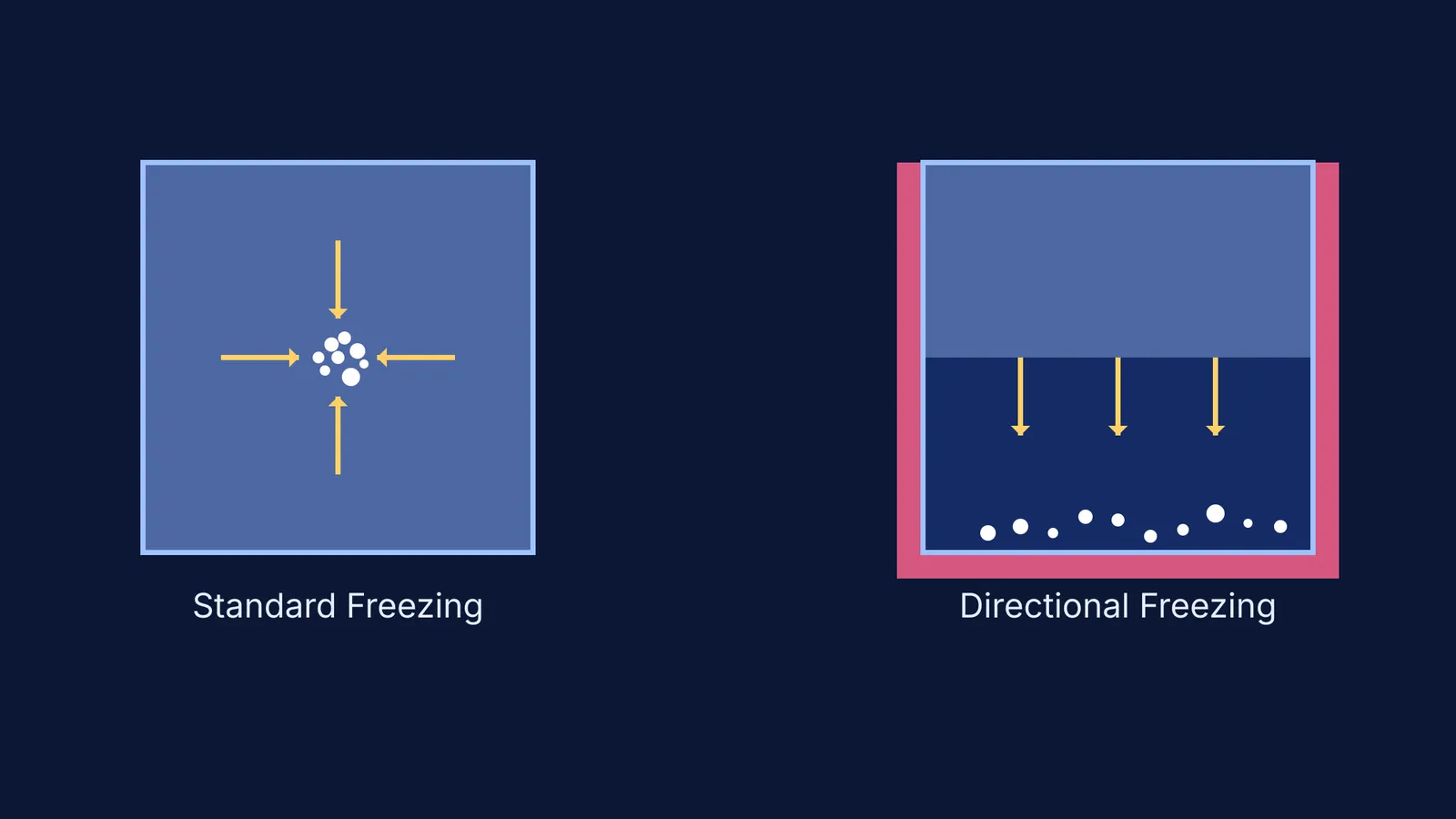
In a standard home freezer, cold air surrounds the plastic or silicone ice tray on all sides. This means the water in each cubic slot begins to cool and freeze from the outside in. The outer layer of water—touching the cold walls and the surface—freezes first. Because this first layer is freezing out of a relatively large pool of liquid, it successfully pushes its dissolved air into the centre of the cube, resulting in a perfectly clear outer shell.
As freezing continues, the boundary of solid ice advances inward, constantly driving more dissolved air into a shrinking pocket of liquid water in the middle. The concentration of air in this remaining liquid steadily rises until it becomes supersaturated. At this point, the air can no longer stay dissolved and comes out of solution to form microscopic bubbles.
Because the centre is the very last part of the cube to freeze, these bubbles have nowhere to escape; they are trapped inside the solid ice shell. When light hits these thousands of trapped micro-bubbles, it scatters in all directions. This scattering is what makes the centre of the ice cube appear white and opaque.
How can you make perfectly clear ice?
While boiling water removes some dissolved oxygen, it does not prevent the outside-in freezing pattern that traps the remaining gases. The only reliable way to make crystal-clear ice is to change the direction of the freeze. This technique, known as directional freezing, was popularised for home use by drinks writer Camper English on Alcademics in 2009.
Directional freezing mimics how nature works. Just as Time for ice to form on a pond: conduction with growing thickness describes the top-down freezing of a lake, you can force water to freeze in one direction by insulating the sides and bottom of a container. As the ice grows slowly from the top down, it acts as a filter, continuously pushing all the dissolved air and impurities into the liquid water below.
Here is the step-by-step method to try it yourself:
Prepare the cooler: Remove the lid from a small insulated cooler.
Fill with water: Fill the cooler with regular tap water and place it in the freezer.
Wait for the freeze: Leave it until a thick slab of ice forms, as described by Alcademics. The insulation ensures the cold air only hits the exposed top surface, forcing the water to freeze from the top down.
Harvest the ice: Remove the cooler before the water freezes entirely to the bottom.
Separate the clear ice: You will find a thick, perfectly clear slab of ice on top, with the concentrated impurities floating in the unfrozen liquid below.
This pure, air-free ice is denser than standard freezer ice, meaning it melts more slowly and keeps drinks cold with far less dilution. It is a brilliant, everyday demonstration of how a simple change in physical conditions—like insulating a box—can completely alter how A journey through states of water in Class 6: evaporation explained translates into physical reality.


