On this page
When you put a mixture of water, sugar, and flavourings into the freezer, it does not freeze as a single, uniform block. Instead, it undergoes a process called freeze fractionation or freeze concentration. This separation happens because the physical structure of ice is highly ordered, and only pure water molecules fit perfectly into the growing crystal lattice.
What is freeze fractionation?
Pure water freezes at exactly 0 °C. As the temperature of the dessert mixture drops, the water molecules slow down and begin to bond together to form pure ice crystals. Because the larger molecules of sugar and artificial food colouring do not fit into the rigid, hexagonal structure of an ice crystal, they are systematically pushed out into the surrounding liquid.
The result is a structural matrix of pure, clear ice crystals. Trapped in the microscopic gaps and channels between these crystals is a highly concentrated syrup holding almost all the original flavour and colour. As the ice crystals grow, the volume of this liquid phase shrinks, making the syrup increasingly dense and intense.
Why does the sugary syrup not freeze solid?
The remaining syrup does not freeze easily because of a phenomenon known as freezing point depression. Dissolved substances like sugar interfere with water's ability to form solid ice, meaning the mixture must be cooled well below 0 °C to freeze entirely. The more concentrated the syrup becomes, the lower its freezing point drops.
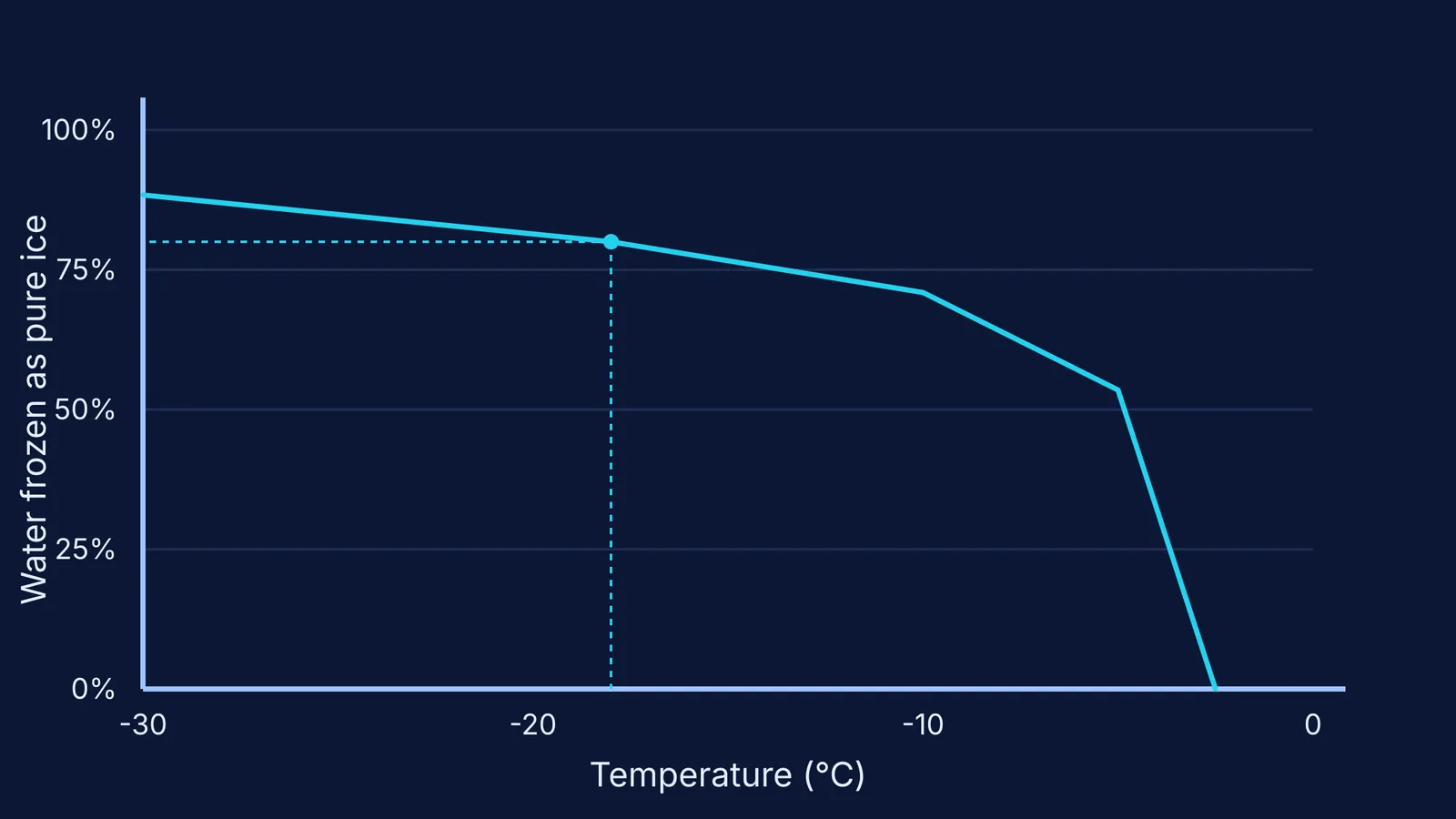
According to *Ice Cream* by H. Douglas Goff and Richard W. Hartel, a typical sweet dessert mix begins to freeze at roughly -2.5 °C. As the temperature in the freezer continues to drop, more pure ice forms and the leftover syrup becomes even more concentrated, driving its freezing point lower still.
Even in a standard home freezer set to -18 °C, only about 80% of the water in a typical mix freezes into pure ice. The remaining 20% stays as an intensely sweet, colourful, and unfrozen liquid trapped within the ice structure. (You can explore related concentration and pressure effects in the Raoult's law simulation: predict how vapour pressure falls).
Why does sucking remove the colour and flavour?
When you eat an ice lolly, the warmth of your mouth first melts the highly concentrated syrup, which already has a much lower melting point than the pure ice surrounding it.
As you suck on the lolly, you create a slight vacuum. The structure of the ice acts like a dense bundle of tiny, interconnected straws. Capillary action, aided by the suction from your mouth, draws the sweet, melted syrup out of these microscopic tunnels.
You consume the sugar and food colouring first, leaving the rigid structural skeleton of pure water ice behind. Because the dye has been completely removed from this remaining matrix, the ice looks white or pale, and tastes like nothing. The light scattering off the empty microscopic channels makes the pure ice appear white rather than clear. (For more everyday thermodynamics, read Why metal feels colder than wood at the same temperature).
Why does this not happen to commercial ice lollies?
If you make an ice lolly at home by simply freezing fruit juice, it usually freezes slowly over several hours. This slow, undisturbed process allows very large pure ice crystals to form, creating wide channels that make it extremely easy to suck the sweet syrup out.
Commercial manufacturers prevent this separation by using rapid blast freezing and adding stabilisers such as guar gum, locust bean gum, or pectin. Freezing the mixture extremely quickly at very low temperatures creates millions of tiny ice crystals rather than large ones. The stabilisers bind with the water and increase the viscosity of the unfrozen syrup. Together, these techniques trap the syrup evenly throughout a fine matrix so it cannot be easily drawn out, ensuring the lolly retains its colour and flavour until the very last bite.
How to explore freezing in the Fermi Simulation Lab
Visualising how molecules move and freeze helps you understand freezing point depression deeply. The Fermi Simulation Lab provides interactive simulations for ideas that are easier to see than read. You can watch how adding solute particles disrupts crystal formation, predicting how the freezing point changes before you run the test.