

On this page
Have you ever booked a cab in a busy city centre, only to watch your blue dot jump three streets over or stick you inside a shopping mall? You are not alone, and your phone is not necessarily broken.
The culprit is a phenomenon called multipath error. It is a classic example of wave reflection—a concept you learn in Class 11 physics—happening in real time on your phone.
Why is my GPS location wrong near tall buildings?
Your phone finds your location by talking to the Global Positioning System (GPS), a network of satellites orbiting the Earth. It acts as a highly precise stopwatch. By measuring exactly how long a radio signal takes to travel from a satellite down to your phone, it calculates the distance between you and the satellite.
When you stand in an open field, this works perfectly. The signals travel in a straight, direct line of sight.
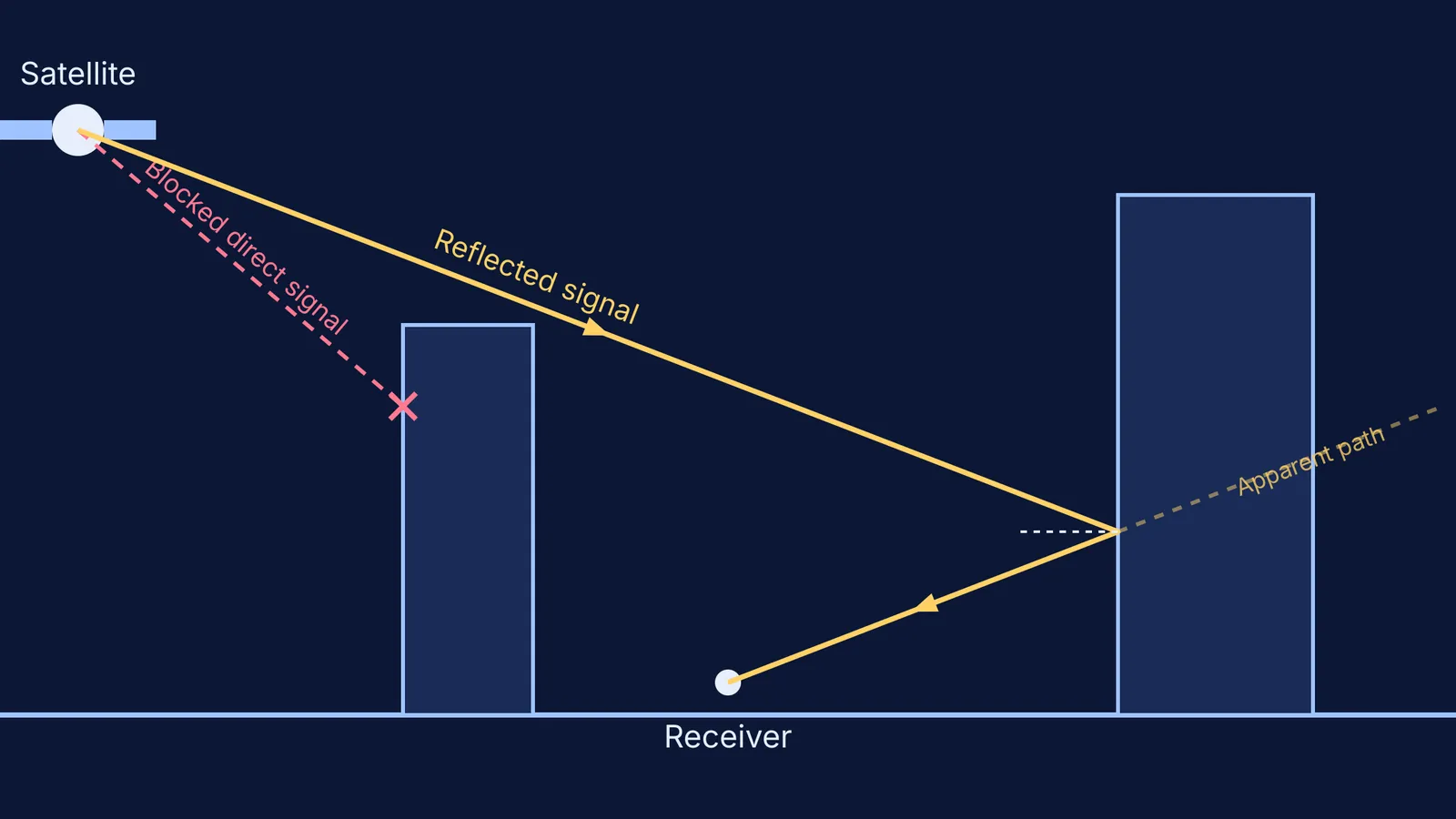
However, in an "urban canyon"—a street lined with tall buildings—the direct path is often physically blocked by concrete and steel. Instead of receiving a clean signal, your phone picks up echoes. The microwave signals bounce off the glass facades of skyscrapers before finally reaching your antenna.
Because this reflected path is not a straight line, it is longer. The wave takes slightly more time to arrive. Your phone's software does not know that the signal bounced; it simply assumes the satellite is further away than it actually is.
A 2020 study published in *Sensors* found that in dense urban areas, this multipath error can shift a calculated location by more than 100 meters, with some test errors reaching 175 meters in Tokyo's skyscraper districts.
How does the reflection of waves cause this?
In physics, the laws of reflection state that when a wave hits a smooth boundary, the angle of incidence equals the angle of reflection. While we usually think of this with light in a mirror or sound echoing in an empty hall, it applies perfectly to radio waves hitting flat, rigid boundaries like a glass tower block.
When the GPS microwave hits the building, it bounces back into the street. If the building is perfectly flat, the wave maintains its shape but changes its direction. Just like looking into a mirror makes an object seem like it is standing behind the glass, the reflected signal makes your phone think the satellite is in a false position in the sky.
A worked example of GPS multipath error
Let's use the physics of waves and uniform motion to see how a tiny bounce breaks your map. The relationship between distance, speed, and time is fundamental: Distance = Speed × Time.
Radio waves travel at the speed of light (c = 3 × 10⁸ m/s).
Suppose a building blocks the direct signal, and the wave instead bounces off a glass tower behind you. This V-shaped path adds an extra 150 meters to the wave's journey compared to a straight line.
Calculate the extra time:
Time = Distance / Speed t = 150 m / (3 × 10⁸ m/s) t = 0.5 × 10⁻⁶ s (or 0.5 microseconds)
The receiver's mistake: Your phone detects the signal 0.5 microseconds late.
The result: The GPS software multiplies this time by the speed of light and calculates that the satellite must be 150 meters further away.
When your phone combines this false distance with readings from other satellites, your calculated position is thrown off dramatically.
If you want to see how waves bounce and interfere when they hit an obstacle, try the Fermi Simulation Lab. It has interactive simulations for the ideas that are easier to see than to read, such as the reflection of waves.
How can you fix GPS drift in the city?
While you cannot stop waves from bouncing, you can help your phone figure out where it really is:
Keep moving: Multipath errors change rapidly as you walk. Taking a few steps helps your phone's software average out the errors and realise that the sudden jump was a glitch.
Leave Wi-Fi and Bluetooth on: Modern phones use sensor fusion. When GPS signals are messy, your phone scans for nearby Wi-Fi networks and Bluetooth beacons with known locations to pin down exactly which street you are on.
Look for dual-band GPS: Newer phones support "L5" frequency bands alongside the traditional "L1" bands. The L5 signal is much faster, meaning the waves are packed tighter. This makes it easier for the phone's chip to separate the direct signal from the delayed echoes.
The next time your map spins wildly between skyscrapers, you will know exactly why. Your phone is simply trying to solve a geometry problem with echoes.