

On this page
It is a classic physics question that often confuses students studying mechanics: if gravity is a mutual attraction between two objects, why do we only see the apple fall to the ground, while the planet remains firmly in place? The target search query, why earth does not move towards falling apple, highlights a fundamental misunderstanding of how forces translate into motion. The answer lies in the critical difference between force and acceleration.
Does the apple pull the Earth?
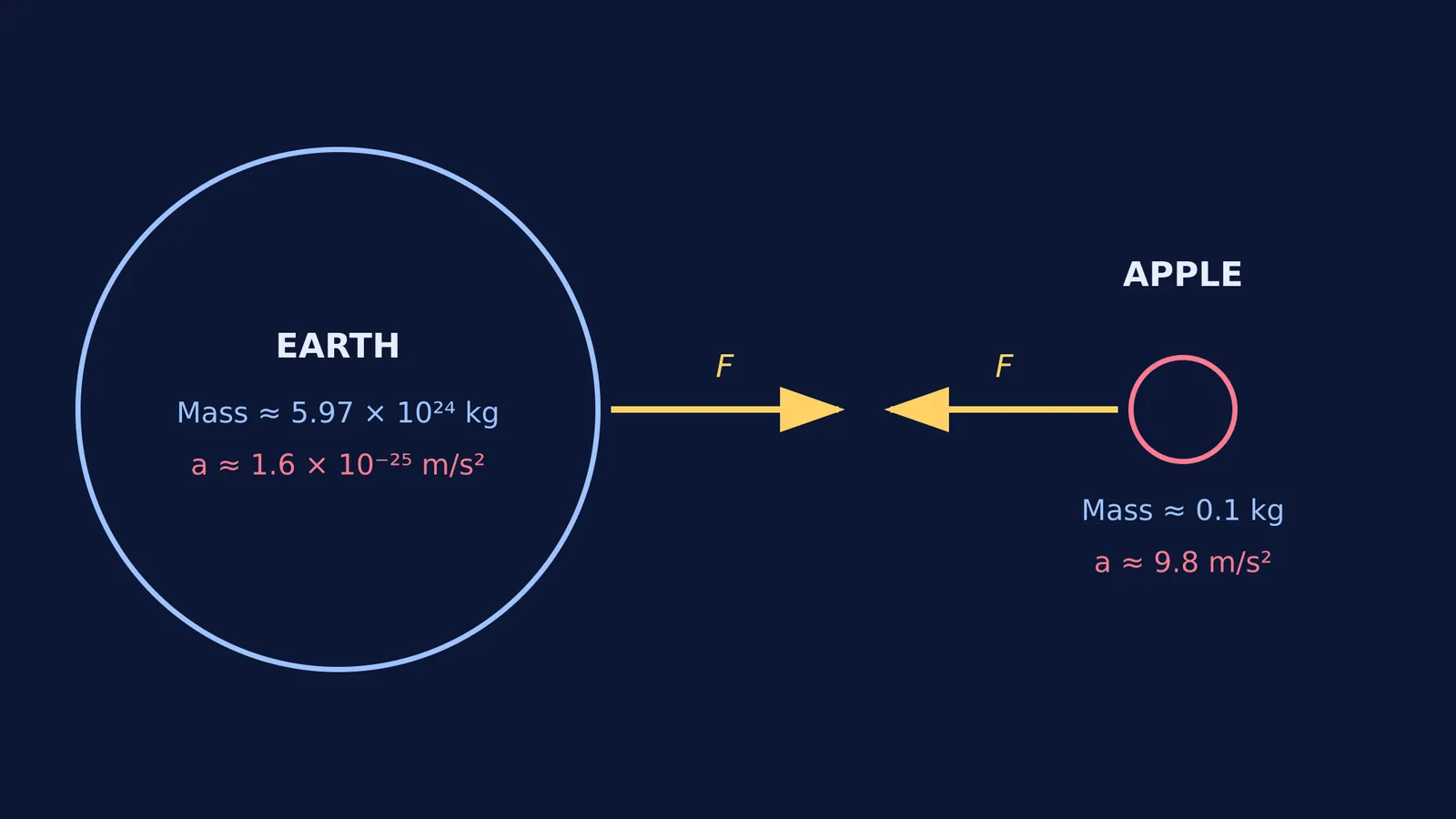
Yes, it does. According to Newton's third law of motion, for every action, there is an equal and opposite reaction. This means forces always occur in pairs. When the Earth exerts a downward gravitational force on an apple, the apple simultaneously exerts an upward gravitational force of the exact same magnitude on the Earth.
If the Earth pulls the apple with a force of about 1 newton, the apple pulls the Earth with exactly 1 newton of force. This mutual pull is the foundation of universal gravitation, much like the equal and opposite forces you see when learning how a balloon rocket works: Newton's third law on a string. The forces are perfectly balanced, but because we are standing on the Earth, we only notice the apple's dramatic reaction.
Why doesn't the Earth move?
The reason we do not see the Earth jump towards the apple comes down to Newton's second law of motion, which states that force equals mass times acceleration (F = ma). While the forces on both objects are entirely equal, their accelerations are inversely proportional to their masses.
According to Wikipedia's article on Earth's mass, the mass of the Earth is approximately 5.97 × 10²⁴ kg. A typical apple has a mass of roughly 0.1 kg. When you apply the same gravitational force to both objects, the tiny mass of the apple results in a highly visible acceleration of 9.8 m/s² towards the ground.
In contrast, dividing that exact same force by the enormous mass of the Earth yields an acceleration of roughly 1.6 × 10⁻²⁵ m/s². This number is so infinitesimally small that the Earth's movement is physically undetectable and effectively zero.
How do you calculate the Earth's acceleration?
You can prove this difference in motion yourself by setting the two forces equal. Here is how the mathematical calculation works step by step:
Write the equation for the force on the apple: F = m × a (apple).
Write the equation for the force on the Earth: F = M × a (Earth).
Since the forces are equal (due to Newton's third law), equate them: m × a (apple) = M × a (Earth).
Rearrange the formula to find the Earth's acceleration: a (Earth) = (m / M) × a (apple).
Plug in the standard values for mass and gravity: a (Earth) = (0.1 / 5.97 × 10²⁴) × 9.8.
The resulting acceleration is roughly 1.6 × 10⁻²⁵ m/s².
If you are struggling to picture how mass changes the effect of gravity on different objects, the Fermi Concept Library contains every concept in physics, chemistry, biology, mathematics and computing, each with its own lesson and its place in the map.
How can you solve similar force problems?
When tackling physics examination questions that ask about the resulting motion of two interacting objects, follow this three-step framework to avoid common mistakes:
Identify the interacting pair: Always clearly define which two objects are exerting forces on each other before writing any equations.
Check the forces: Remember that the internal forces between the two objects are always equal and opposite, regardless of how drastically their sizes differ.
Compare the masses: Use F = ma to determine how each object responds to the force. The object with the larger mass will always experience the smaller acceleration.
Once you master this fundamental rule, it becomes much easier to analyse complex mechanical systems, whether you are understanding planetary orbits with a gravity simulation or deciding when to use energy conservation instead of Newton's laws.


