

On this page
Dogs explore the world nose-first. A working dog can find a missing person in a dense forest or detect hidden substances long before humans are aware of them. According to a 2018 review in *Frontiers in Veterinary Science* (10.3389/fvets.2018.00056), their sense of smell is estimated to be 10,000 to 100,000 times more sensitive than ours. But what gives them this extraordinary ability?
The answer lies in the anatomy of their sense organs and how their nervous system is wired.
Why do dogs have such a strong sense of smell?
The primary reason is the sheer number of sensory cells inside a dog's nose.
Inside the nasal cavity, both humans and dogs have an olfactory epithelium. This is a layer of tissue packed with receptor cells that catch odour molecules from the air. The 2018 review (10.3389/fvets.2018.00056) found there are more than 220 million olfactory receptors in the canine nasal cavity, which allow a vast number of odorants to bind.
The individual cells are also built differently. Each receptor cell in a dog has hundreds of tiny hair-like structures called cilia to trap scents. A human olfactory cell has only about 25 cilia.
How does genetics affect their noses?
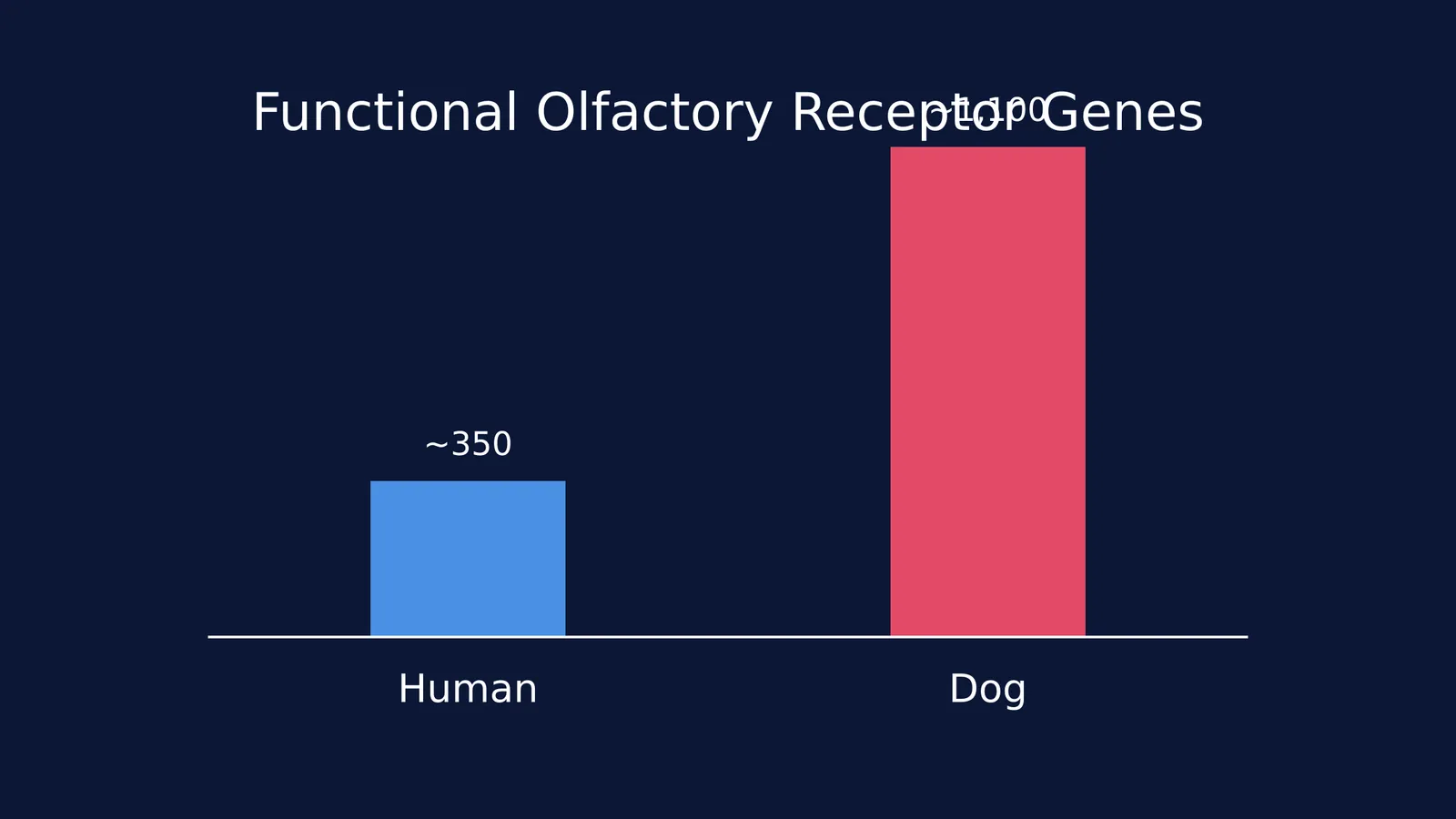
The difference is not just in physical numbers, but in the genetic code itself. A 2003 study in *Genome Biology* (10.1186/gb-2003-4-12-r80) compared the olfactory receptor (OR) genes of dogs and humans.
The researchers found that dogs have roughly 1,300 OR genes, while humans have about 900. The most significant difference is how many of these genes actually work. In humans, approximately 63% of these genes are pseudogenes, which are inactive remnants of evolution. In dogs, only about 18% are pseudogenes, meaning the vast majority of their receptor genes are fully functional.
How does the canine brain process scent?
Capturing the scent is only half the process; the nervous system must also interpret it. Once an odour molecule binds to a receptor, the signal travels along the olfactory nerve straight to the brain's olfactory bulb.
In a dog, the olfactory bulb is located further forward in the brain. Dogs dedicate a significant portion of their brain volume to analysing odours, maintaining high relative volumes in both the higher-order isocortex and the limbic system. Because scent signals route directly to the limbic system, which governs memory and emotion, dogs form immediate, powerful associations with the smells they encounter.
If you are studying the nervous system and find it hard to picture how nerve impulses travel, the Fermi Simulation Lab has interactive simulations for the ideas that are easier to see than to read.
Can dogs breathe and smell at the same time?
Dogs have a mechanical advantage in how they manage airflow. When a human exhales, the spent air pushes out any incoming scents, which is why we must pause smelling to breathe. Dogs bypass this problem entirely.
When a dog sniffs, air is inhaled from the front and exhaled to the side. During expiration, air does not enter or exit the dog's olfactory recess. This results in prolonged exposure of inspired air to the chemoreceptors and continued olfactory stimulation throughout the respiratory cycle, letting a dog sample the air repeatedly.
Study checklist: The olfactory pathway
When revising the nervous system for biology, use this step-by-step checklist to trace how a smell becomes a memory:
Capture: Odour molecules enter the nasal cavity and dissolve in the mucus.
Reception: Molecules bind to the cilia of olfactory receptor cells.
Transduction: The receptor cell fires an electrical impulse along the olfactory nerve.
Processing: The signal reaches the olfactory bulb at the front of the brain.
Integration: The bulb sends the data to the limbic system (for emotion) and the cortex (for identification).
If you want to learn more about human anatomy, you might like our guides on the Parts of the human brain: forebrain, midbrain and hindbrain roles or Control and coordination in Class 10: reflexes, brain and hormones.


