

On this page
When you begin learning calculus, the first differentiation rule you meet is that the derivative of any isolated constant number—like 5, -3, or π—is exactly zero. While it is a quick rule to memorise, it is much easier to apply in exams when you understand why it holds true in the first place.
A derivative tells us how fast one quantity changes as another quantity changes. Because a constant number is fixed and never changes, its rate of change is absolutely zero.
What does the derivative of a constant mean?
The constant rule states that if f(x) = c, where c is a real number, then the derivative f'(x) = 0 (OpenStax, Calculus Volume 1).
In physics, you can picture this as an object standing perfectly still. If the position of a car is fixed at 10 metres from a stop sign, its position does not change over time. The rate of change of position with respect to time is defined as velocity. Since the position is constant, the velocity is zero. Any constant value produces a rate of change of zero, regardless of what variable you differentiate it with respect to.
This also applies to constants that look complicated. For example, the derivative of e², sin(π/4), or √2 is zero, because none of these values contain the variable x.
Why is the derivative of a constant zero on a graph?
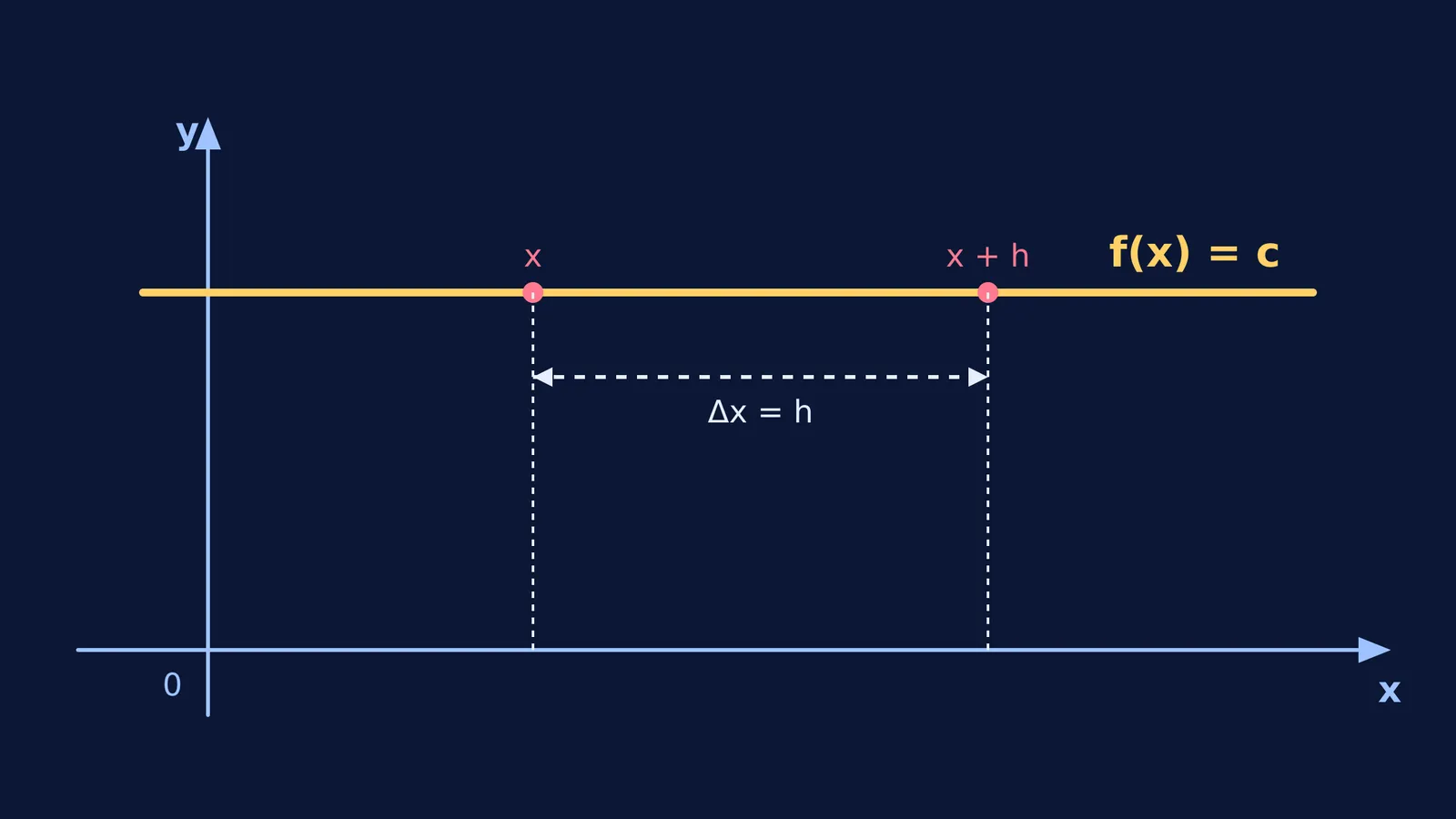
One of the best ways to build intuition for calculus is to draw it. A function takes an input (x) and gives an output (y). For a constant function like f(x) = 4, the output is always 4, no matter what x value you choose.
If you plot this on a graph, you get a perfectly horizontal line at y = 4.
The derivative of a function at a specific point is the slope of the tangent line to the graph at that point (OpenStax, Calculus Volume 1). For a horizontal line, the line is perfectly flat. It does not rise or fall as you move from left to right. A flat line has a slope of exactly zero everywhere. Therefore, the derivative is zero for all values of x.
If you have concept gaps when connecting graphs to algebraic equations, you can find a dedicated lesson for each calculus topic in the Fermi Concept Library, or you can read about the Derivative as the slope of a tangent: zoom in and see it.
How to prove the derivative of a constant is zero?
We can prove this mathematically using the first principles of calculus, also known as the limit definition of a derivative.
The formal definition of a derivative is the limit of the Difference Quotient of x² and 1/x: The Bridge to Calculus as the step size (h) approaches zero:
f'(x) = lim (h → 0) [ f(x + h) - f(x) ] / h
Let us apply this to our constant function, f(x) = c.
Find the value of f(x). The function is a constant, so f(x) = c.
Find the value of f(x + h). Because the function outputs c for any input, adding a small step size h makes no difference. The output remains exactly c, meaning f(x + h) = c.
Put these values into the numerator of the limit formula. f(x + h) - f(x) = c - c = 0.
Divide by h and evaluate the limit. f'(x) = lim (h → 0) [ 0 / h ] = lim (h → 0) 0 = 0.
Because the numerator evaluates to exactly zero before we even take the limit, the whole expression is exactly zero. The step size h never actually reaches zero in the denominator, so we safely avoid division by zero.
What happens when a constant is multiplied by a function?
A common mistake in board exams and competitive tests is confusing an isolated constant with a constant multiplied by a changing variable.
If you have a function like g(x) = 3x², the constant 3 is a coefficient. By the constant multiple rule, the derivative of a constant multiplied by a function is the constant multiplied by the derivative of the function (OpenStax, Calculus Volume 1).
So, d/dx [3x²] = 3 × (2x) = 6x. The 3 does not vanish because it is attached to a variable that is changing.
To help you avoid mistakes, use this three-step differentiation checklist when reviewing your steps:
Check for isolated constants. Does the term contain the variable you are differentiating with respect to? If not (e.g., + 5 or - π), its derivative is zero.
Identify coefficients. Is the constant multiplied by a variable term? If yes, pull it out front and differentiate the variable part.
Watch out for hidden constants. Terms like ln(2) or cos(30°) are constants. Treat them exactly like normal numbers.
By keeping the graph of a horizontal line in your mind, you can rely on a visual picture rather than just memorising the rule.


