

On this page
If you have ever packed a homemade Indian lunch in a plastic box, you know the aftermath: a stubborn, neon-yellow ring that refuses to wash off. No matter how much soap, hot water or scrubbing you use, the stain stays.
The culprit is not poor dishwashing. It is a fundamental rule of chemistry taking place right inside your lunchbox.
The chemistry of the yellow pigment
The defining ingredient in most curries is turmeric, which gets its vibrant yellow colour from a chemical compound called curcumin.
Curcumin's structure consists of two aromatic rings connected by a carbon chain. Because it is largely made of carbon and hydrogen, it lacks the charged, polar regions that would make it attract water molecules. Instead, its hydrophobic (water-repelling) structure makes it easily soluble in the fats, oils and ghee used for cooking a curry.
Why do plastic containers get stained by curry?
The stubbornness of the stain comes down to a rule taught in early chemistry classes: "like dissolves like."
Most everyday food containers are made from polypropylene or polyethylene. These plastics are essentially very long chains of repeating carbon and hydrogen units, making them structurally similar to cooking oils. They have no partial electrical charges across their surface. In chemistry, polar substances (like water) dissolve other polar substances, while non-polar substances dissolve other non-polar substances.
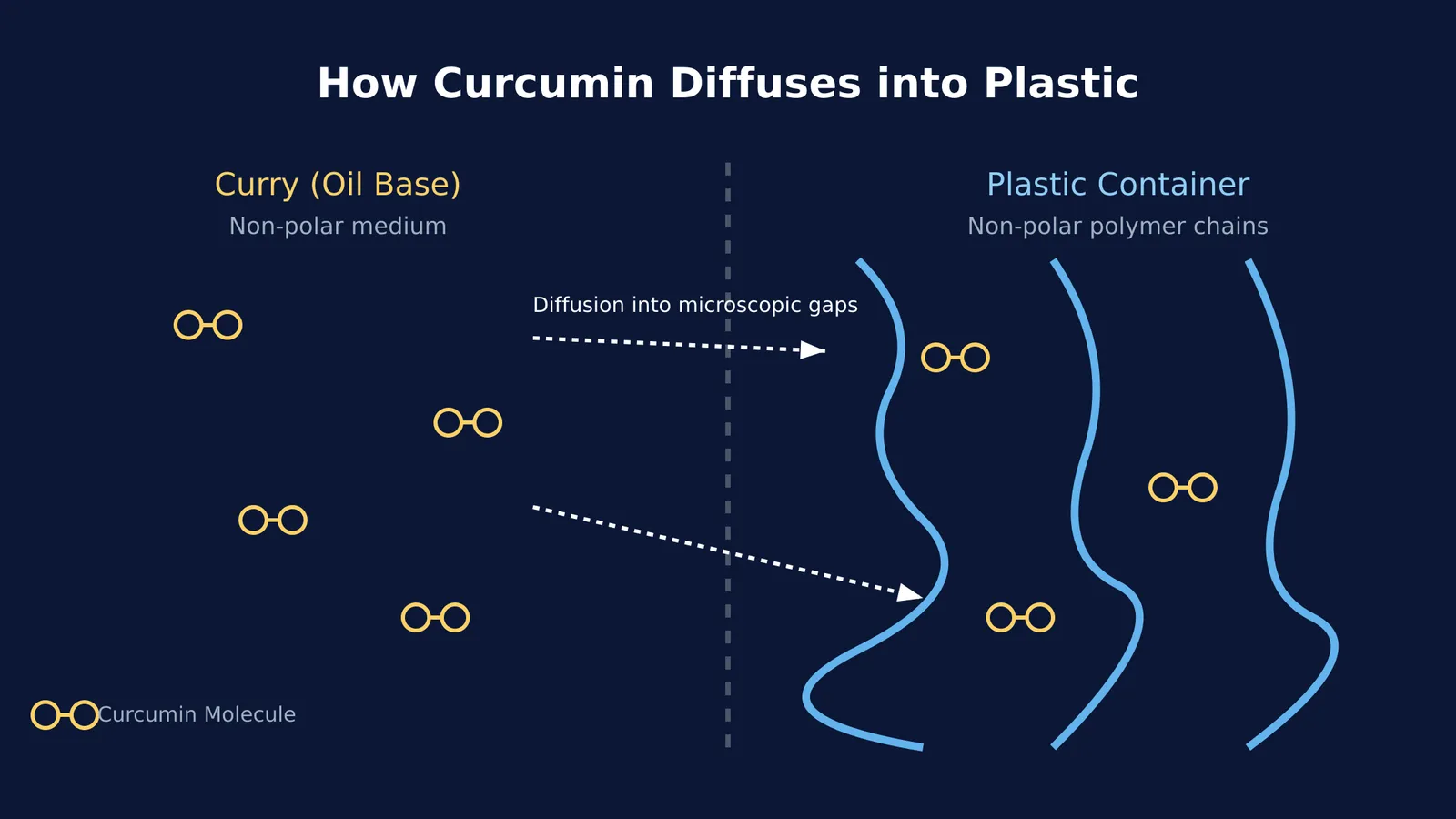
When warm, oil-rich curry meets the plastic container, the non-polar curcumin molecules migrate from the food into the walls of the box. They slip into the microscopic spaces between the long polymer chains. Because both the pigment and the plastic are non-polar, they share a strong chemical affinity, making the stain deep and persistent rather than a simple surface mark.
Visualising how molecules move and dissolve can be tricky. If you want to see how temperature and structure affect particle motion, the Fermi Simulation Lab provides interactive simulations for the ideas that are easier to see than to read.
How does heat affect the stain?
The staining effect is accelerated by temperature. When you store a hot meal or reheat a box in a microwave, the thermal energy increases the kinetic energy of the molecules. The long polymer chains that make up the polypropylene container begin to vibrate and move further apart, creating larger microscopic gaps in the plastic matrix.
At the same time, the hot oil and curcumin molecules become more energetic and fluid. This allows the yellow pigment to diffuse much faster and deeper into the expanded plastic walls. As the food and the container later cool down in the fridge or on the counter, the polymer chains lose their kinetic energy and contract, tightly trapping the curcumin molecules inside the plastic.
Why does soap not work?
Dish soap is designed to bridge the gap between oil and water, which is why it easily cleans the grease off the surface of the container. However, soap and water are polar mixtures. They cannot penetrate the non-polar polymer matrix to reach the curcumin molecules that are trapped deep inside the plastic.
Can sunlight remove curry stains?
Since you cannot easily scrub the curcumin out of the plastic, another approach is to break the molecule down chemically.
Curcumin is sensitive to light and breaks down under ultraviolet radiation. If you leave your stained container outside in direct sunlight, the energy from the sun helps break the molecule apart. As the pigment degrades into smaller fragments, the stain fades, leaving your container clearer.
Read next:


