

On this page
You spill a drop of coffee on your desk, leave it to dry, and come back to find a dark stain around the edge with a lighter centre. Why does the coffee not dry as an even, uniform spot?
The answer lies in a physical process known as the coffee ring effect. In 1997, a team of physicists led by Robert Deegan at the University of Chicago published a study in *Nature* showing that this ring formation is driven by capillary flow. Their 1997 paper has since been cited over 6,150 times, explaining everything from drying paint to DNA mapping.
Why does the edge get pinned?
When a liquid drop hits a solid surface, it does not sit perfectly like a mathematical sphere. The contact line — the perimeter where the liquid meets the solid and the air — gets "pinned" to microscopic bumps and roughness on the surface.
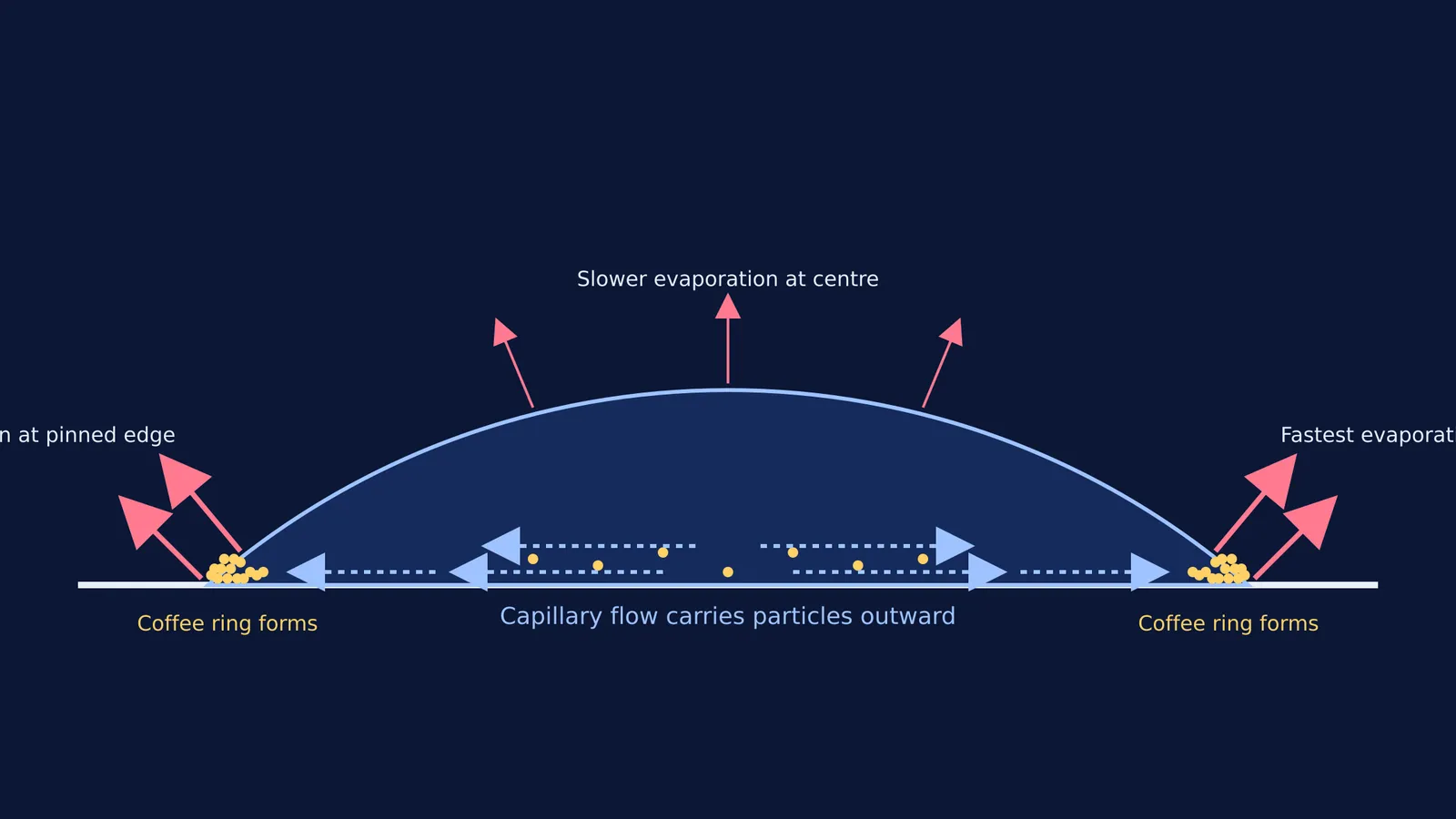
Because the edge is trapped, the drop cannot shrink inward as its water evaporates. Instead of getting narrower, the drop simply gets flatter over time. This pinning is essential. If the drop could shrink smoothly, it would simply leave a small, concentrated dot of coffee right in the middle of the spill.
Why is evaporation faster at the edge?
Water evaporates from the entire surface of the drop, but it happens fastest at the perimeter. This is a matter of geometry. At the very edge, the curved surface of the drop meets the flat desk at an acute angle. Water molecules escaping from the edge have a wider angle of empty air to diffuse into, compared to molecules escaping from the centre of the drop.
Because the pinned edge is losing water faster than the rest of the drop, liquid must move to replace it to prevent the edge from shrinking.
How does capillary flow build the ring?
To keep the pinned edge wet and stop the drop from shrinking, a capillary flow rushes outward from the centre of the drop to the perimeter.
Think of this outward flow as a microscopic conveyor belt. Coffee is a mixture of water and tiny, suspended particles. As the liquid flows to the edge, it carries all these suspended particles with it. When the water reaches the edge and evaporates, it leaves the solid particles behind. By the time the drop has completely dried, almost all the coffee grounds have been swept to the perimeter, leaving a dense, dark ring.
The researchers noted that this effect is independent of the chemical composition of the liquid or the suspended solids. Whether you are dealing with a spilled beverage or advanced materials, the physics remains the same. The mathematical model they developed showed that the outward velocity of the fluid actually becomes extremely high just before the last of the liquid evaporates, packing the particles tightly at the very rim.
How can you stop the coffee ring effect?
If you are formulating a new ink or just want to stop a spill from staining as a ring, you have to break the capillary flow. You can disrupt the flow in two practical ways:
Change the surface: If you spill on a highly water-repellent (hydrophobic) surface, the edge does not get pinned. The drop shrinks evenly as a sphere, leaving a small dot.
Add a second liquid: Adding a solvent that evaporates at a different rate creates a counter-current — called the Marangoni flow — that swirls the liquid and pulls particles back toward the centre.
Understanding these flows is a standard part of studying fluid dynamics. Surface tension and viscosity: capillary rise to terminal velocity explores the forces at play in these liquids, while A journey through states of water in Class 6: evaporation explained covers the basics of phase changes.
If you are trying to picture exactly how evaporation rates change across a curved surface or how fluids flow under pressure, reading a textbook is often not enough. The Fermi Simulation Lab provides interactive simulations for the ideas that are easier to see than to read, allowing you to watch the particles move and understand the forces driving them.


