On this page
When you lift a hot slice of pizza, the cheese does not tear cleanly like bread or drip like water. Instead, it draws out into long, glossy ribbons that stretch across the dinner table. This behavior is rooted in the molecular architecture of milk proteins, specifically a family of phosphoproteins known as caseins.
What happens to milk proteins when cheese melts?
In liquid milk, caseins do not float as solitary molecules. As detailed in a review on casein micelle architecture in the Journal of Dairy Science73869-7), caseins assemble into spherical colloidal clusters known as micelles, ranging from 50 nm to 500 nm in diameter. These micelles are held together internally by nanoscale bridges of colloidal calcium phosphate, which bind to phosphorylated serine amino acids on the protein chains. During cheesemaking, the enzyme chymosin trims the protective outer coat of κ-casein, causing the micelles to stick together into an interconnected gel network.
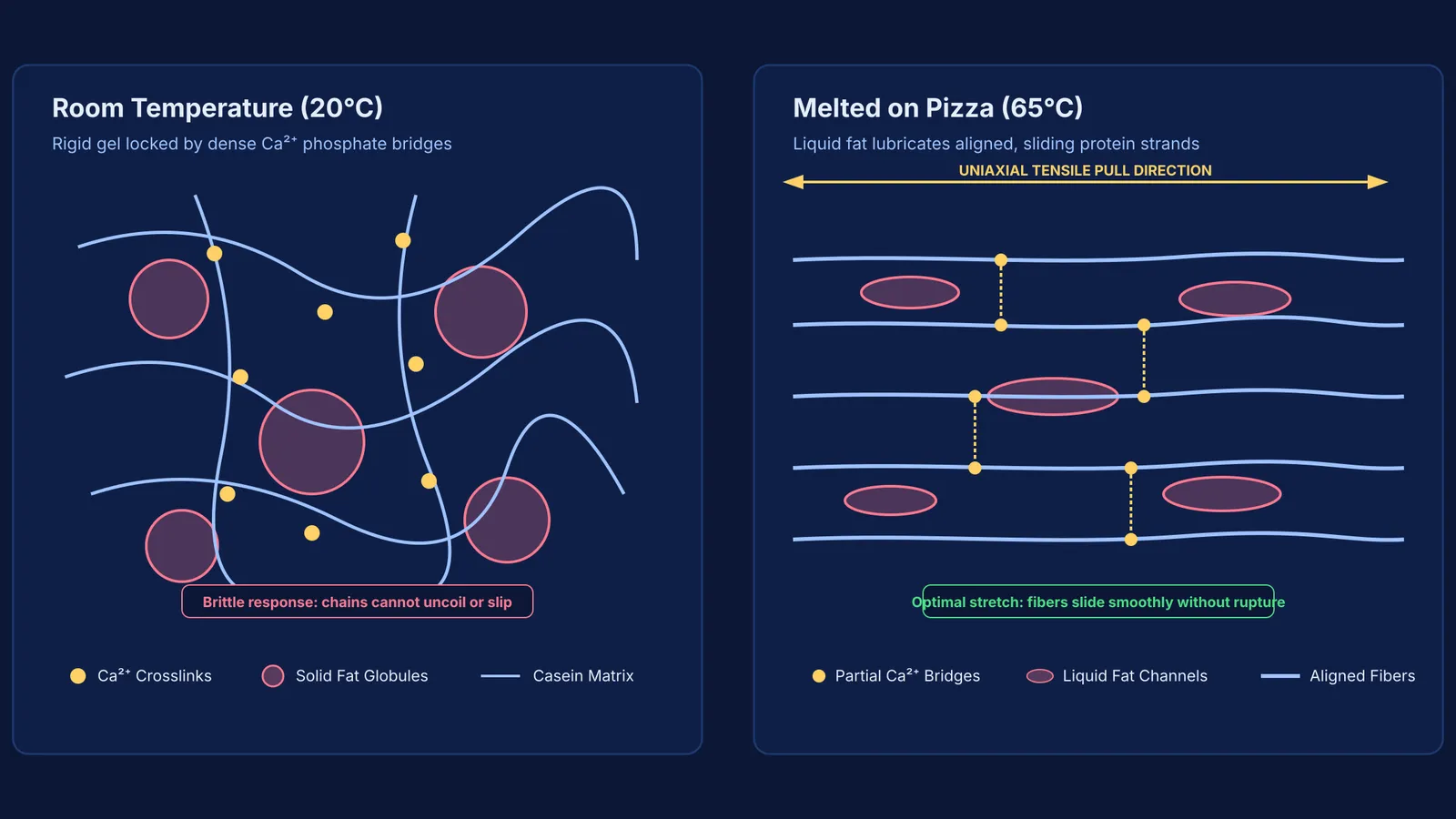
Cheeses are viscoelastic materials possessing both solid elasticity and liquid viscosity. At room temperature, the casein network forms a continuous scaffold that traps moisture and solid fat globules. When pizza enters an oven, heat delivers thermal kinetic energy that weakens the non-covalent hydrogen bonds and hydrophobic interactions stabilizing the protein matrix. The scaffold relaxes, allowing the protein chains to unfold, untangle, and flow under mechanical tension. To understand how primary peptide chains fold into these intricate three-dimensional networks, see our guide on protein structure from primary to quaternary levels.
Why does mozzarella stretch while paneer and cheddar do not?
If heat softens milk proteins, why does mozzarella stretch while an Indian paneer or an aged cheddar does not? The secret lies in a delicate balance between acidity and calcium crosslinks.
Cheesemakers produce mozzarella through the Italian *pasta filata* technique, monitoring the curd until lactic acid fermentation brings the pH down to a window between 5.2 and 5.4. According to research on calcium distribution in the Journal of Food Science, acidity directly controls how much calcium stays locked inside the protein matrix versus dissolving into the surrounding whey. At neutral pH, excessive calcium bridges make the protein gel too rigid to elongate. Below pH 5.0, nearly all calcium phosphate dissolves, leaving the protein chains unlinked so that they slip apart into a soupy puddle.
A study in the Journal of Dairy Science74238-0) demonstrated that curd at pH 5.2 to 5.4 achieves an ideal calcium-to-casein balance: partial solubilization of colloidal calcium phosphate loosens the dense matrix, while the remaining calcium crosslinks provide tensile cohesion to prevent strands from snapping. Furthermore, as described in investigations of protein matrix structure in the Journal of Dairy Science73061-7), kneading the warm curd during manufacturing aligns the casein micelles into parallel longitudinal fibers, creating microscopic runways that guide uniform elongation.
By contrast, aged cheddar undergoes extensive proteolysis, where enzymes break long casein polymers into short peptide fragments that lack the structural length needed to form fibers. Paneer undergoes acid-heat coagulation at high temperatures exceeding 80°C, causing whey proteins like β-lactoglobulin to denature and form permanent covalent disulfide bonds with casein that resist melting.
How does temperature turn a solid curd into elastic strands?
The transformation of mozzarella on a hot pizza is a two-step physical transition driven by temperature:
Fat liquefaction (32°C to 40°C): Milk fat triglycerides melt fully between 32°C and 40°C, turning solid fat crystals into microscopic pockets of liquid oil. According to research on cheese melting dynamics in the Journal of Texture Studies, this liquid fat lubricates the dense casein matrix, preventing friction and premature tearing as the protein strands move.
Casein matrix relaxation (55°C to 65°C): As temperature climbs past 55°C, thermal energy overcomes the weak secondary bonds holding the protein chains in place. The storage modulus drops sharply, shifting the cheese from an elastic solid to an elongational fluid.
A mechanical study in the Journal of Dairy Science measured this behavior using a standardized three-prong tensile test and found that mozzarella stretchability reaches its maximum performance at an optimal temperature of 60°C to 65°C. At this temperature, the balance between liquid fat lubrication, protein chain mobility, and intact calcium crosslinks allows the cheese to extend under tensile pull without thinning unevenly. If the cheese cools below 50°C, the fat begins to recrystallize and the protein bonds re-harden, causing the pull to snap abruptly.
To see how molecular networks stretch and flow under mechanical stress, the Fermi Simulation Lab provides interactive simulations for the ideas that are easier to see than to read.
What does the pizza pull teach us about states of matter?
Rheological studies in the Journal of Dairy Science73869-7) demonstrate that melted cheese behaves like a viscoelastic polymer network rather than an ordinary liquid. In school science, students often learn that matter transitions neatly between distinct solid, liquid, and gas phases, as covered in foundational lessons on states of matter and phase changes. Yet melted cheese shows that real materials frequently exist as complex viscoelastic fluids that defy simple classification.
When you pull a slice of pizza, you are applying uniaxial tensile stress to a polymer network. If you pull too quickly, the cheese behaves like an elastic solid and snaps because the casein chains do not have enough time to uncoil and rearrange. If you pull slowly, the Deborah number of the deformation decreases, allowing the chains to slip past one another in steady viscous extension. The physical principles governing this response mirror the equations for stress, strain, and Young's modulus in mechanical physics.
When reviewing how intermolecular forces shape macroscopic properties for school exams, the Fermi Concept Library covers every concept in physics and chemistry, each with its own lesson and its place in the map.