

On this page
A butterfly landing on a leaf in your garden is not just resting. If it is a female, she is likely tasting the plant. While butterflies drink nectar through a straw-like proboscis, they use their feet to taste surfaces. This ability, known as contact chemoreception, is a critical step in their life cycle.
Why do butterflies taste with their feet?
A female butterfly tastes leaves to find the correct host plant for her offspring. Most caterpillars are extreme specialists, meaning they can only eat specific types of plants. For example, monarch caterpillars feed exclusively on milkweed, which contains toxins that deter predators but do not harm the monarch.
If a butterfly lays her eggs on the wrong species of plant, her caterpillars will not survive because they cannot digest the leaves or survive the plant's natural chemical defences. By tasting the plant before laying eggs, the mother ensures her young will hatch onto a safe, ready-to-eat food source. This early decision dictates the survival of the next generation.
What is tarsal drumming?
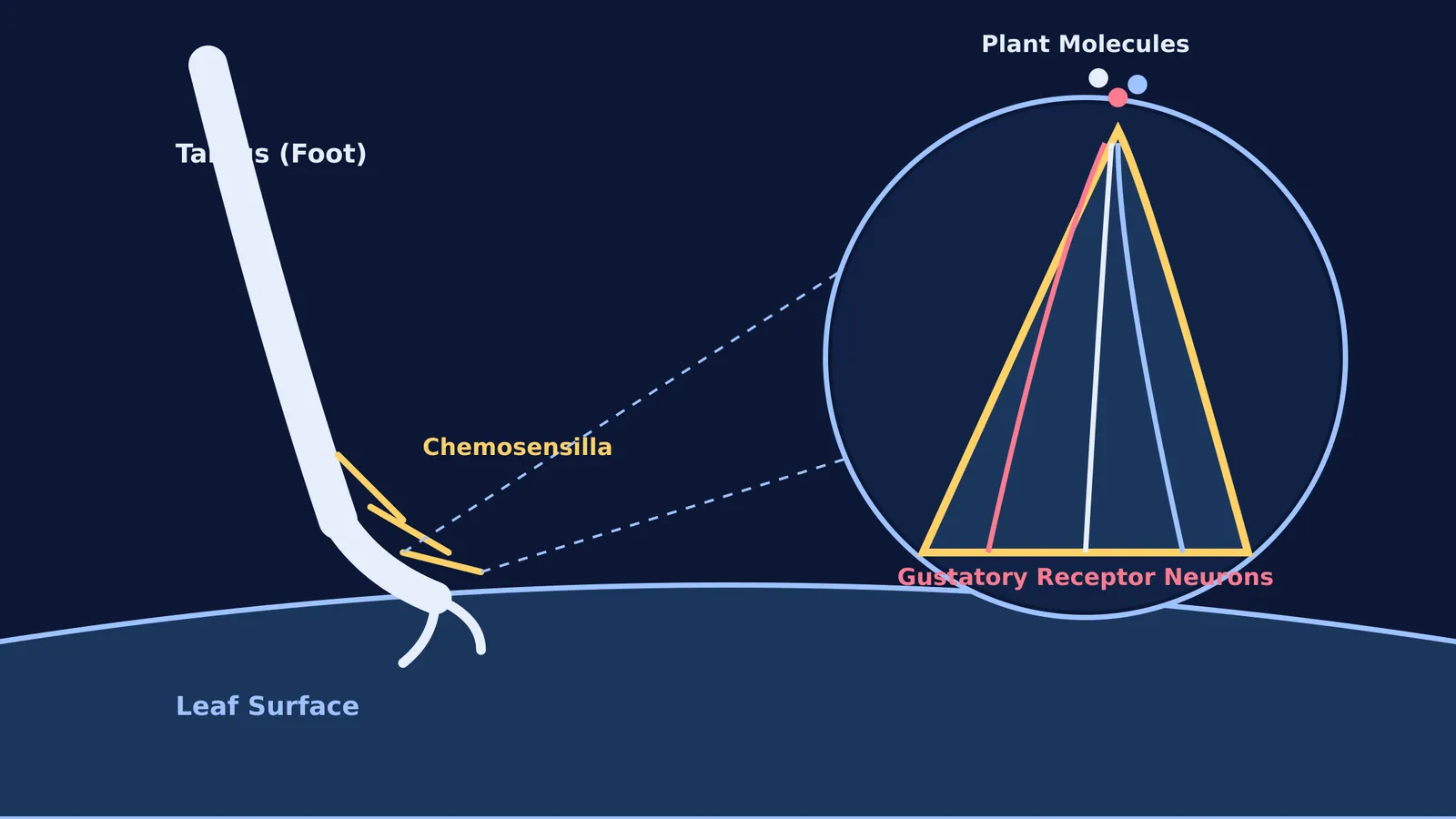
To taste a leaf, a female butterfly performs a behaviour called tarsal drumming. During tarsal drumming, the butterfly taps her forelegs against the leaf surface (Ozaki et al., 2011).
This drumming action releases non-volatile plant juices and secondary metabolites, which wash over the sensory organs on the butterfly's feet. The butterfly evaluates this chemical soup to identify the plant. If the chemical profile is a match, she curls her abdomen and lays an egg. If the plant is incorrect, she immediately flies away to test another leaf.
How do butterflies taste with their feet?
The butterfly's feet, formally called tarsi, are equipped with specialised sensory hairs known as contact chemosensilla. Inside these microscopic hairs are nerve endings called gustatory receptor neurons (GRNs) that act as the actual taste sensors.
A 2013 study found that the female swallowtail butterfly (*Papilio xuthus*) uses specialised chemosensilla on its forelegs to detect host plants (Ryuda et al., 2013). These sensilla house specific neurons that fire only when they detect a precise mixture of chemical compounds. In the swallowtail, three specific GRNs must fire together in response to five different plant compounds—including synephrine and stachydrine—to trigger the egg-laying reflex.
This lock-and-key binding between plant chemicals and nerve receptors is a classic example of biology at the molecular level. The receptor proteins in the nerve cell membrane change shape when the right plant molecule binds to them, initiating an electrical spike that travels to the butterfly's brain.
If you find it hard to picture how molecular receptors and action potentials work, the Fermi Simulation Lab provides interactive simulations for the ideas that are easier to see than to read. You can manipulate variables and watch how a signal propagates across a synapse.
How to observe butterfly behaviour in your garden
You do not need a laboratory to observe this biology in action. If you have access to a park or garden, here is a short checklist for watching butterflies make these chemical decisions:
Watch the landing: Look for a female butterfly flying low over vegetation and landing briefly on multiple leaves.
Look for drumming: Watch her front legs carefully. If she rapidly taps the leaf surface, she is tarsal drumming to release the plant's chemicals.
Check for eggs: If she stays on the leaf and curls her abdomen underneath it, she has successfully matched the host plant. Once she leaves, you can gently turn the leaf over to find a tiny, round egg.
Identify the plant: Note which plant species she chose. Over time, you will notice that certain butterfly species only visit specific plant families.
Understanding how species interact through chemistry connects many areas of biology, from ecology to neural pathways. If you need to trace these connections across your syllabus, the Fermi Concept Library holds every concept in physics, chemistry, biology, mathematics and computing, each with its own lesson and its place in the map.
To learn more about how insects interact with their environment, read about Christian Konrad Sprengel and how flowers recruit insects. For more on butterfly adaptations and survival, explore the story of Henry Walter Bates and the butterflies that copy others. If you are curious about the science of taste and chemoreceptors in humans, see our post on Kikunae Ikeda and the discovery of umami taste.


