

On this page
Why does looking at the sun make some people sneeze?
Step out of a dim room into direct afternoon sunlight, and your nose may prickle before an explosive sneeze. This reaction is known as the photic sneeze reflex, or ACHOO syndrome (Autosomal Dominant Compelling Helio-Ophthalmic Outburst), coined in 1978 by William Collie and colleagues in *Birth Defects Original Article Series*. A review by Bradley Whitman and Roger Packer in *Neurology* estimates that the reflex affects between 18% and 35% of the population, often provoking two or three sneezes in succession.
Over 2,300 years ago, Aristotle noted in *Problemata Physica* that the sun induced sneezing while a fire's heat did not, attributing it to nasal moisture warming. In 1627, Francis Bacon corrected this in *Sylva Sylvarum* by observing that facing the sun with closed eyes prevents sneezing, proving that light entering the eye is the trigger. In *Military Medicine*, Ray Breitenbach and colleagues tested sneezers at 430 nm, 532 nm, and 560 nm, confirming the reflex is independent of wavelength and driven purely by sudden shifts in luminance.
Is the photic sneeze reflex inherited in families?
If one parent carries the reflex, offspring have a 50% chance of inheriting it because the trait is autosomal dominant. In 1984, neurologist Stephen Peroutka published a three-generation pedigree in the *New England Journal of Medicine* after observing his four-week-old daughter sneezed twice whenever taken into sunlight.
In a 2010 study in *PLoS Genetics*, Nicholas Eriksson and colleagues analysed 9,126 individuals and identified single nucleotide polymorphism rs10427255 near the *ZEB2* gene on chromosome 2q22.3, associated with the reflex at an odds ratio of 1.32 (p ≈ 1.26 × 10⁻¹¹). They also noted a secondary marker, rs11856995, near *NR2F2* on chromosome 15q26.2.
How does neural cross-talk trigger a sneeze?
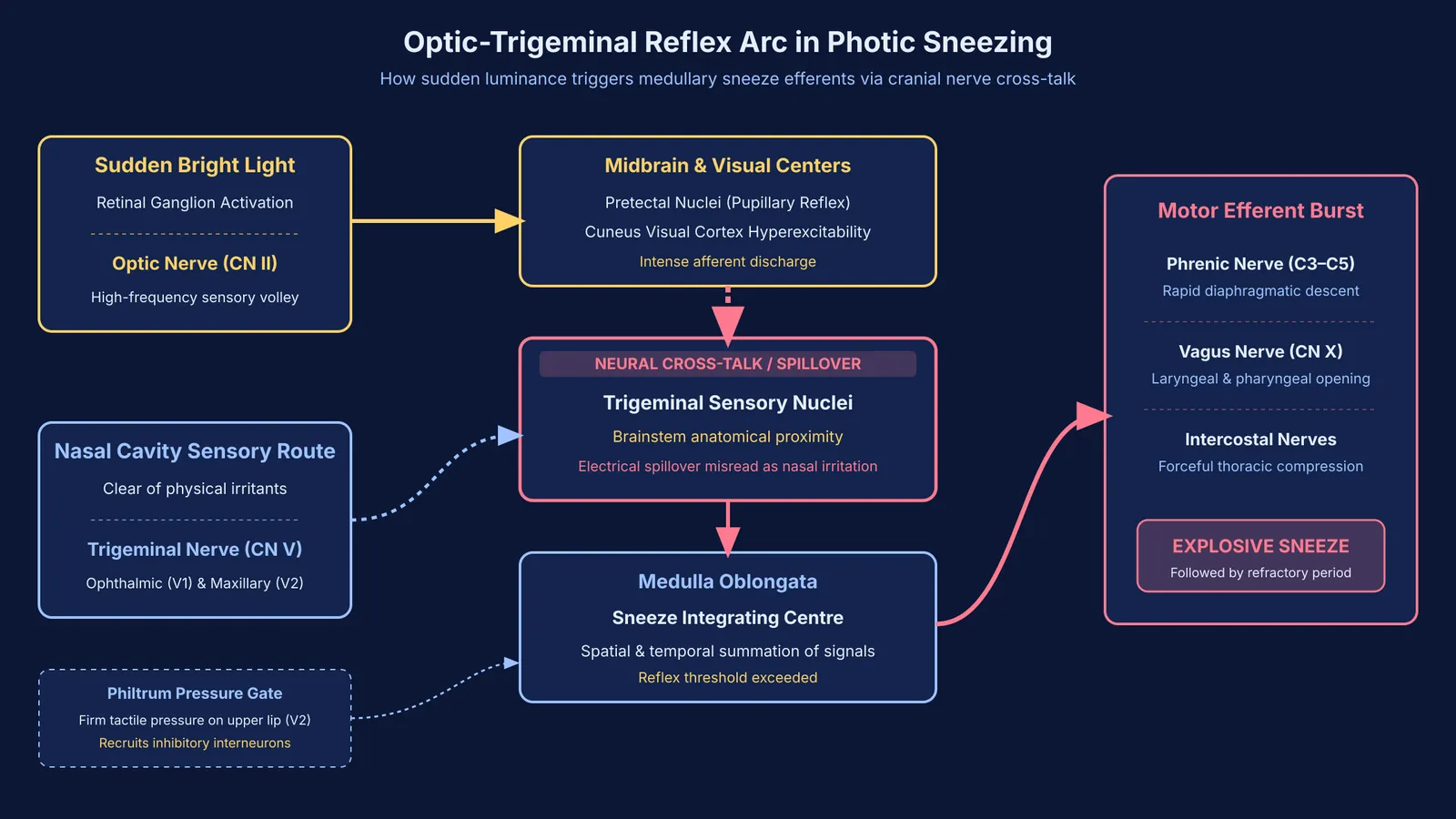
A normal sneeze clears airway irritants. As explained in our step-by-step guide to neural control and coordination, sensory receptors in the nasal lining send impulses along ophthalmic and maxillary branches of the trigeminal nerve (cranial nerve V) to the medulla oblongata, which directs respiratory motor output.
In a photic sneeze, the nasal lining is clear. Neurobiologists point to two complementary mechanisms:
Optic-trigeminal summation: Bright light causes the optic nerve (cranial nerve II) to send intense electrical volleys to pupillary centers. Because optic and trigeminal sensory pathways run close together in the brainstem, signals spill over into trigeminal nuclei, tricking the medullary sneeze centre into detecting nasal irritation.
Cortical hyperexcitability: In *PLoS ONE*, Nicolas Langer and colleagues recorded 30-channel EEGs from 10 photic sneezers and 10 controls. Photic sneezers showed heightened visual cortex (cuneus) excitability, which co-activates secondary somatosensory areas to produce a prickling facial sensation.
Can you stop a photic sneeze before it happens?
Although benign, photic sneezing can startle drivers exiting dark tunnels. Unlike allergies, photic sneezes have a refractory period: after a sneeze, sensory thresholds stay elevated, preventing another reflex for several minutes.
Two non-invasive techniques can interrupt the reflex:
Shielding the eyes: Polarized sunglasses or a brimmed hat buffer sudden luminance jumps below the spillover threshold.
The philtrum press: Pressing firmly across the groove between the nose and upper lip can arrest the sneeze before it triggers.
How are reflex arcs tested in biology exams?
The photic sneeze illustrates how real reflex circuits differ from simplified textbook diagrams. British neurophysiologist Charles Sherrington first showed how synapses coordinate reflexes, as recounted in our profile of Charles Sherrington's discovery of the reflex arc and synapse. While introductory questions often focus on simple spinal loops, like the knee-jerk reflex in our Class 10 guide to reflexes and the nervous system, cranial reflexes involve multi-sensory summation across brainstem nuclei.
Exam questions compare the two pathways:
Afferents: Trigeminal sensory fibers (CN V) in a nasal sneeze versus optic nerve volleys (CN II) spilling into trigeminal tracts in a photic sneeze.
Integration: The medullary sneeze centre alone versus combined pretectal, visual cortex, and medullary centers.
Efferents: Both converge on motor impulses via the phrenic nerve (C3–C5), vagus nerve (CN X), and intercostal nerves to contract the diaphragm and chest wall.
When studying human physiology, tracing nerve signals across multi-layered cranial networks is hard to picture on a static page. The Fermi Simulation Lab provides interactive simulations for the ideas that are easier to see than to read. To master broader nervous system concepts, the Fermi Concept Library covers every concept in physics, chemistry, biology, mathematics and computing, each with its own lesson and its place in the map.


