

On this page
Have you ever wondered why you can jump much higher on a trampoline than from the ground? The secret is in the physics of the springs.
A trampoline is a highly efficient energy conversion machine. It takes the kinetic energy of your fall, stores it, and releases it to throw you back into the air.
How does a trampoline make you bounce so high?
When you jump on solid ground, your body generates all the upward force using only your leg muscles. The ground cannot store any energy from your landing.
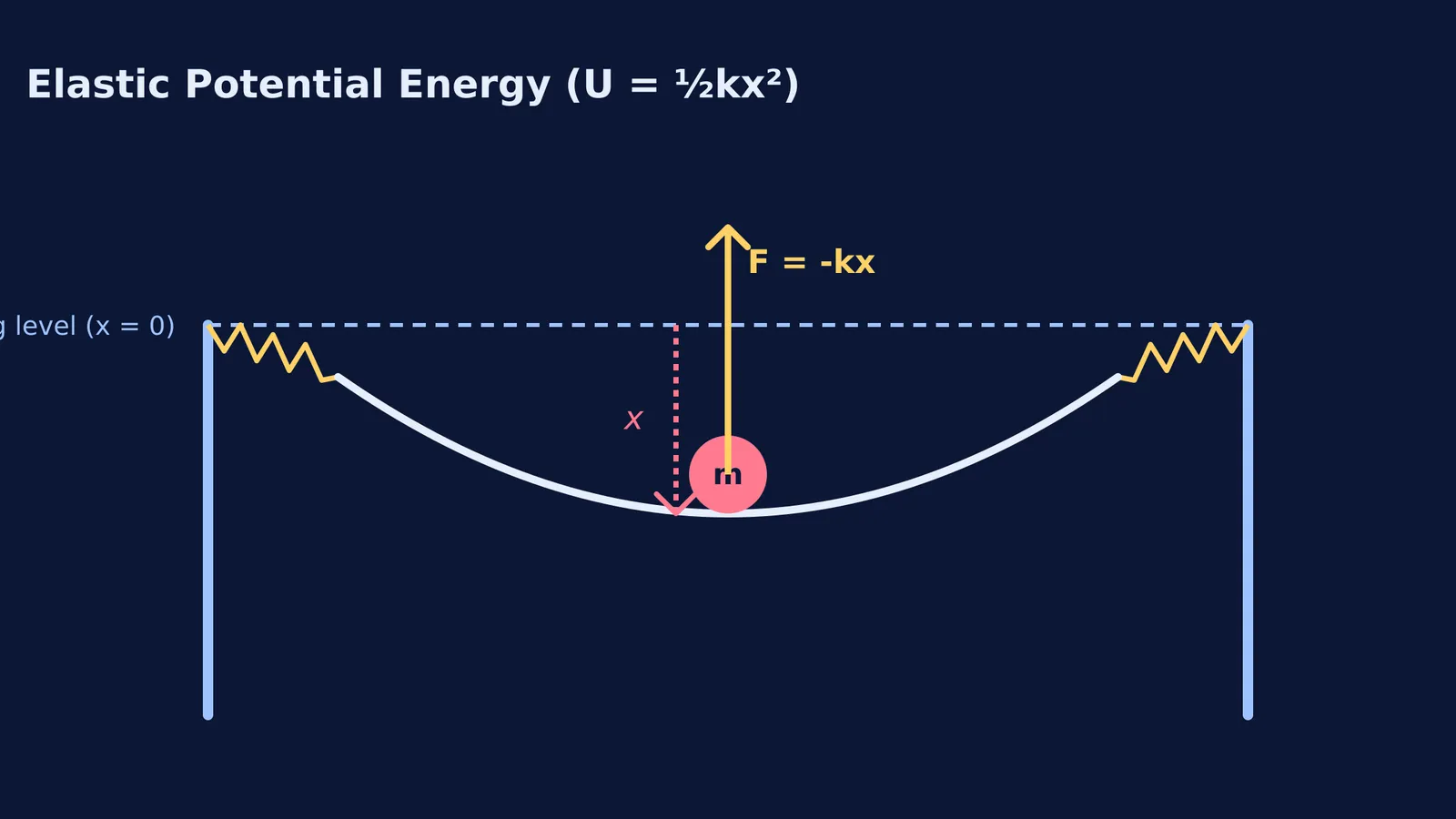
But when you land on a trampoline, the flexible mat and coiled steel springs stretch downwards. As the springs extend, they capture the energy of your falling motion and store it as elastic potential energy.
Hooke's law states that the restoring force exerted by a spring is directly proportional to how far it has been stretched. The formula for the elastic potential energy (U) stored in these springs is U = ½kx², according to the OpenStax *University Physics* textbook. In this equation, k is the spring constant (a measure of stiffness) and x is the displacement the spring stretches from its resting position.
Because the stored energy depends on the square of the stretch (x²), the physics works in your favour. If you sink twice as deep into the mat, the trampoline stores four times as much energy to throw you back up. Sink three times as deep, and you get nine times the stored energy. This quadratic relationship is why a small increase in effort results in a dramatically higher bounce.
How is energy conserved during the bounce?
Bouncing on a trampoline demonstrates the conservation of mechanical energy. This cycle of energy transformation is closely related to the simple harmonic motion simulation concepts often tested in exams.
Here is what happens during a perfect bounce:
The Peak: At your highest point, you briefly stop. Your kinetic energy is zero, and your gravitational potential energy is at its maximum.
The Fall: Gravity pulls you down, converting potential energy into kinetic energy. You move fastest right before touching the mat.
The Compression: The mat pushes down and the springs stretch. Your kinetic energy becomes elastic potential energy. At the deepest point, your speed is zero, meaning all energy is now stored in the springs.
The Rebound: The springs snap back to their original shape, transferring the stored energy back into kinetic energy and launching you skyward.
If you struggle to picture how velocity drops to zero exactly as spring stretch reaches its maximum, the Fermi Simulation Lab provides interactive simulations for ideas that are easier to see than to read.
When does Hooke's law stop working?
Hooke's law applies only within a certain range, known as the elastic limit.
The law assumes that springs are perfectly linear. If you stretch the steel springs too far with too much mass, they exceed their elastic limit. When this happens, the springs deform permanently. They lose their ability to bounce back, meaning they can no longer store elastic potential energy effectively.
How do you calculate the height of a trampoline bounce?
You can apply the principle of energy conservation to predict how high you will bounce. If you assume no energy is lost to air resistance or internal friction, your maximum elastic potential energy at the bottom equals your maximum gravitational potential energy at the peak.
You can calculate this in three steps:
Stored energy: Use Hooke's law (U = ½kx²) to find the total elastic potential energy stored at the lowest point.
The equality: Set this equal to your gravitational potential energy (mgh), where m is your mass, g is gravity, and h is the maximum height.
Solve for height: The equation is ½kx² = mgh. Dividing by mg, the height of your bounce is h = kx² / (2mg).
This equation proves mathematically why trampolines are powerful: the upward height (h) grows with the square of the depth (x) you push into the mat.
For students working through calculations at home, Fermi's AI tutor can work out what you already know, build a plan for the session, and teach through the problem by drawing the figure and checking your understanding as it goes.


