

On this page
Spin a coin on a table and listen. It starts upright and quiet, then leans over, and the whirr gets faster until it slaps flat. It seems to speed up just as it runs out of energy. It does not, and the reason is a neat lesson in rotation.
Why does a spinning coin wobble faster before it stops?
A spinning coin does two different things at once. The coin's face turns, and the point where its edge touches the table runs round in a circle. The whirr you hear comes from that contact point, and physicists call its rate the precession rate, Ω.
For a thin disc rolling without slipping, with its centre at rest, Ω² = g/(k·a·sin α), where a is the radius, α is the tilt from the table and k = 1/4 for a uniform disc (McDonald and McDonald, arXiv). The same paper notes that as α approaches zero, the angular velocity of the point of contact becomes very large, while the figure on the face of the coin turns more and more slowly.
So the flatter the coin, the faster the contact point must circle. Gravity tries to tip the coin, and its angular momentum turns sideways in response: the same precession that keeps a top up. Our post on why a spinning top does not fall over covers that idea, and gyroscopic precession in a spinning wheel shows it at a larger scale.
If it is losing energy, how can it speed up?
Write the coin's energy as height energy plus rotation energy. Caps and colleagues use E = mga·sin α + ½·I·Ω²·sin²α (Caps et al., Physical Review E, 2004). Put in the steady-rolling formula above, with I = ma²/4, and the two terms combine to E = (3/2)·m·g·a·sin α.
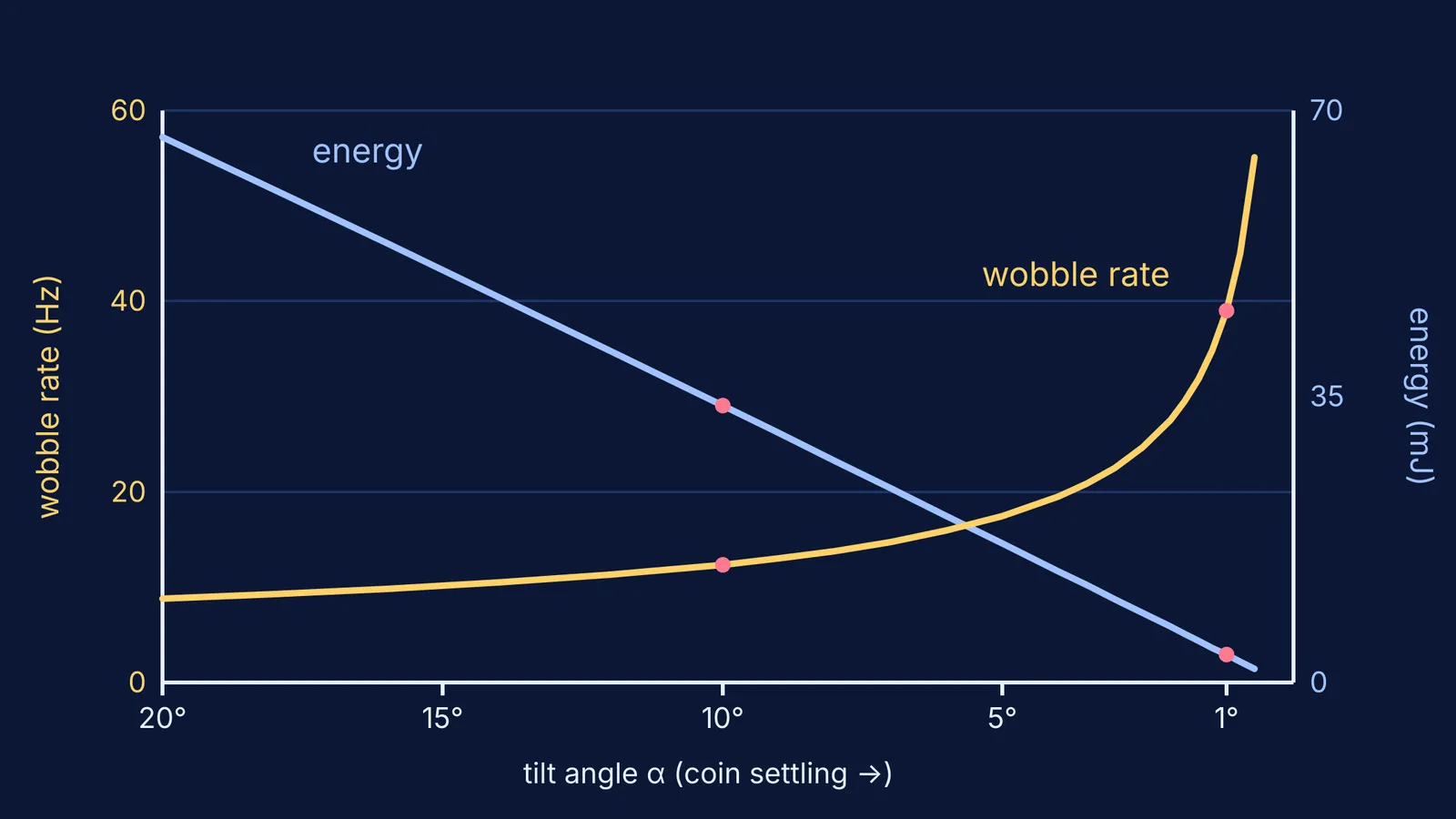
That line answers the puzzle. Energy depends only on the tilt, so as friction drains energy, the tilt must fall. A smaller tilt then forces a larger Ω. Nothing about the coin gets more energetic: the kinetic energy goes as Ω²·sin²α, and that still shrinks.
Worked example: the numbers for a real disc
Take the stainless steel disc from the Caps experiment: 75 mm across (a = 0.0375 m) and 353.4 g (Caps et al., arXiv version). Use Ω² = 4g/(a·sin α), E = (3/2)·m·g·a·sin α, and the face's turning rate Ω(1 − cos α) from the McDonald paper.
At 10° tilt: Ω is about 78 rad/s (about 12 circuits a second), energy about 34 mJ, and the face turns once in about 5 seconds.
At 5° tilt: Ω is about 110 rad/s (about 17 a second), energy about 17 mJ, and the face turns once in about 15 seconds.
At 1° tilt: Ω is about 245 rad/s (about 39 a second), energy about 3.4 mJ, and the face turns once in nearly 3 minutes.
From 10° to 1°, energy falls about tenfold while the wobble rises about 3.2 times, roughly the square root of 10. In the same paper, the measured rate for an alumina disc of the same 75 mm size climbs from about 80 to about 260 rad/s over its last 4 seconds, the same range as these numbers. The formula assumes perfect rolling; real coins also slip, so treat it as a guide, not an exact prediction.
What actually drains the energy?
This was argued over for years. In 2000, Keith Moffatt proposed that viscous drag in the thin layer of air under the disc does the damping (Moffatt, Nature, 2000). Caps and colleagues found that the air-drag predictions did not fit their measurements, and pointed to vacuum experiments that showed only small effects from air drag (Caps et al., 2004).
Their own test was direct. The same alumina disc spun for about 12.4 seconds on glass but about 3.4 seconds on a higher-friction alumina plate, and they concluded that rolling and slipping on the surface is the major loss. A 2017 study also checked tiny impacts from imperfect edges and found they are typically not dominant for a uniform disc on a hard surface (Baranyai and Várkonyi, Physical Review E).
How can you test this at home?
You need a heavy coin, a phone and two surfaces.
Spin the coin on glass or polished stone and time it. Repeat three times.
Predict which surface gives a shorter spin, then time it on a wooden table.
Near the end, watch the picture on the coin's face. It barely turns while the whirr races.
Measure your coin's radius and use Ω² = 4g/(a·sin α) to estimate the wobble rate at 2° tilt.
Precession is easier to see than to read. The Fermi Simulation Lab has interactive simulations for ideas like this. If angular momentum still feels shaky, start with its lesson in the Fermi Concept Library.


