

On this page
If you have ever spun a wooden top (a *lattu*) on the ground, you know that it stands perfectly on its sharp point as long as it spins fast. But the moment it slows down, it begins to wobble and eventually tips over.
Every student learning rotational mechanics in Class 11 encounters this exact puzzle. It is one of the most elegant demonstrations of angular momentum in action.
Why does a spinning top lattu not fall over?
To understand why a top stays upright, we must first look at what happens when it is not spinning. If you stand a stationary top on its tip and let go, gravity pulls down on its centre of mass. Because the top is supported only at the tip, this downward force creates a turning effect, or torque. In a stationary object, this torque simply makes the object fall over.
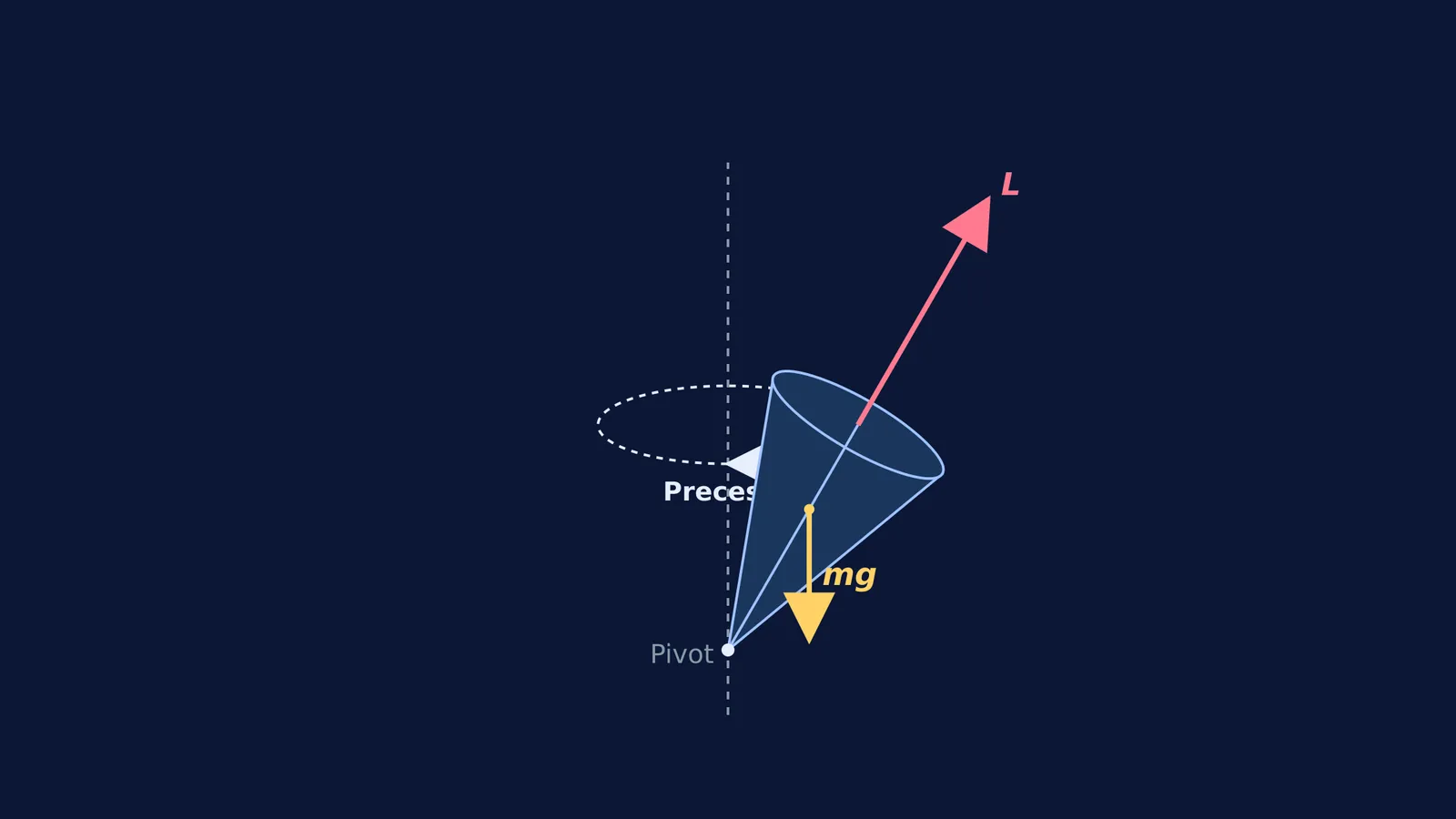
However, when the top is spinning rapidly, it possesses a large amount of angular momentum. Angular momentum is a vector quantity that points along the axis of rotation. According to the conservation of angular momentum, a spinning object resists any change to the direction of its spin axis.
When gravity applies a torque to the spinning top, this torque is perpendicular to the angular momentum vector. Instead of changing the speed of the spin, a perpendicular torque changes its direction. This causes the top's axis to move sideways, tracing out a cone in the air. This continuous circular motion of the axis is called precession, as explained by HyperPhysics at Georgia State University.
How does torque keep a spinning top upright?
The secret lies in the relationship between torque and angular momentum. In physics, torque is the rate of change of angular momentum: τ = dL/dt.
Because gravity pulls straight down and the top is tilted, the torque vector is always horizontal. This means the change in angular momentum must also be horizontal. The top is essentially "falling" constantly, but because it is spinning, it falls in a direction that is exactly 90 degrees away from the pull of gravity.
To visualize how forces create rotational motion in different systems, you can experiment in the Fermi Simulation Lab. Seeing the vectors update in real time helps clarify why the top's axis sweeps out a steady circle instead of collapsing to the ground.
For a deeper dive into calculating these forces, see our guide on Torque as r × F: finding torque about a point with vectors.
Why does a top wobble before it falls?
A unique feature of precession is that its speed depends inversely on how fast the top is spinning. The formula for the precession angular velocity (ω_P) is:
ω_P = mgr / (Iω)
Here, m is the mass, g is gravity, r is the distance from the tip to the centre of mass, I is the moment of inertia, and ω is the spin speed.
As friction at the tip and air resistance gradually slow the top down, ω decreases. To compensate, the precession speed ω_P must increase. The top's axis circles faster and faster. When the spin becomes too slow to maintain stability against the gravitational torque, the top begins a bobbing motion known as nutation. Eventually, the tilt becomes too great, the side of the top strikes the floor, and it stops.
This principle of angular momentum is not just for toys. It is the same physics that applies to gyroscopes and explains why planets sweep out equal areas in equal times, a concept we explore in Kepler's second law from angular momentum: areal velocity worked.
A Worked Example: Calculating Precession
Working through the numbers makes the abstract concepts concrete. You can apply the same logic to other rotating bodies, such as those discussed in our post on Pulleys with mass: combining torque and Newton's second law.
Let us find the precession frequency of a toy top.
Identify the variables: Suppose a wooden top has a mass of 0.05 kg. Its centre of mass is r = 0.02 m from the tip. Its moment of inertia I is roughly 1 × 10⁻⁵ kg m².
Set the spin speed: It is spinning at 100 radians per second (about 16 revolutions per second).
Calculate the torque: The gravitational torque is mgr = 0.05 × 9.8 × 0.02 = 0.0098 N m.
Find the angular momentum: L = Iω = 1 × 10⁻⁵ × 100 = 0.001 kg m²/s.
Calculate precession speed: Divide the torque by the angular momentum: ω_P = 0.0098 / 0.001 = 9.8 radians per second.
The top will complete one full circle of precession roughly every 0.64 seconds (2π / 9.8). As the spin ω drops to 50 rad/s, the precession ω_P will double to 19.6 rad/s, making the wobble visually obvious before it finally falls.


