

On this page
You have three formulas for electrical power and a question asking which of two bulbs glows brighter. Pick the wrong one and you can talk yourself into the opposite answer. The fix is not memorising more formulas. It is asking one question first: what stays the same?
Are VI, I²R and V²/R really different formulas?
No. The NCERT Class 12 Physics textbook, Chapter 3 (Current Electricity) derives the power dissipated in a conductor as P = IV in Section 3.9 (equation 3.32).
Substituting Ohm's law, V = IR, the same section gives P = I²R = V²/R (equation 3.33), which NCERT calls the "ohmic loss": the power that heats, for example, the coil of an electric bulb until it glows.
HyperPhysics at Georgia State University makes the same point: the resistor forms come from P = VI plus Ohm's law. So for a resistor, all three give one number. What changes is which quantity each formula hides, and that decides which one makes a comparison easy.
Which power formula should you use, VI or I²R?
When you compare two resistors, use the form in which the shared quantity appears and resistance is the only thing that differs.
Series: the same current flows through every part, so use P = I²R. Bigger R means more power.
Parallel: every branch has the same voltage, so use P = V²/R. Bigger R means less power.
One device, V and I both known: use P = VI directly.
A rated device ("60 W, 220 V"): find its resistance with R = V²/P, then treat it as a fixed resistor.
Why does a 100 W bulb glow dimmer than a 60 W bulb in series?
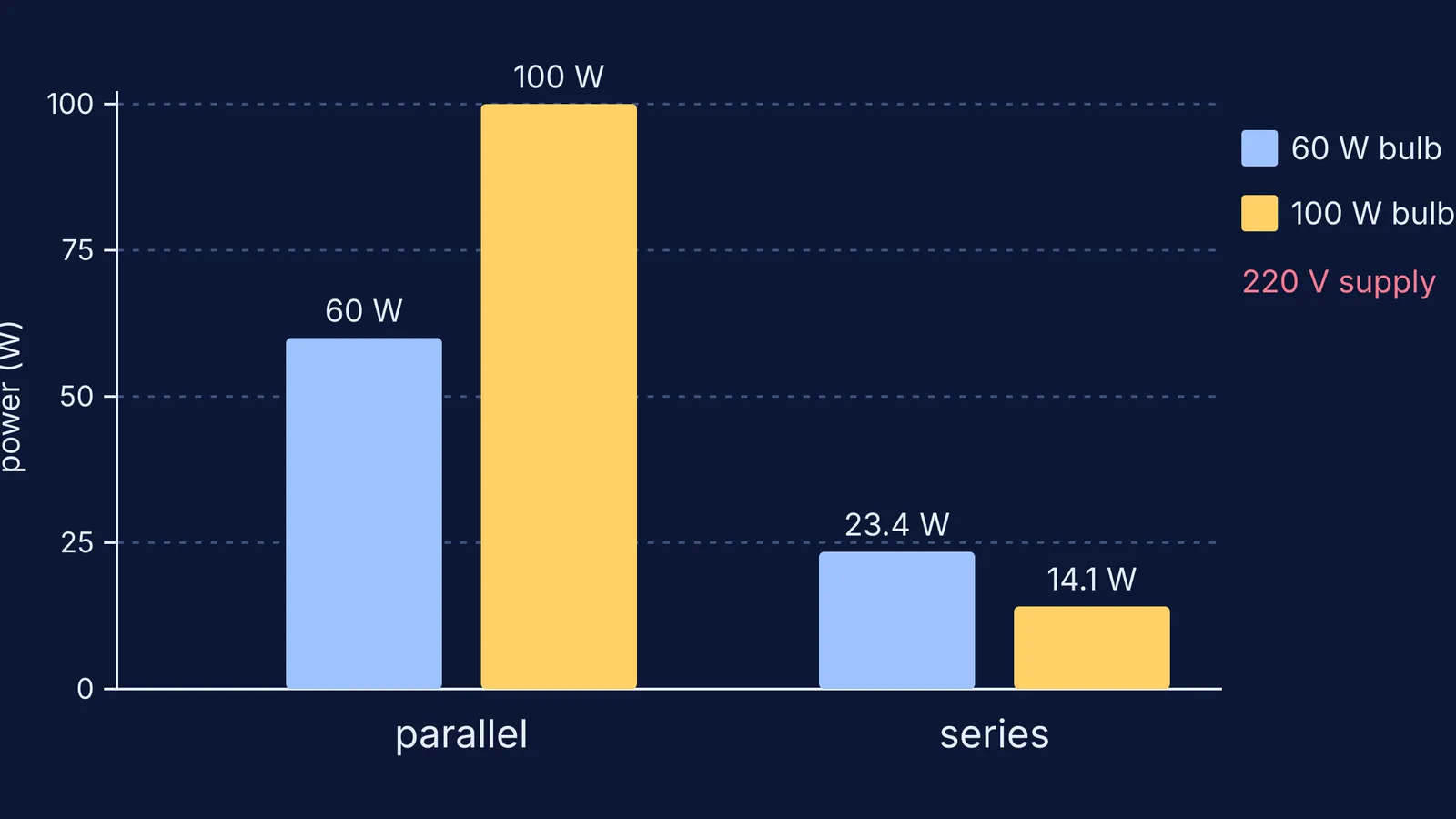
The classic case uses equation 3.33 from NCERT's Current Electricity chapter. Two bulbs are rated 60 W and 100 W at 220 V. Treat brightness as the power each filament dissipates.
Resistances: R = V²/P gives 48,400/60 ≈ 807 Ω for the 60 W bulb and 48,400/100 = 484 Ω for the 100 W bulb. The lower-wattage bulb has the higher resistance.
In parallel on 220 V: each bulb gets its full rated voltage, so each runs at its rating. The 100 W bulb is brighter. This is how home wiring works, as our post on why household appliances are connected in parallel explains.
In series on 220 V: total resistance is about 1,291 Ω, so the current is 220/1,291 ≈ 0.170 A through both bulbs.
Same current, so use I²R: the 60 W bulb dissipates about 0.0291 × 807 ≈ 23.4 W; the 100 W bulb about 0.0291 × 484 ≈ 14.1 W. The 60 W bulb is now the brighter one.
The ratio 23.4 : 14.1 is exactly the resistance ratio, 5 : 3. Together they use 37.5 W, less than either rating. The shortcut: in series, brightness follows resistance; in parallel, it runs the other way. A series string has another weakness too, covered in why all bulbs go off when one fuses in series.
When do these formulas mislead you?
First, a filament's resistance is not truly constant. NCERT's Chapter 3 explains that the resistivity of a metal rises with temperature, and its Example 3.3 shows a toaster element going from 75.3 Ω at room temperature to 85.8 Ω once it is hot. Bulbs in series run cooler than their rating, so their real resistance is lower than the V²/P estimate. Exam problems assume fixed resistance unless they say otherwise, so follow the question.
Second, I²R is only the heat produced in a resistance. For a motor or a charging battery, VI is the total electrical power going in, and I²R is just the part lost as heat. If you want the story behind that heating law, read Joule's law of heating and the history of H = I²Rt.
A 30-second check before you choose
Circle what the components share: current (series) or voltage (parallel).
Turn every rating into a resistance with R = V²/P.
Write the power using the shared quantity and R only.
Sanity check: on the rated voltage, the total power in series must be less than the smallest rating.
If the device is not a plain resistor, use VI for the power it draws.
If you pick the right formula but still land on the wrong number, the Fermi Problem Library has worked problems with a step-by-step solver that explains the reasoning rather than printing an answer, so you can spot the step where your method slipped. If the idea of series and parallel itself feels shaky, the Fermi Concept Library gives each physics concept its own lesson and its place in the map.
Next time a bulb question appears, ask what stays the same before you write a single formula.


