

On this page
Physics exercises, from NCERT Class 11 to JEE practice sets, often give a list of expressions and ask which can be a travelling wave. You do not need to memorise forms, just one short test that works on any function.
What makes a function a travelling wave?
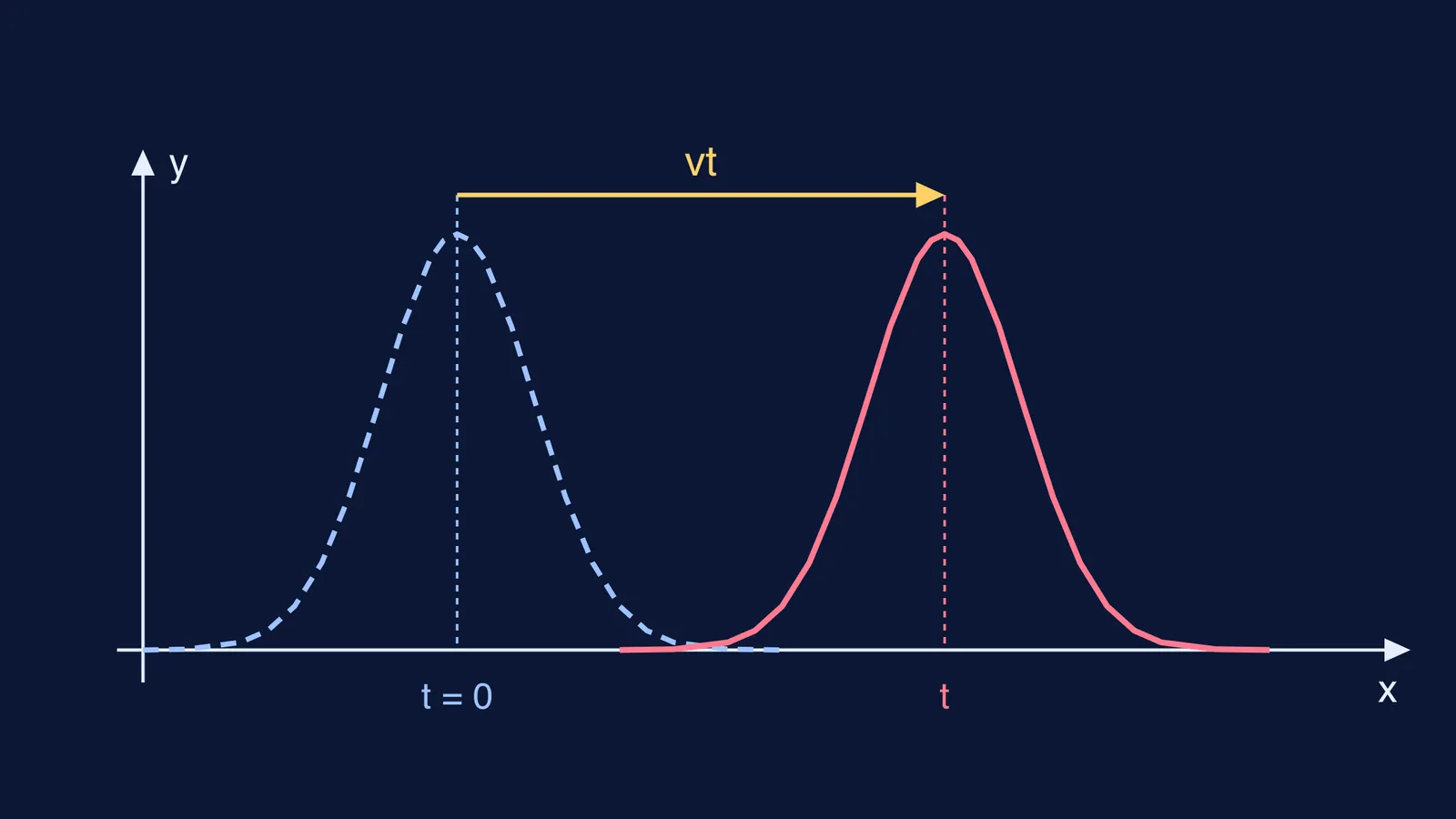
OpenStax University Physics defines a wave function as any function for which f(x, t) = f(x − vt) (OpenStax, Mathematics of Waves). The same chapter uses the minus sign for a wave moving in the positive x-direction and the plus sign for a wave moving in the negative x-direction.
Why does the shape keep moving? The value at x = 0 when t = 0 turns up at x = vt at time t. Every point shifts by the same distance vt, so the shape slides along without stretching, as the diagram above shows.
OpenStax also gives the linear wave equation, ∂²y/∂x² = (1/v²) ∂²y/∂t², and says it describes any wave or pulse of the form y(x, t) = f(x ∓ vt) (OpenStax).
The catch is the converse. An NCERT Class 11 Physics exercise asks whether every function of x ± vt can be a travelling wave, and the worked answer is no: (x − vt)² cannot represent a wave, because it grows without limit as x or t grows (NCERT exercise solution on Careers360). The same exercise rejects 1/(x + vt), which blows up where x + vt = 0, for instance at x = 0 and t = 0 (solution). A real string or air column cannot have an infinite displacement.
How do you check if a function represents a travelling wave?
Run these four steps on any expression.
One combination. Try to write the whole expression using a single combination ax − bt or ax + bt. Then factor out the coefficient of x: ax − bt = a(x − (b/a)t).
Speed and direction. The speed is v = b/a. A minus sign between the terms means motion towards +x; a plus sign means motion towards −x.
Finite everywhere. Check that y stays bounded for every x and t. If it blows up anywhere, it is not a physical wave.
Backup check. If step 1 is unclear, put y into the wave equation and see whether both sides match.
Which example functions pass the travelling wave test?
Take x in metres and t in seconds throughout.
Exponential pulse, y = e^(−(x − 3t)²). Step 1: one combination, x − 3t. Step 2: v = 3 m/s towards +x. Step 3: the largest value is 1, at x = 3t, and y falls towards 0 on both sides. It passes: a single bump moving right.
Growing exponential, y = e^(x − 3t). Step 1 passes, with the same speed and direction. Step 3 fails: at any fixed time, y grows without limit as x increases. Having the right combination is not enough.
Sine wave, y = 0.05 sin(4x − 2t). Step 1: 4x − 2t = 4(x − 0.5t). Step 2: v = 2/4 = 0.5 m/s towards +x. This matches v = ω/k with ω = 2 rad/s and k = 4 rad/m. Step 3: y stays between −0.05 m and +0.05 m. It passes. For more on reading amplitude, k and ω from this form, see our guide to reading y = A sin(kx − ωt) step by step.
Quadratics, y = (x − vt)² and y = x² − v²t². The first passes step 1 but fails step 3, which is the NCERT answer above. The second fails earlier. Since x² − v²t² = (x − vt)(x + vt), it mixes both combinations, so no single shape is sliding one way. The wave equation confirms it: ∂²y/∂x² = 2, but (1/v²) ∂²y/∂t² = −2.
A trap, y = 2 cos(3x) sin(10t). Here x and t sit in separate factors and never combine as 3x ± 10t. The points where cos(3x) = 0 never move, so this is a standing wave, not a travelling one. You can see how a standing wave is built from two travelling waves in how two travelling waves form a standing wave equation.
What mistakes cost marks on these questions?
Seeing both x and t in an expression and assuming it must be a wave.
Reading the speed from 2x − 6t as 6 m/s instead of factoring: 2(x − 3t) gives 3 m/s.
Flipping the direction: x − vt moves towards +x, not −x.
Accepting (x − vt)² or e^(x − vt) because they have the right combination, and skipping the finiteness check.
To practise the same idea from graphs instead of equations, try finding wave speed and direction from two snapshots.
If you keep getting the speed or direction wrong, the Fermi Problem Library has worked problems with a step-by-step solver that explains the reasoning rather than printing an answer. If the idea of a wave function itself feels shaky, the Fermi Concept Library gives each physics concept its own lesson.
Next time you see a list of functions, run the four steps on each one before you look at the options.


