

On this page
A blue moon looks like any other full moon: silvery white, not blue. The name is about the calendar, not the colour, and it happens because of a small mismatch between the Moon's rhythm and ours.
What is a blue moon?
NASA's definition is short: a blue moon is the second full moon in a calendar month. The same NASA page says that, on average, there is one every 2.5 years.
There is also a seasonal meaning. NASA describes a seasonal blue moon as the third full moon of an astronomical season that has four full moons, and says blue moons come along every 2 to 3 years.
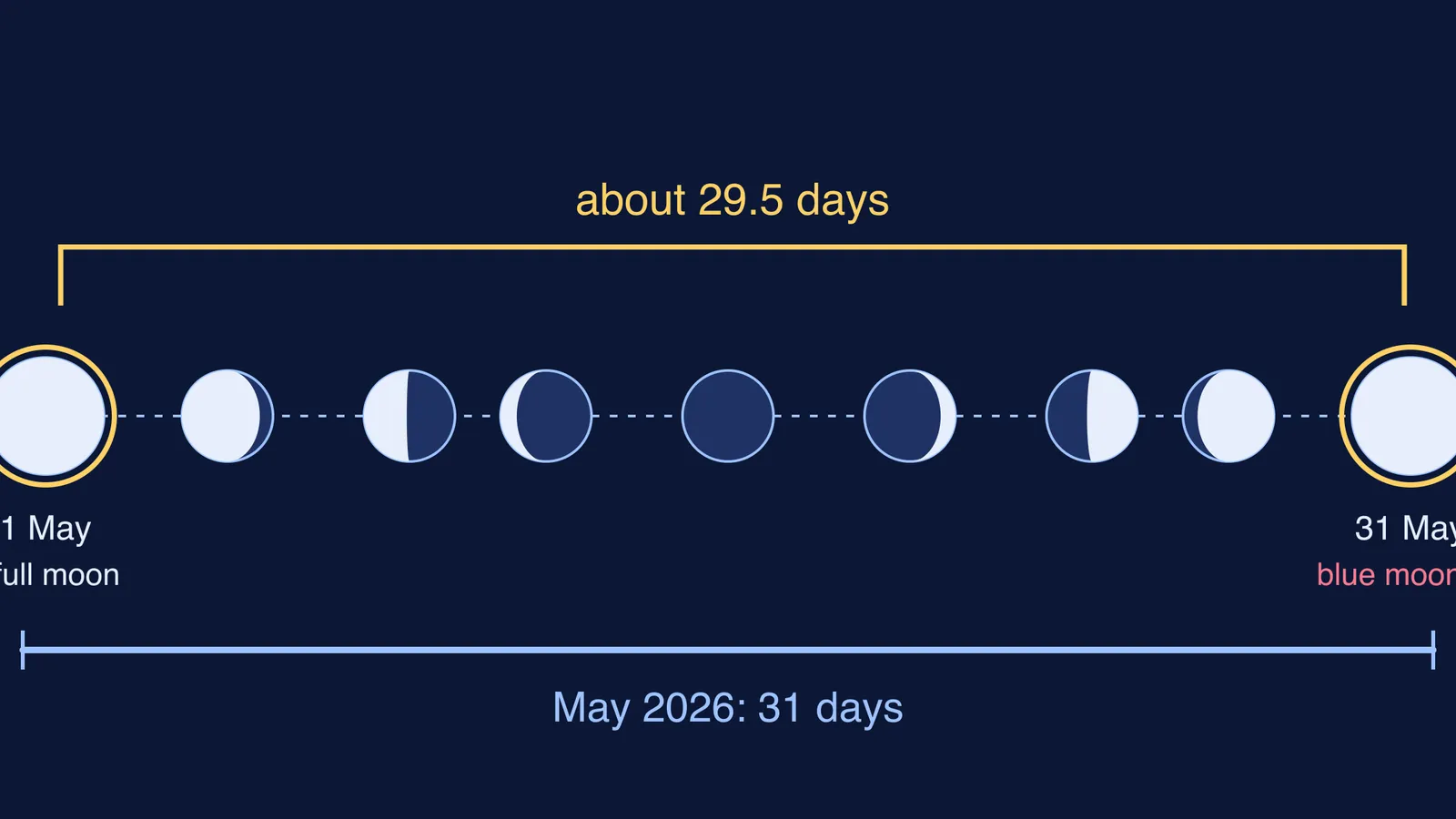
The most recent monthly blue moon was on 31 May 2026. NASA's May 2026 skywatching guide listed a full moon on 1 May and a second on 31 May, and added that "it actually won't look blue."
Why does a month sometimes get two full moons?
The Moon takes about 29.5 days to go from one new moon to the next, according to NASA's guide to Moon phases. That is longer than the roughly 27.3 days it takes to complete one orbit. The difference comes from Earth moving around the Sun at the same time, so the Moon has to travel a little further to line up with the Sun again.
Most calendar months have 30 or 31 days, slightly more than 29.5. That leftover day or day and a half is the only room a second full moon has. February, with 28 or 29 days, can never have a blue moon.
A worked example: May 2026
A 31-day month minus a 29.5-day cycle leaves 1.5 days of spare room.
So the first full moon must arrive within about the first 36 hours of the month for a second one to fit before the month ends.
In May 2026, the first full moon peaked at 17:23 GMT on 1 May and the second at 08:45 GMT on 31 May, according to Star Walk's blue moon guide. The first arrived well inside the window, so the second still fitted, about 29.6 days later.
A 30-day month leaves only half a day of spare room, so its first full moon has to fall within the first 12 hours of the 1st.
Where you are matters too: the full moon happens at one instant, and each time zone gives it its own date. Star Walk notes that some places far west of GMT saw the May 2026 blue moon rise on 30 May. Lunar calendars meet the same problem, as our explainer on why Eid depends on moon sighting shows.
Is a blue moon really blue?
Almost never. But the Moon can look genuinely blue when unusual particles fill the air.
After the Indonesian volcano Krakatoa erupted in 1883, people saw blue moons almost every night, according to NASA. Some of its ash particles were about 1 micron wide, close to the wavelength of red light, so they scattered red light and let blue pass through. NASA gives a second case: smoke from a giant muskeg fire in Alberta, Canada, in September 1953 produced blue moons from North America to the United Kingdom.
To make the Moon look bluish, dust or ash particles must be larger than about 0.6 micron, NASA says. That condition is rare, and the same NASA feature on Krakatoa notes that red blue moons are far more common than blue ones.
Where did the 'second full moon' meaning come from?
It began as a misreading. NASA explains that "blue moon" once simply meant rare or absurd, and that in the 1940s the Maine Farmer's Almanac used a complicated rule involving Easter, Lent and the seasons. In 1946, James Hugh Pruett wrote in Sky & Telescope that the "second [full moon] in a month, so I interpret it, is called Blue Moon." NASA's verdict: "This was not correct, but at least it could be understood." The easy version stuck. (Blue moons are also unrelated to supermoons, which are about distance.)
How can you spot the next blue moon?
Try this with a calendar and NASA's 29.5-day phase cycle:
Note the date and time of the first full moon in each 30- or 31-day month, in your own time zone.
Apply the rule of thumb: within 1.5 days of the start for a 31-day month, half a day for a 30-day month.
Skip February.
Check against a published list. Star Walk gives a seasonal blue moon on 20 May 2027 and the next monthly one on 31 December 2028.
If the gap between the 27.3-day orbit and the 29.5-day phase cycle is hard to picture, watch it move. The Fermi Simulation Lab has interactive simulations for ideas that are easier to see than to read, and our guide to predicting Moon phases with a simulation gives you predictions to test.
Next time someone says "once in a blue moon", you will know it names a calendar quirk, not a colour.


