

On this page
If you are learning VSEPR for boards or JEE Main, double bonds raise an awkward question early. A C=O bond holds four electrons; a C–H bond holds two. Does the double bond count twice? It does not. Once you see why, a whole family of "why is this angle 116° and not 120°?" questions becomes easy.
How do double bonds count in VSEPR theory?
In VSEPR theory, a multiple bond counts as a single electron group, just like a single bond or a lone pair (LibreTexts, The VSEPR Model/09%3A_Molecular_Geometry_and_Bonding_Theories/9.02%3A_The_VSEPR_Model)). The reason is simple: the two or three electron pairs of a multiple bond all sit between the same two nuclei, so they point in one direction and act as one cloud.
So you count neighbouring atoms plus lone pairs, never bond pairs. Formaldehyde, H₂CO, has three atoms around carbon and no lone pairs: three domains, trigonal planar. CO₂ has two domains and is linear, even though carbon carries eight bonding electrons.
Ronald Gillespie and Ronald Nyholm set out the model in their 1957 review "Inorganic stereochemistry" in Quarterly Reviews of the Chemical Society (DOI record). If you need the basic counting method first, start with our four-step guide to VSEPR and molecular shapes.
Why does a double bond repel more than a single bond?
One domain does not mean one size. A double bond packs four electrons where a single bond has two, so its cloud is fatter and pushes harder on its neighbours. Like lone pairs, multiple bonds occupy more space around the central atom than a single bond, which can make other bond angles somewhat smaller than expected (LibreTexts, The VSEPR Model/09%3A_Molecular_Geometry_and_Bonding_Theories/9.02%3A_The_VSEPR_Model)).
So a multiple bond does two separate jobs:
It counts as one domain, so it decides the basic arrangement: linear, trigonal planar, tetrahedral and so on.
It repels more, so it adjusts the angles inside that arrangement. Angles that include the multiple bond open up; angles between the other bonds close.
It is the same logic that makes lone pairs squeeze angles, which we cover in why the CH4, NH3 and H2O bond angles shrink.
What are the bond angles in formaldehyde and SO2?
Experimental geometries from the NIST Computational Chemistry Comparison and Benchmark Database (CCCBDB) show the effect clearly. Here are three worked examples you can redo on paper.
Worked example 1 is formaldehyde (H₂CO):
Count domains on carbon: O, H, H and no lone pairs. Three domains, trigonal planar, ideal angle 120°.
Spot the fat domain: the C=O double bond.
Predict: the two H–C–O angles open beyond 120°, so the H–C–H angle must close below it.
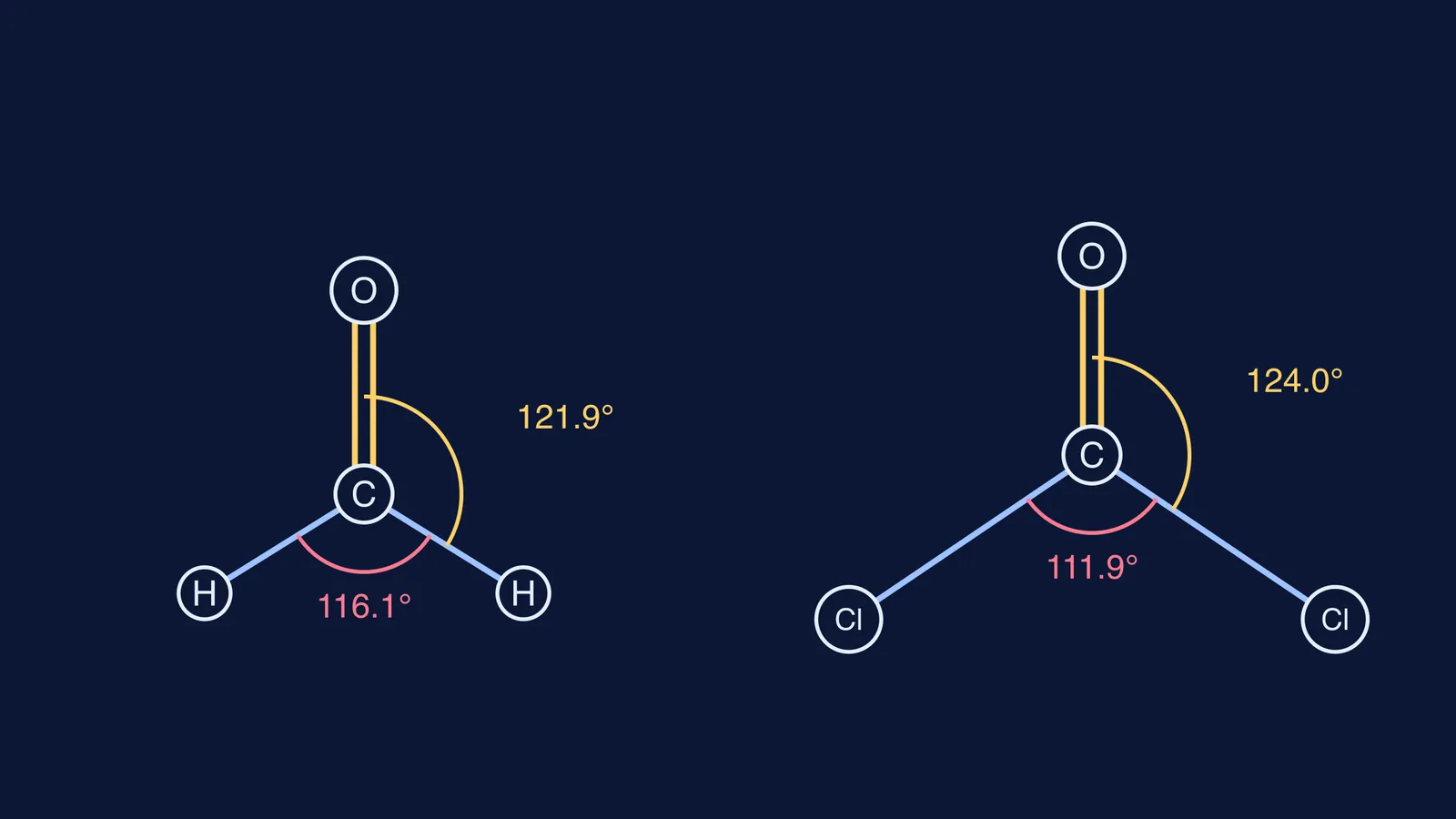
Check: in formaldehyde the measured H–C–H angle is 116.1° and each H–C–O angle is 121.9° (NIST CCCBDB, H2CO). The three angles add up to 360° (within rounding), as they must in a flat molecule.
Worked example 2 is phosgene (COCl₂), the same skeleton with chlorines in place of the hydrogens. In phosgene the Cl–C–Cl angle is 111.9° and each O–C–Cl angle is 124.0° (NIST CCCBDB, COCl2). Again the double bond sits inside the two widest angles.
Worked example 3 is sulfur dioxide (SO₂). Sulfur has two oxygen neighbours and one lone pair: three domains, a trigonal planar arrangement and a bent shape. However you draw the Lewis structure, each sulfur–oxygen link counts once. The measured O–S–O angle in SO₂ is 119.5° (NIST CCCBDB, SO2). In VSEPR terms, the lone pair squeezes that angle while the two bulky sulfur–oxygen bonds push back against each other, which is one way to see why it ends up only just under 120°. For why SO₂ bends while CO₂ stays straight, see CO2 linear vs SO2 bent: lone pairs and dipoles.
How do you use this in an exam question?
Run this five-step check on any molecule with a double or triple bond:
Draw the Lewis structure and mark the central atom.
Count domains: each neighbouring atom is one, each lone pair is one. Ignore whether the bonds are single, double or triple.
Name the arrangement from the count: 2 linear, 3 trigonal planar, 4 tetrahedral, 5 trigonal bipyramidal, 6 octahedral.
Mark the big domains: lone pairs and multiple bonds are bigger than single bonds.
Adjust the angles: angles that include a big domain open; angles between small single bonds close.
Two common traps to watch for:
Counting C=O as two domains. That gives formaldehyde four domains and a tetrahedral shape, which is wrong.
Writing exactly 120° for formaldehyde because it is trigonal planar. The ideal angle only holds when all three domains are the same size.
If a question still trips you up, the Fermi Problem Library has worked problems with a step-by-step solver that explains the reasoning rather than printing an answer, so you can see where your domain count went wrong. To go back over electron domains themselves, each idea in the Fermi Concept Library has its own lesson and its place in the map.
Next time you see a double bond in a shape question, count it once, then let it push.


