

On this page
A question gives you a gas mixture "by volume" and asks for the composition "by mass". Many students try to use densities, or just copy the percentages across. Both go wrong. The fix takes one idea and three short steps, and it works for any mixture of gases that behave close to ideal.
Why does volume percent equal mole percent for gases?
Avogadro's law states that equal volumes of all gases, at the same temperature and pressure, contain the same number of molecules (Avogadro's law). So at fixed temperature and pressure, the volume a gas takes up is proportional to its number of moles. If nitrogen makes up 78 parts in 100 of the volume, it also makes up 78 moles in every 100 moles of the mixture.
That is why reference tables list air's volume percentages as molar ratios (Engineering ToolBox, composition of air). If the idea still feels shaky, our post on deriving Avogadro's law from kinetic theory shows where it comes from.
Mass is a different story. A mole of CO2 weighs more than a mole of CO, so the heavier gas takes a bigger share of the mass than of the volume.
How do you convert volume percent to mass percent?
The mass fraction of a component equals its mole fraction times its molar mass, divided by the average molar mass of the mixture (mole fraction to mass fraction formula). In practice:
Read each volume percent as moles in a 100 mol sample.
Multiply each by its molar mass to get grams.
Add the grams, then divide each gas's grams by the total and multiply by 100.
The total in step 3, divided by 100, is the average molar mass of the mixture. You get it for free, and many questions ask for it next.
Worked example 1: what is the mass percent of dry air?
NASA gives dry air as about 78.08% nitrogen, 20.95% oxygen and 0.93% argon by volume (NASA Science). We ignore the small CO2 share here. Using the abridged standard atomic weights N = 14.007, O = 15.999 and Ar = 39.95 (CIAAW abridged atomic weights), N2 = 28.014 g/mol and O2 = 31.998 g/mol.
Take 100 mol of air:
N2: 78.08 mol x 28.014 g/mol = 2187.33 g
O2: 20.95 mol x 31.998 g/mol = 670.36 g
Ar: 0.93 mol x 39.95 g/mol = 37.15 g
Total: 2894.85 g in 99.96 mol, so the average molar mass is about 28.96 g/mol
Now renormalise: nitrogen is 2187.33 / 2894.85 = 75.56% by mass, oxygen is 23.16%, and argon is 1.28%. Nitrogen loses share because it is the lightest gas in the mix; oxygen and argon gain.
Check against a reference: Engineering ToolBox lists 75.51% nitrogen, 23.14% oxygen and 1.29% argon by mass (Engineering ToolBox). The small gaps come mostly from the trace gases we left out and from slightly different input figures. For more on the average molar mass itself, see average molar mass of a gas mixture.
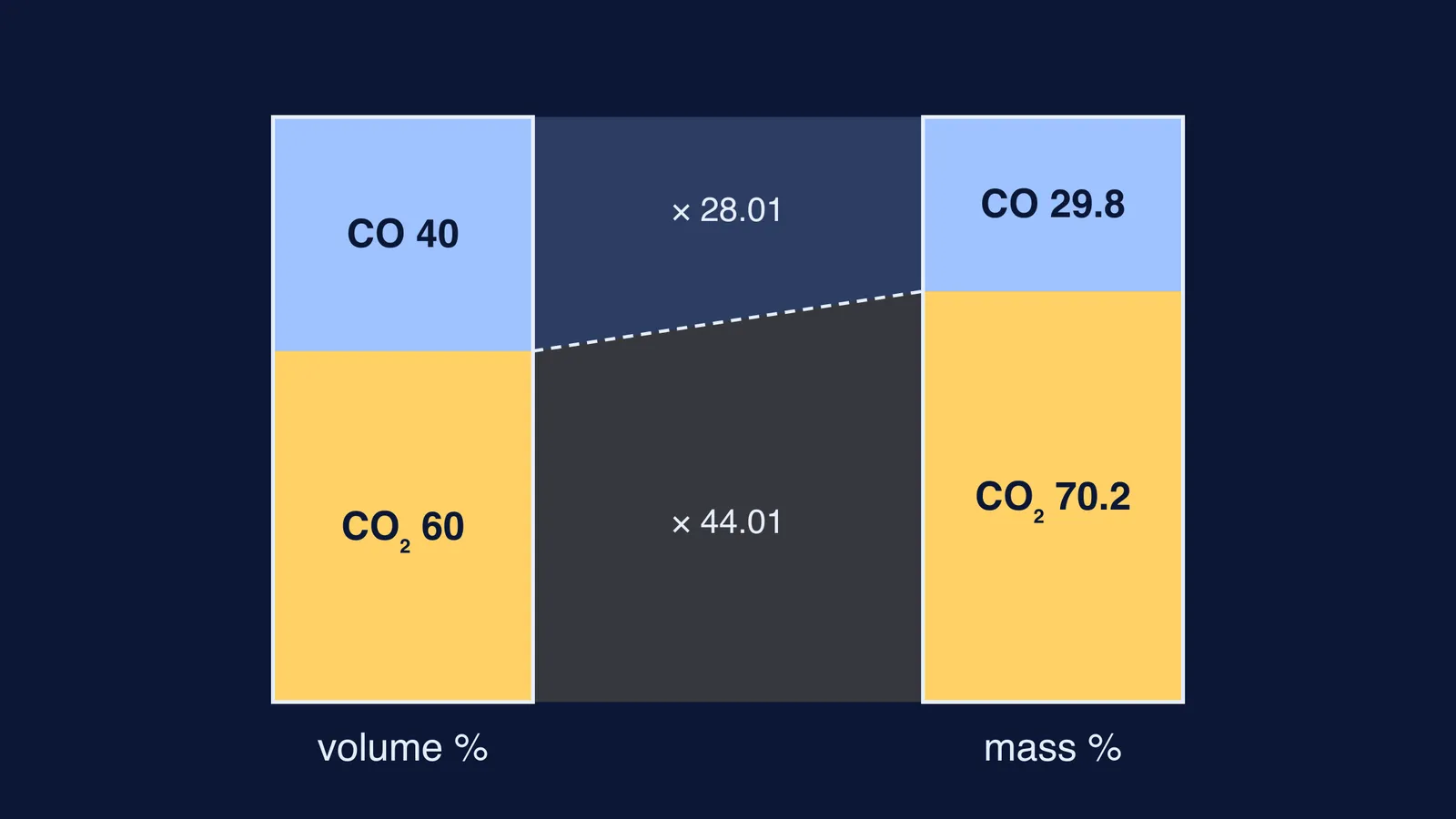
Worked example 2: what is the mass percent of a CO and CO2 mixture?
Suppose a gas from incomplete combustion is 40% CO and 60% CO2 by volume. With C = 12.011 and O = 15.999 (CIAAW), CO = 28.010 g/mol and CO2 = 44.009 g/mol.
In 100 mol:
CO: 40 x 28.010 = 1120.40 g
CO2: 60 x 44.009 = 2640.54 g
Total: 3760.94 g, so the average molar mass is 37.61 g/mol
CO is 1120.40 / 3760.94 = 29.79% by mass, and CO2 is 70.21%. A 60:40 split by volume becomes roughly 70:30 by mass, because each CO2 molecule is about 1.57 times as heavy as a CO molecule.
What mistakes cost marks here?
Copying volume percent straight across as mass percent. That only works when all the gases have the same molar mass.
Using atomic mass for a diatomic gas: O2 is about 32 g/mol (2 x 15.999 from the CIAAW table), not 16.
Forgetting to divide by the total, so the answer does not add to 100.
Rounding molar masses too early. Keep two decimals until the last step.
The same multiply-then-renormalise move appears when you find the percentage of an element in a compound, so practising it once pays off twice. If you set up the steps but get a different number, the Fermi Problem Library has worked problems with a step-by-step solver that explains the reasoning rather than printing an answer. If the gap is in the idea of a mole itself, start with the Fermi Concept Library.
Try it now on a mixture of 50% H2 and 50% N2 by volume, and see how lopsided the mass split becomes.


